
 jer zastita zena? A muskaraca? Djece? Starijih? Crnci, bijelici, azijati, ovi i oni, umjesto zdravstvene zastite za sve, hajmo prebirati po spolu i boji a onda kukati o podjelama.
Danasnji "feminizam"
-
Niemand
- Posts: 7944
- Joined: 31/03/2014 01:55
#10601 Re: Danasnji "feminizam"
Sistemu zdravstvene zastite u usa treba feminizam? jer zastita zena? A muskaraca? Djece? Starijih? Crnci, bijelici, azijati, ovi i oni, umjesto zdravstvene zastite za sve, hajmo prebirati po spolu i boji a onda kukati o podjelama.
jer zastita zena? A muskaraca? Djece? Starijih? Crnci, bijelici, azijati, ovi i oni, umjesto zdravstvene zastite za sve, hajmo prebirati po spolu i boji a onda kukati o podjelama.-
piupiu

- Posts: 16761
- Joined: 05/01/2008 05:08
#10602 Re: Danasnji "feminizam"
Koristan ogled o potrebi za feminističkim pokretom je i ova teme na kojoj se ljudi (a posebno muški ljudovi) ubiše od posla da objasne kako je feminizam prevazidjen.S4mpion wrote: ↑10/06/2020 13:11 Začetnice feminizma se u grobu okreću zbog današnjeg feminizma.
Feminizam je danas toliko potreban da jedna Amerikanka, za svoju feminističku borbu, ne može smislit' bolji razlog od potlačenih žena u Indiji, za koje je, onako realno gledajući, zaboli neka stvar.
Davno je bilo vrijeme za motanje kablova.

-
hadzinicasa

- Posts: 13620
- Joined: 08/11/2005 16:08
- Location: u tranziciji
#10603 Re: Danasnji "feminizam"
jedno ne iskljucuje drugo. nije takmicenje.
-
wewa

- Posts: 14767
- Joined: 27/05/2010 15:20
- Location: djah na brdu, djah u ravnici
#10604 Re: Danasnji "feminizam"
malo citanja, pa mozemo diskutovati:
https://www.mhtf.org/topics/maternal-he ... ed-states/The United States (U.S.) fares worse in preventing pregnancy-related deaths than most other developed nations. Despite participation in the Millennium Development Goals (MDGs) and spending more than any other country on hospital-based maternity care, the MMR in the U.S. remains at about 17 deaths per 100,000 live births. During the same time period, the global MMR decreased by 44%. The U.S. has also failed to meet prior national goals for maternal mortality reduction and is not on track to meet the modest Healthy People 2020 goal of reducing maternal mortality by 10% between 2007 and 2020. Although differences in reporting related to a new classification of maternal deaths in the updated International Classification of Disease (ICD-10) can partly explain the growing number of recorded maternal deaths, improvements in data accuracy are not enough to account for the alarming rise in MMR.
The most notable disparity in mortality rates in the U.S. is defined by race: Black women die at a rate that ranges from three to four times the rate of their white counterparts—42 deaths per 100,000 live births among black women versus 12 deaths per 100,000 live births among white women as of 2010; this difference in risk has remained unchanged for the past six decades. American Indian and Alaskan Native women also fare worse than white women with approximately twice as many pregnancy-related deaths per 100,000 live births. Women of color tend to have poorer access to high quality reproductive health information and services than white women, are discriminated against in the healthcare system and experience higher rates of disrespect and abuse. Furthermore, there is evidence suggesting that the stress associated with daily experiences of racial discrimination can increase the risk of negative perinatal outcomes including preterm birth and delivery of a low birth weight infant for women of color. Maternal mortality ratios also vary significantly by socioeconomic status and geography. Women living in poverty and women in certain states experience significantly higher maternal mortality ratios than the national average.
A major driver of maternal health disparities in the U.S. is the growing contribution of non-communicable diseases to maternal mortality. Access to prenatal care also appears to play a role: Women receiving no prenatal care are three to four times more likely to have a pregnancy-related death than women who receive prenatal care. Approximately 25% of all U.S. women do not receive the recommended number of prenatal visits; this number rises to 32% among African Americans and to 41% among American Indian or Alaska Native women.
Not all states gather information on race, ethnicity, income and health insurance status because there are no national standards for data collection and reporting of maternal mortality statistics. Such data are critical for recognizing and understanding disparities, and without them there has been insufficient accountability for maternal mortality. Maternal mortality review boards have the potential to better inform state health departments and clinicians on context-specific interventions that can reduce preventable maternal mortality. As of 2010, only 23 states have a full or partial policy establishing maternal mortality review boards.
Efforts at the local, state, and national levels to address maternal mortality are ongoing and civil society advocates such as Black Mamas Matter are calling for attention and action to address the unjust differences in preventable maternal mortality in the United States.
Resources
Key Papers
Health care disparity and state-specific pregnancy-related mortality in the United States, 2005-2014
Obstetrics & Gynecology | October 2016
Deadly delivery: The maternal health care crisis in the USA & 2011 update
Amnesty International | 2010 & 2011
Pregnancy-related mortality in the United States, 2006-2010
Obstetrics & Gynecology | January 2015
Reproductive injustice: Racial and gender discrimination in U.S. health care
Center for Reproductive Rights, Sister Song, National Latina Institute for Reproductive Health | 2014
Racial/ethnic disparities in obstetric outcomes and care: Prevalence and determinants
American Journal of Obstetrics & Gynecology | April 2010
Black-white differences in severe maternal morbidity and site of care
American Journal of Obstetrics & Gynecology | January 2016
Shifting the frame: A report on diversity and inclusion in the American College of Nurse-Midwives
ACNM | June 2015
Racial disparities in comorbidity and severe maternal morbidity/mortality in the United States: an analysis of temporal trends
Acta Obstetrica et Gynecologica Scandinavica | October 2017
-
wewa
- Posts: 14767
- Joined: 27/05/2010 15:20
- Location: djah na brdu, djah u ravnici
#10605 Re: Danasnji "feminizam"
ti izaberi cause koji je tebi blizak srcu, umjesto sto drugima spocitavas bavljenje temama po izboru.
-
S4mpion

- Posts: 19317
- Joined: 24/11/2011 21:16
#10606 Re: Danasnji "feminizam"
Ideje prvobitnog feminizma su nastajale iz potrebe da žene ostvare jednakopravnost s muškarcima, dok ideje modernog feminizma nastaju iz potrebe da se nekako potroši slobodno vrijeme, kojeg, zahvaljujući modernom dobu, ima napretek.
-
Niemand
- Posts: 7944
- Joined: 31/03/2014 01:55
#10607 Re: Danasnji "feminizam"
Pokret za zene na prvo mjesto stavlja zene, pa umjesto kritike sistemu zdravstvene zastite u usa uopste, ide kritika zdravstvene zastite zena. Al eto, ja bas kad procita "zdravstvena zastita zena" odma mi pred ocima i neki djecak crnac, jer sto bi jedno iskljucivalo drugo. Logicno da se feminizam bori i za njega. Mozda to zaboravi pomenuti i mozda se zove uopste pokret za zene, al logicno.
-
Hakiz
- Posts: 48440
- Joined: 30/07/2015 20:01
#10608 Re: Danasnji "feminizam"
Ko je rekao da je prevaziđen?piupiu wrote: ↑10/06/2020 13:42Koristan ogled o potrebi za feminističkim pokretom je i ova teme na kojoj se ljudi (a posebno muški ljudovi) ubiše od posla da objasne kako je feminizam prevazidjen.S4mpion wrote: ↑10/06/2020 13:11 Začetnice feminizma se u grobu okreću zbog današnjeg feminizma.
Feminizam je danas toliko potreban da jedna Amerikanka, za svoju feminističku borbu, ne može smislit' bolji razlog od potlačenih žena u Indiji, za koje je, onako realno gledajući, zaboli neka stvar.
Davno je bilo vrijeme za motanje kablova.
Naravno da nije.
Samo nije ono šta se hvali da jeste.
-
Niemand
- Posts: 7944
- Joined: 31/03/2014 01:55
#10609 Re: Danasnji "feminizam"

-
Škobo Habu
- Posts: 9860
- Joined: 19/06/2013 17:54
- Location: Kod Sirogojna na sijelu.
#10610 Re: Danasnji "feminizam"
A, gdje da ga stavimo? U Veneciju 17. stoljeća kao centar svijetske dekadencije?Connaisseur Karlin wrote: ↑10/06/2020 13:33
ali njeni poceci nisu u Americijednsotavno je nepravilno postavljati zacetak i pocetak seksualne revolucije natakav naccin

Moderna seksualna revolucija započinje u Americi. Ako ti znaš značajniju od te - prosvjetli me.
-
S4mpion
- Posts: 19317
- Joined: 24/11/2011 21:16
#10611 Re: Danasnji "feminizam"
I kakve ovo veze ima s feminizmom?wewa wrote: ↑10/06/2020 13:43malo citanja, pa mozemo diskutovati:
https://www.mhtf.org/topics/maternal-he ... ed-states/The United States (U.S.) fares worse in preventing pregnancy-related deaths than most other developed nations. Despite participation in the Millennium Development Goals (MDGs) and spending more than any other country on hospital-based maternity care, the MMR in the U.S. remains at about 17 deaths per 100,000 live births. During the same time period, the global MMR decreased by 44%. The U.S. has also failed to meet prior national goals for maternal mortality reduction and is not on track to meet the modest Healthy People 2020 goal of reducing maternal mortality by 10% between 2007 and 2020. Although differences in reporting related to a new classification of maternal deaths in the updated International Classification of Disease (ICD-10) can partly explain the growing number of recorded maternal deaths, improvements in data accuracy are not enough to account for the alarming rise in MMR.
The most notable disparity in mortality rates in the U.S. is defined by race: Black women die at a rate that ranges from three to four times the rate of their white counterparts—42 deaths per 100,000 live births among black women versus 12 deaths per 100,000 live births among white women as of 2010; this difference in risk has remained unchanged for the past six decades. American Indian and Alaskan Native women also fare worse than white women with approximately twice as many pregnancy-related deaths per 100,000 live births. Women of color tend to have poorer access to high quality reproductive health information and services than white women, are discriminated against in the healthcare system and experience higher rates of disrespect and abuse. Furthermore, there is evidence suggesting that the stress associated with daily experiences of racial discrimination can increase the risk of negative perinatal outcomes including preterm birth and delivery of a low birth weight infant for women of color. Maternal mortality ratios also vary significantly by socioeconomic status and geography. Women living in poverty and women in certain states experience significantly higher maternal mortality ratios than the national average.
A major driver of maternal health disparities in the U.S. is the growing contribution of non-communicable diseases to maternal mortality. Access to prenatal care also appears to play a role: Women receiving no prenatal care are three to four times more likely to have a pregnancy-related death than women who receive prenatal care. Approximately 25% of all U.S. women do not receive the recommended number of prenatal visits; this number rises to 32% among African Americans and to 41% among American Indian or Alaska Native women.
Not all states gather information on race, ethnicity, income and health insurance status because there are no national standards for data collection and reporting of maternal mortality statistics. Such data are critical for recognizing and understanding disparities, and without them there has been insufficient accountability for maternal mortality. Maternal mortality review boards have the potential to better inform state health departments and clinicians on context-specific interventions that can reduce preventable maternal mortality. As of 2010, only 23 states have a full or partial policy establishing maternal mortality review boards.
Efforts at the local, state, and national levels to address maternal mortality are ongoing and civil society advocates such as Black Mamas Matter are calling for attention and action to address the unjust differences in preventable maternal mortality in the United States.
Resources
Key Papers
Health care disparity and state-specific pregnancy-related mortality in the United States, 2005-2014
Obstetrics & Gynecology | October 2016
Deadly delivery: The maternal health care crisis in the USA & 2011 update
Amnesty International | 2010 & 2011
Pregnancy-related mortality in the United States, 2006-2010
Obstetrics & Gynecology | January 2015
Reproductive injustice: Racial and gender discrimination in U.S. health care
Center for Reproductive Rights, Sister Song, National Latina Institute for Reproductive Health | 2014
Racial/ethnic disparities in obstetric outcomes and care: Prevalence and determinants
American Journal of Obstetrics & Gynecology | April 2010
Black-white differences in severe maternal morbidity and site of care
American Journal of Obstetrics & Gynecology | January 2016
Shifting the frame: A report on diversity and inclusion in the American College of Nurse-Midwives
ACNM | June 2015
Racial disparities in comorbidity and severe maternal morbidity/mortality in the United States: an analysis of temporal trends
Acta Obstetrica et Gynecologica Scandinavica | October 2017
Ili ćemo sad počet' nabrajat' šta sve muškarci u USA nemaju.
-
wewa
- Posts: 14767
- Joined: 27/05/2010 15:20
- Location: djah na brdu, djah u ravnici
#10612 Re: Danasnji "feminizam"
ukljucujuci specificno zenska ljudska prava. nije to tako tesko za shvatiti, zaista nije. open your mind, and the rest will follow.
-
wewa
- Posts: 14767
- Joined: 27/05/2010 15:20
- Location: djah na brdu, djah u ravnici
#10613 Re: Danasnji "feminizam"
feminizam se bori za (i) unapredjenje stanja zena. zastita materinstva, a majke su zene jelte, spada u podrucja gdje postoji veliki prostor za napredak. a mogu ja i da nacrtam.S4mpion wrote: ↑10/06/2020 13:53I kakve ovo veze ima s feminizmom?wewa wrote: ↑10/06/2020 13:43malo citanja, pa mozemo diskutovati:
https://www.mhtf.org/topics/maternal-he ... ed-states/The United States (U.S.) fares worse in preventing pregnancy-related deaths than most other developed nations. Despite participation in the Millennium Development Goals (MDGs) and spending more than any other country on hospital-based maternity care, the MMR in the U.S. remains at about 17 deaths per 100,000 live births. During the same time period, the global MMR decreased by 44%. The U.S. has also failed to meet prior national goals for maternal mortality reduction and is not on track to meet the modest Healthy People 2020 goal of reducing maternal mortality by 10% between 2007 and 2020. Although differences in reporting related to a new classification of maternal deaths in the updated International Classification of Disease (ICD-10) can partly explain the growing number of recorded maternal deaths, improvements in data accuracy are not enough to account for the alarming rise in MMR.
The most notable disparity in mortality rates in the U.S. is defined by race: Black women die at a rate that ranges from three to four times the rate of their white counterparts—42 deaths per 100,000 live births among black women versus 12 deaths per 100,000 live births among white women as of 2010; this difference in risk has remained unchanged for the past six decades. American Indian and Alaskan Native women also fare worse than white women with approximately twice as many pregnancy-related deaths per 100,000 live births. Women of color tend to have poorer access to high quality reproductive health information and services than white women, are discriminated against in the healthcare system and experience higher rates of disrespect and abuse. Furthermore, there is evidence suggesting that the stress associated with daily experiences of racial discrimination can increase the risk of negative perinatal outcomes including preterm birth and delivery of a low birth weight infant for women of color. Maternal mortality ratios also vary significantly by socioeconomic status and geography. Women living in poverty and women in certain states experience significantly higher maternal mortality ratios than the national average.
A major driver of maternal health disparities in the U.S. is the growing contribution of non-communicable diseases to maternal mortality. Access to prenatal care also appears to play a role: Women receiving no prenatal care are three to four times more likely to have a pregnancy-related death than women who receive prenatal care. Approximately 25% of all U.S. women do not receive the recommended number of prenatal visits; this number rises to 32% among African Americans and to 41% among American Indian or Alaska Native women.
Not all states gather information on race, ethnicity, income and health insurance status because there are no national standards for data collection and reporting of maternal mortality statistics. Such data are critical for recognizing and understanding disparities, and without them there has been insufficient accountability for maternal mortality. Maternal mortality review boards have the potential to better inform state health departments and clinicians on context-specific interventions that can reduce preventable maternal mortality. As of 2010, only 23 states have a full or partial policy establishing maternal mortality review boards.
Efforts at the local, state, and national levels to address maternal mortality are ongoing and civil society advocates such as Black Mamas Matter are calling for attention and action to address the unjust differences in preventable maternal mortality in the United States.
Resources
Key Papers
Health care disparity and state-specific pregnancy-related mortality in the United States, 2005-2014
Obstetrics & Gynecology | October 2016
Deadly delivery: The maternal health care crisis in the USA & 2011 update
Amnesty International | 2010 & 2011
Pregnancy-related mortality in the United States, 2006-2010
Obstetrics & Gynecology | January 2015
Reproductive injustice: Racial and gender discrimination in U.S. health care
Center for Reproductive Rights, Sister Song, National Latina Institute for Reproductive Health | 2014
Racial/ethnic disparities in obstetric outcomes and care: Prevalence and determinants
American Journal of Obstetrics & Gynecology | April 2010
Black-white differences in severe maternal morbidity and site of care
American Journal of Obstetrics & Gynecology | January 2016
Shifting the frame: A report on diversity and inclusion in the American College of Nurse-Midwives
ACNM | June 2015
Racial disparities in comorbidity and severe maternal morbidity/mortality in the United States: an analysis of temporal trends
Acta Obstetrica et Gynecologica Scandinavica | October 2017
Ili ćemo sad počet' nabrajat' šta sve muškarci u USA nemaju.
-
Niemand
- Posts: 7944
- Joined: 31/03/2014 01:55
#10614 Re: Danasnji "feminizam"
A stas, poglupa sam za to i nat openmajnded.
-
wewa
- Posts: 14767
- Joined: 27/05/2010 15:20
- Location: djah na brdu, djah u ravnici
#10615 Re: Danasnji "feminizam"
zanimljivo je, inace, kojeg su dijapazona prigovori feminizmu - od 'feminizam je prevazidjen' do 'feminizam nije dovoljno inkluzivan jer se ne bori istovremeno za sve koji su ugrozeni vec stavlja akcent na ____'.
pitam se postoji li jos neki pravac djelovanja, ideologija ili pokret na koji projiciramo tako mnogo svojih potreba ali i animoziteta?
a pazi, radi se o temama koje su, u najmanju ruku, od znacaja za nesto vise od pola, globalne populacije.
pitam se postoji li jos neki pravac djelovanja, ideologija ili pokret na koji projiciramo tako mnogo svojih potreba ali i animoziteta?
a pazi, radi se o temama koje su, u najmanju ruku, od znacaja za nesto vise od pola, globalne populacije.
-
S4mpion
- Posts: 19317
- Joined: 24/11/2011 21:16
#10616 Re: Danasnji "feminizam"
Feminizam se NE BORI za unaprijeđenje položaja žena u društvu, nekada jeste, ali danas se to svelo na skakanje po ulici, bez odjeće.
Boriti se isključivo za prava žena, u modernom društvu, gdje je položaj žene na zavidnom nivou, je nepotrebno, krajnje nepotrebno.
-
wewa
- Posts: 14767
- Joined: 27/05/2010 15:20
- Location: djah na brdu, djah u ravnici
#10617 Re: Danasnji "feminizam"
to je tvoje misljenje na koje imas pravo, ma koliko neosnovano i pristrasno bilo.S4mpion wrote: ↑10/06/2020 13:59Feminizam se NE BORI za unaprijeđenje položaja žena u društvu, nekada jeste, ali danas se to svelo na skakanje po ulici, bez odjeće.
Boriti se isključivo za prava žena, u modernom društvu, gdje je položaj žene na zavidnom nivou, je nepotrebno, krajnje nepotrebno.
-
S4mpion
- Posts: 19317
- Joined: 24/11/2011 21:16
#10618 Re: Danasnji "feminizam"
Nije neosnovano, žene, koje su urlikale i gologuze skakale po ulici, su dobile vašu podršku baš na ovoj temi, ne možemo sve relativizirat', to JESTE ono što se danas naziva feminizmom.
Pozdravljaju vas žene iz Indije i gladna djeca iz Afrike.
-
piupiu
- Posts: 16761
- Joined: 05/01/2008 05:08
#10619 Re: Danasnji "feminizam"
Pozdravljaju i tebe gladni muškarci i gladna djeca Afrike i Azije i gladni starci Bosne i Hercegovine. Šta činiš po tom pitanju? Feminizam se bori i za žene zemalja u razvoju. Problem je što žene za Zapada treba da se bore za svoja prava tamo gdje one osjećaju da su ugrožene. A žene za Istoka za svoja prava, jer su im konteksti, potreba i htijenja drugačiji. Znaš, naravno, da je to jedan od glavnih sukoba u feminizmu, da žene Afrike i Azije ne žele da im žene sa zapada nameću svoj svjetonazor i probleme, jer se to smatra modernim kolonijalizmom?
-
S4mpion
- Posts: 19317
- Joined: 24/11/2011 21:16
#10620 Re: Danasnji "feminizam"
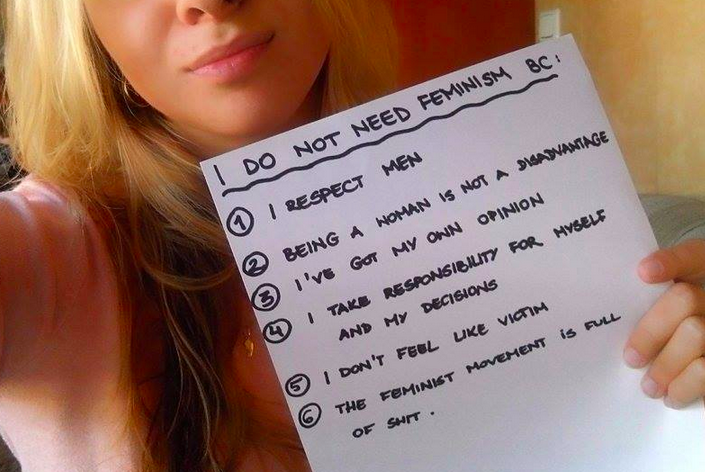
Ali, da ne bude da stvari posmatramo samo iz jednog ugla, nemoguće je ne primjetiti koliko veliki broj današnjih žena ne podržava feminizam, kao prepoznatu ublehu, #womenagainstfeminism
-
pustopoljina

- Posts: 14049
- Joined: 19/05/2008 16:33
#10621 Re: Danasnji "feminizam"
Evo sampion kaze da jeste, marlboro kaze da jeste, ti kazes da je feminizam zenska obijest.Hakiz wrote: ↑10/06/2020 13:49Ko je rekao da je prevaziđen?piupiu wrote: ↑10/06/2020 13:42Koristan ogled o potrebi za feminističkim pokretom je i ova teme na kojoj se ljudi (a posebno muški ljudovi) ubiše od posla da objasne kako je feminizam prevazidjen.S4mpion wrote: ↑10/06/2020 13:11 Začetnice feminizma se u grobu okreću zbog današnjeg feminizma.
Feminizam je danas toliko potreban da jedna Amerikanka, za svoju feminističku borbu, ne može smislit' bolji razlog od potlačenih žena u Indiji, za koje je, onako realno gledajući, zaboli neka stvar.
Davno je bilo vrijeme za motanje kablova.
Naravno da nije.
Samo nije ono šta se hvali da jeste.
-
piupiu
- Posts: 16761
- Joined: 05/01/2008 05:08
#10622 Re: Danasnji "feminizam"
Gdje ima slobodnog vremena? Na zapadu? Šališ se? Zar ne pričamo ovdje stalno kako tamo ljudi žive na potezu pidžama-posao-pidžama?
-
wewa
- Posts: 14767
- Joined: 27/05/2010 15:20
- Location: djah na brdu, djah u ravnici
-
S4mpion
- Posts: 19317
- Joined: 24/11/2011 21:16
#10624 Re: Danasnji "feminizam"
Evo osnivam muški pokret, šta ću drugo.piupiu wrote: ↑10/06/2020 14:12Pozdravljaju i tebe gladni muškarci i gladna djeca Afrike i Azije i gladni starci Bosne i Hercegovine. Šta činiš po tom pitanju? Feminizam se bori i za žene zemalja u razvoju. Problem je što žene za Zapada treba da se bore za svoja prava tamo gdje one osjećaju da su ugrožene. A žene za Istoka za svoja prava, jer su im konteksti, potreba i htijenja drugačiji. Znaš, naravno, da je to jedan od glavnih sukoba u feminizmu, da žene Afrike i Azije ne žele da im žene sa zapada nameću svoj svjetonazor i probleme, jer se to smatra modernim kolonijalizmom?

Nisam feminista, tako da mi nije bitno jesu li ti jadni gladni ljudi žene ili muškarci, tako da nema potrebe da ih dijeliš.
Eto, to je otprilike razlika između zdravog rezona, s jedne, i feminizma, s druge strane.
I ponovo ispravka, feminizam se NE BORI za prava potlačenih žena, nekada jeste, ali to je prošlo vrijeme, današnj ifeminitam je nešto drugo.
-
pustopoljina
- Posts: 14049
- Joined: 19/05/2008 16:33
#10625 Re: Danasnji "feminizam"
To dama moze napisati, jer su se one prije nje za to izborile.
A ako misli da joj je to bogom dano, neka nastavi. Ko je jaci taj kvaci, pa bi joj se moglo obiti o glavu kcerke ili unuke.
Ja mogu itekako voljeti biti zena, ali i biti feminista. Mogu i postovati muskarce vrijedne postovanja i biti feminista. Ne biti zrtva i biti feminista. Imati svoje misljenje i reci da je abortirati fetus jer je musko "shit" i biti feminista.
To sto internet/papir/taraba sve trpi i bude objavljeno ne znaci da se vodi ispravnom logikom.