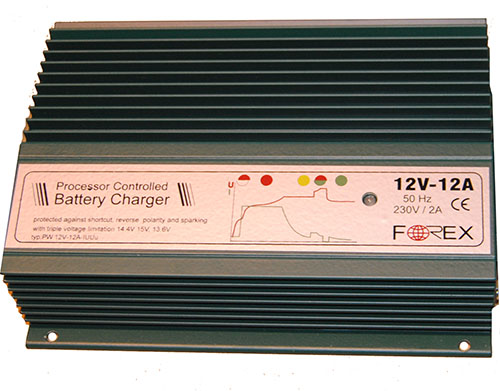

evo tabela koja ima malo detaljnije podatke o SoC i padu napona iliti "napunjenosti" pri nizim temperaturama.

A vrijeme punjenja (navodno) je ovako nekako.
(odnosi se na akumulatore cija je kapacitet izrazen u CCA)

(vrijeme punjenja preporuceno za ispraznjen akumulator)

In order to calculate the amount of amp-hours in a battery, the rule of thumb is to multiply the reserve capacity by 0.6. For example, if you have an automotive/flooded battery with 100 minutes reserve capacity, multiplied 100 by 0.6 = your battery would have approximately 60 amp-hours (at the 20-hour rate).
Primjer:
If the voltmeter shows a voltage reading of 12.2 volts then the battery is approximately 50% charged. Since the battery is 50% charged, this means that there is approximately half of the 60 amp-hours in the battery or 30 amp-hours. Therefore it is necessary to put about 30 amp hours plus 20% more to compensate for the internal resistance in the battery for a total of 30 amps x 0.2 = 36 amp-hours to fully charge your battery.
If you charge your battery at a 10-amp rate and you need to replace 36 amp-hours in the battery. To determine how long (in hours) you will need to charge your battery, divided 36 by 10 = 3.6 or 3.6 hours to recharge your battery.
Meni je interesantan ovaj drugaciji standard za oznacavanje kapaciteta akumulatora izrazen u CCA, CA i RC, ili cak HCA. Nisam ovo kod nas vidio, ali opet, nemam dodira sa tim i ne razmisljam o tome dok mi ne zatreba novi akumulator.
Hot Cranking Amps (HCA) or Cranking Amps (CA)
Products that display HCA or CA ratings are tested at higher temperatures, in the case of HCA — 80 degrees — so the resulting numbers appear higher. (CAs are tested at 30°F.)
* Amp Hour Rating (A/H) This rating is not used much any more. It measures low current draw for 20 hours while maintaining a minimum post voltage of 10.5 Volts at 70 degrees F. (Example: a drain of 3 amps for 20 hours = 60 A/H rating).
Cold Cranking Amps (CCA) This is the most common battery capacity rating. The rating is the number of amps the battery can deliver for 30 seconds at 0 degrees F. while maintaining post voltage of 7.2 Volts. For reliable cold weather starting, most vehicles require 400 to 600 cold cranking amps. Larger displacement engines require more cranking amps. Some batteries are rated up to 1000 CCA, but may sacrifice reserve capacity to achieve high short term outputs.
Cranking Amps (CA) This is a less meaningful rating. It is the same as CCA except it is measured at 32 degrees F. A battery's CA rating can be converted to CCA by dividing the number by 1.28 (Example: a CA rating of 500 amps becomes 390 CCA).
Reserve Capacity (RC) Think of this as the battery's staying power. This is the number of minutes the battery will deliver 25 amps and still maintain a post voltage of 10.5 Volts. The higher the reserve capacity rating, the longer the battery will last if the charging system fails.
Ili malo detaljnije.

Koliko sam razumio, ne postoji pouzdan nacin pretvaranja A/H u CCA zbog konstrukcijskih karakteristika akumulatora koji se koriste za racunanje ovih vrijednosti tako da veci kapacitet izrazen u A/H ne mora da znaci i veci kapacitet izrazen u CCA i obratno.