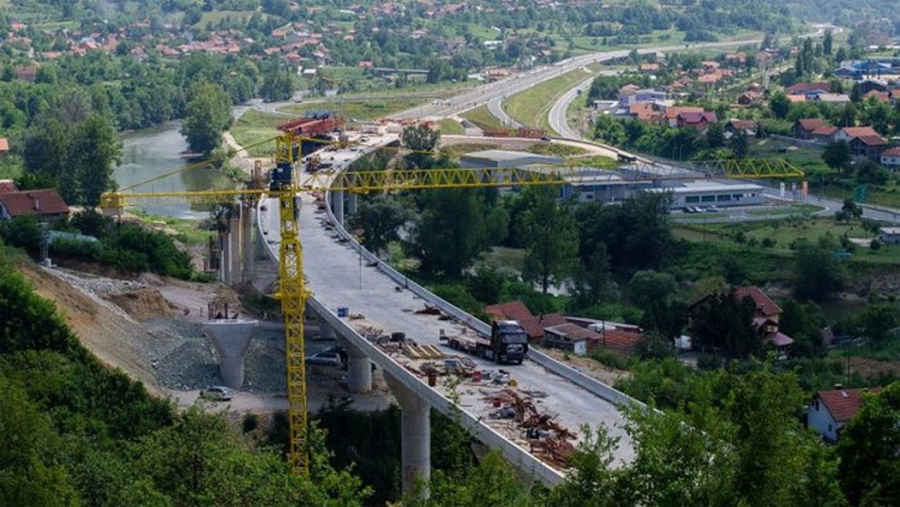
EU diplomat criticises way Christopher Dell pushed through deal for Bechtel Corporation to build controversial highway to Albania.

A US ambassador to Kosovo, who lobbied for the construction of a 820 million euros road through the war-torn country, has taken up a post with the American construction giant that secured the lucrative contract.
Christopher Dell, a career diplomat nominated by Barack Obama to represent the US in Pristina, was employed by the Bechtel Corporation, which he helped win a contract to build a highway to neighbouring Albania.
Dell took on a role as an African country manager with Bechtel late last year, months after ending a three-decade career at the State Department.
His employment at Bechtel, America’s largest engineering and construction firm, has ignited a debate over the controversial road-building project, named the “Patriotic Highway”.
Pieter Feith, the senior EU diplomat in Kosovo when the contract was secured, criticised the way the US ambassador pushed through the deal, and has called for an inquiry. Feith accused Dell of withholding information about the Bechtel contract, and lobbying Kosovo to agree to what he describes as an ill-advised deal with a US company, which placed enormous pressure on the fledgling country’s budget.
It is routine for western ambassadors to push the business interests of companies from the countries they come from. But it is unusual for a former diplomat to land a job with a major corporation after using their sway to secure lucrative government contracts.
After he was appointed ambassador in 2009, Dell had huge influence in Kosovo, where the US is widely viewed as a supervising power and is feted for its role in securing independence for the klix Balkan state. A statue of President Clinton adorns the capital, Pristina, and boulevards are named after George W Bush and other US officials.
As the International Civilian Representative in Kosovo between 2008 and 2012, Feith was the other major figure in the country, entrusted with wide-ranging powers by the US and EU, including the ability to overrule Kosovan officials. For several years, Feith and Dell served side by side, the two most senior foreign officials supervising Kosovo’s campaign for recognition as a sovereign state following the 1999 war.
At the time Dell was encouraging Kosovo’s government to sign the highway contract, Feith said he had grave concerns about awarding the enormous contract to a consortium consisting of Bechtel and its partner, Turkish firm Enka. Feith believed the deal risked undermining Pristina’s finances.
Feith said he clashed with Dell over the logic of an impoverished, nascent country undertaking such a huge infrastructure project, and instead argued that the money should be spent on tackling Kosovo’s unemployment rate, which stood at 40%.
Feith also said he asked to see details of the contract, which he believed was part of his mandate, but was denied access by the US embassy. “Information was withheld, and all of a sudden we were presented with a fait accompli of this contract being concluded and being a liability on the budget,” he told the Guardian.
The Bechtel-Enka deal was signed in April 2010, despite concerns from the IMF, the World Bank, EU diplomats, Feith, and the Kosovan government’s own legal adviser. Dell and the State Department declined requests for comment. Bechtel defended its employment of the former ambassador and said any suggestion that his appointment was improper was “unfair and offensive”.
But Andrea Capussela, who served as head of Feith’s economic department in Kosovo and was a vocal critic of the road-building scheme, said: “Ambassador Dell’s employment at Bechtel raises a rather serious question mark over the whole project.”
“This contract was irrational for Kosovo, and caused considerable damage to it,” he added. “The State Department would do well to investigate this.”
Feith declined to comment on Dell’s employment at Bechtel. However, he did say a wider inquiry into the probity of the highway deal was warranted, although he did not specify which organisation would conduct such an investigation.
“We have been involved in the fight against corruption in Kosovo, and anything that can help, ex-post, to clarify, elucidate or provide transparency about what has happened is beneficial for the future of the young state,” he said. “If there is an investigation, I would welcome it.”
The government in Pristina argues that the Patriotic Highway has connected northern Albania and Kosovo, replacing crumbling mountain roads with a four-lane highway, and will provide an economic injection into the region. However, critics point out that its costs have more than doubled from the original estimate.
The initial offer was to complete the Kosovo section of the highway for 400 million euros ($555m). The price subsequently rose to 660 million euros ($916m), to pay for 102km of road. In the end, the project cost 820 million euros ($1.13bn) for what turned out be only a 77km stretch of highway. By comparison, Kosovo’s total government budget in 2012 was 1.5 billion euros.
The highway project was completed last year, but it has been mired in allegations of corruption on both sides of the border. The Kosovo side of the highway deal is currently under investigation by the EU rule-of-law mission, Eulex, a source at the mission has confirmed.
Last week, the Albanian government announced it was launching a fresh corruption probe into the financing of its portion of the highway. The former minister of transport in Tirana, Lulzim Basha, was earlier cleared of “abuse of power” charges when the case against him was blocked by the supreme court over a legal technicality. He denied all wrongdoing.
There is no evidence to suggest Bechtel or Dell are implicated in the corruption investigations, the details of which are confidential.
The Kosovo contract was signed at a ceremony in April 2010. Among the officials present at the event was Dell, shown in a picture standing beside Kosovo’s controversial prime minister, Hashim Thaci, and behind Mike Adams, the president of Bechtel.
Sitting beside Adams is Kosovo’s transport minister, Fatmir Limaj, who is currently under investigation for corruption. Feith said he also clashed with Dell over Limaj, after he was placed under investigation for corruption by EU law enforcement officials in Kosovo.
Dell, who had little faith in the the EU investigation into Limaj, attempted to remove the minister from Kosovo with a diplomatic posting in New York or Washington.
Feith said he believed the move was effectively providing an allegedly corrupt minister with a “backdoor exit”, blocking a corruption investigation. Dell, on the other hand, is understood to have believed that there was insufficient evidence to prosecute Limaj. He believed that quietly removing Limaj from Kosovo was a more pragmatic and effective solution.
“I thought this was a bad idea, and I told him so,” Feith said of his conversation with Dell. “I thought this would strengthen the impression of impunity and not help our efforts to combat corruption.” In the end, Dell’s proposal to remove Limaj from Kosovo was never enacted. The transport minister was later arrested, and he has faced a series of war crimes and corruption charges, but has yet to be convicted of any offences.
A diplomat with a distinguished career serving across the world, including in Afghanistan, Zimbabwe and Angola, Dell left his role as chief of mission in Pristina in 2012 – two years after shepherding the Bechtel-Enka deal. He spent a brief period on secondment at the Pentagon, working for the US Africa Command, known as Africom, and stationed in Germany.
Bechtel initially made contact with Dell about possibly working for the company the previous year, in 2012. The company confirmed that at the time it made the approach he was still the US ambassador to Kosovo. According to Bechtel, Dell “immediately reported the conversation” with the State Department, in line with with US government regulations, and recused himself from matters relating to the company.
After his brief stint in Germany, Dell formally left the State Department, joining Bechtel in November 2013 as its country manager in Mozambique. There is no suggestion Dell did not comply with US “revolving door” regulations. While there is a one-year “cooling off” period before former ambassadors can lobby the US government on behalf of a private firm, they are not prevented from taking a job in the private sector with a company they helped secure a contract for.
There is no reference to Dell on Bechtel’s website, except for a picture of the former US ambassador at the contract-signing ceremony in Kosovo in 2010.
Michelle Michael, a spokeswoman for Bechtel, said of Dell: “His extensive knowledge and experience in the region [Africa] are an ideal fit with our current work and future opportunities there.”
She added: “As you likely know, one of the roles of US ambassadors is to promote American business interests. Chris spent more than 30 years as a public servant, and any suggestion that he acted inappropriately or otherwise failed to meet his responsibility as a public servant is both unfair and offensive.”
Earlier this year, the Kosovo government awarded Bechtel another contract, worth 600 million euros ($833m), this time building a road to neighbouring Macedonia. The company said Dell played no part securing the Kosovo to Macedonia contract.



 i obicno je tako. Ujutro do BL 2h30, popodne od bl 2h50