

Ukrajina
-
statixx
- Posts: 9938
- Joined: 15/12/2011 14:40
- Location: Sarajevo
#122026 Re: Ukrajina
I kazu sta ce im oni slovenski nadogradjeni.
-
SanskiBiser

- Posts: 9159
- Joined: 14/05/2007 02:18
- Location: Unsko-Sansko-Migrantski Kanton
#122027 Re: Ukrajina
Tom Cooper o zadnjim vojnim aktivnostima na hersonskom ratistu.
Good morning everybody!
This morning, and amid an ‘entire string of counteroffensives’ run by the Ukrainian Armed Forces (ZSU) — I’ll, again, try to address just one of them, and then one about which there are many questions: the one in northern Kherson Oblast.
What happened there the last three days can be mostly deducted from Russian reports: so far, Ukrainians are rather reluctant to say what is going on.
Up front, it is obvious this operation was prepared in a much better fashion than the one from late August — even if its aims, probably even axes of advance, remained largely the same.
First problem was that during operations in northern Kherson in late August and early September, involved ZSU units quite quickly run out of artillery ammunition. The reason is that the ammunition expenditure in this war remains far higher than anybody expects. That said, the ammo was not spent for nothing: it severely depleted the opposition. Moreover, the ZSU offensives into eastern Kharkiv have forced the Russian Armed Forces (VSRF) to re-route lots of reinforcements and supplies in that direction: the concentration of VDV (Russian airborne units) and Separatist forces in Kherson Oblast — the two are commanded by the 49th Combined Arms Army (southern and western Kherson) and the XXII Army Corps (northern Kherson) could not yet receive similar reinforcements.
The next problem was improving both electronic warfare (EW) support and reconnaissance. That the severe EW was deployed can be deducted from Russian reports about a break-down in communications and lack of air support. Almost certainly, this caused a break-down in the artillery support, too. Reconnaissance was improved in so far that the ZSU took better care to find and neutralise Russian combat vehicles before launching its own attack. As a result, early reports indicated a loss of only one or two T-72Ms of the (‘destroyed’) 128th Mountain (compared to almost half a company during initial assaults of early August), in exchange for about half a battalion tactical group of the opposition (AFAIK, the total number of destroyed Russian vehicles reported by now includes about a dozen of tanks, a similar number of infantry fighting vehicles and armoured personnel carriers, and twice as many of other vehicles).
Another problem was that some of ZSU brigade commanders were still ‘leading from the front’: was ‘in’ — indeed: a sort of ‘status symbol’ — over much of the last 70 years, but is not ‘perfect’ for modern day warfare. Nowadays, COs are best serving if coordinating their troops from the safety of their HQs. They’ve got UAVs and the Kropyva automatic tactical management system, can monitor the battle ‘live’ and ‘from vantage point’, and see what’s going on much better than from the ground. Furthermore, I’m certain the ZSU deployed its special forces (apparently SSO Centre South Branch) behind enemy lines — in advance, and in order to provide additional info on enemy troop movements.
Finally, the opposition was of different ‘quality’: back in late August, the 128th Mountain was assaulting well-prepared positions of two BTGs of the crack VDV. As reported at the time, these suffered such losses that one had to be withdrawn from Kherson Oblast, completely. Thus, this time, the 128th Mountain was facing the (comparatively) poorly-armed 205th Cossack Motor Rifle Brigade (Separatists), and the depleted 83rd VDV Brigade.
Finally, this attack was to be supported by advances of the 35th Naval Infantry from the Inhulets Bridgehead, in northern (Davydiv Brid) and eastern direction (Bruskynske).
Action
On Sunday, 2 October, the Initial, multi-prong assault quickly collapsed positions of the 205th Cossack in Myroliubivka and Ljubymivka, causing its survivors to flee (reportedly: all the way to Beryslav, some 80km further south). This exposed the strongholds in Khreshchenivka and Zolota Balka: the 83rd VDV was meanwhile knocked out by a hit on its headquarters (causing at least the death of its deputy commander) and its survivors prompted into a quick withdrawal in direction of Dubchany.
The Russians ‘regrouped’ from Mykhailivka by Monday, 3 October, morning. When the VKS attempted to intervene, it quickly lost a Su-25, somewhere in the Novovoskresenske area.
By the time, the ‘regrouping’ turned into a rout, with the Russians abandoning Ukrainka and Bilvaivka, and fleeing south: as of yesterday, Ukrainians have liberated Novooleksandrivka, Havrylivka, and the Russians — after blowing up the local bridge on the T0403 road — abandoned even Dubchany, prending ‘complete and successful regrouping in Beryslav’.
Further east, as a sign of its goodwill, and in confirmation of Shoygu’s statement that everything is going along the plan, the VDV regrouped from Arhanhelske and Myrolyubivka.
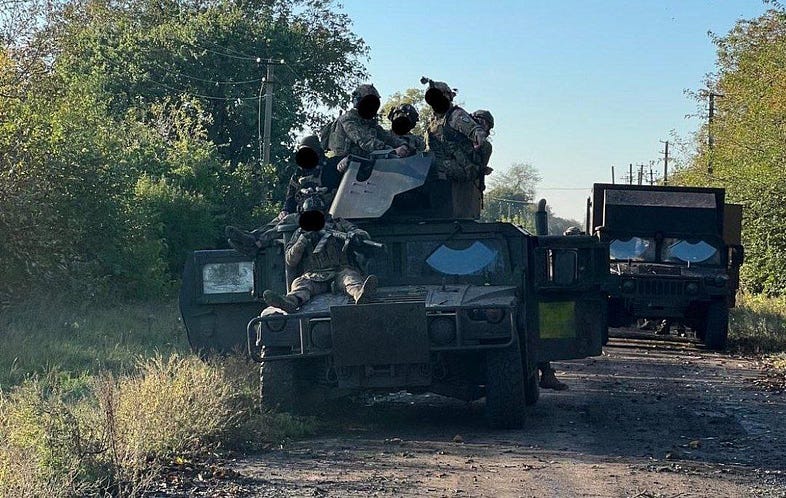
The 35th Naval Infantry seems to have had a had a bad start when one of its columns was pinned down by the Russian artillery, and lost a number of vehicles (this video is played up and down the Russian social media for at least three days now). However, eventually, it came through and seems to have liberated Davydiv Brid, capturing a few Separatists.
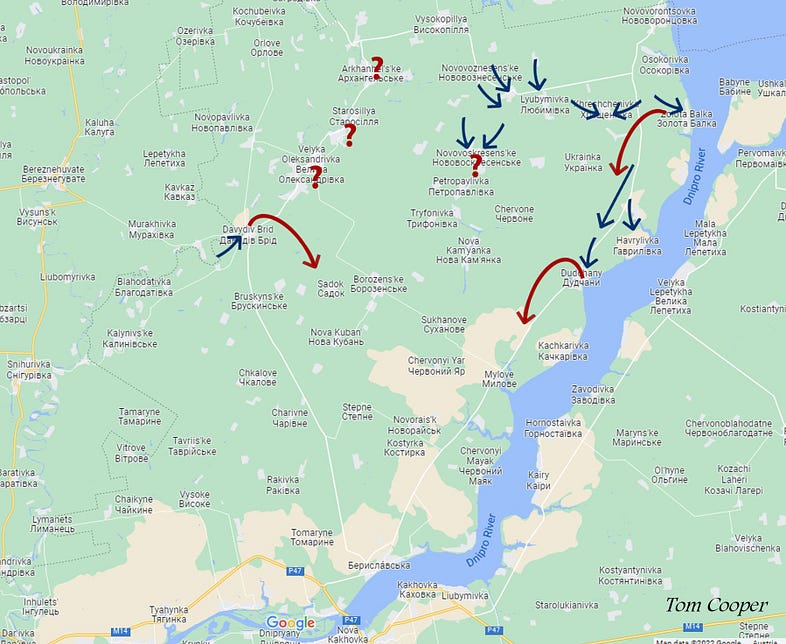
Map of the ZSU operation in northern Kherson since 2 October. Mind: this was drawn yesterday, when it was not yet clear that the VDV ‘regroupped’ from Arhanhelske, and then abandoned all of its positions along the northern Inhulets river (that’s why the three question signs over its positions there).
The Game of Seek and Hide
Now, how comes all of this?
In reaction to quite a few questions of the last few days, let me try to explain how is the war in Ukraine fought, how certain things ‘work’ (or not at all), and perhaps even what it is to serve as a ‘soldier’ there — whether in the infantry, armoured/mechanised formations, artillery, logistics or else.
Foremost, plenty of people seem to wonder ‘where are tanks’, and — even after seven months of this war — can’t wait for something like ‘big mechanised formations to run sweeping manoeuvres’, drive through enemy positions shooting broadsides like line-ships of the Napoleonic times (or, should I say: Nelson’s times?) as they go… And if tanks do not do that, or if a few of them get shot to pieces whenever they try, then the conclusions are getting rather hysteric. In the style of: ‘tank is obsolete’…
Beg your pardon, everybody: this is simply not how the ‘war works’. It didn’t work that way even in France of mid-May 1940. No surprise it doesn’t now.
The battlefield in Ukraine is dominated by one thing. Two things, if you like.
UAV-guided artillery.
….and then ‘not just some UAV-guided artillery’, but UAV-guided artillery networked with help of automatic tactical management systems (ATMS) — like Kropyva/Urtica (Ukraine) and Sozvezdiye/Constellation (Russia).
That means not only that both sides are deploying ‘plenty of artillery’: both the Russians and Ukrainians are deploying hundreds of UAVs on a constant search for enemy troops and vehicles. With help of ATMS, these UAVs are in constant contact with field headquarters. As soon as UAVs find something of particular interest: the object in question is subjected to artillery fire.
Unsurprisingly, UAVs — no aircraft and no helicopters — are the primary target of air defences on both sides, and both are shooting down UAVs in droves, every single day. Whenever they fail to do so, whoever and whatever is found by an UAV within 10–15km from the ‘frontline’, is shelled by artillery in a matter of 1–5 minutes.
This is getting so far that there are times and sectors of the frontline where Ukrainians — who, arguably, are better equipped with UAVs — are spending 30, 40, 50% of the flight time of their UAVs to run reconnaissance of their own positions, just in order to make sure these couldn’t be found by the Russian UAVs.
This is why artillery of both sides is hiding most of the times. Yes: it’s frequently hiding even when involved in fire action.
Sometimes, this is reaching such proportions that Ukrainians are protecting their ‘most precious’ self-propelled artillery pieces 1-for-1 by such rare stuff like German-made Gepard Flakpanzer: whenever the artillery piece in question goes into fire action, the Flakpanzer is responsible to protect it — from enemy UAVs, and thus from enemy artillery.
In turn, UAVs are foremost searching for enemy artillery. Whenever they find some, this is shelled until either destroyed, or until it runs away outside the range. That’s what they call ‘counter-battery action/fire’.
Sometimes, enemy artillery is not going to run away when targeted, but — preferably with help of UAVs, but sometimes with support of artillery radars — shoot back at the artillery that’s shooting at it. That’s what they call ‘artillery duels’.
Second principal target of artillery are fortifications: especially fortifications behind the frontline, like those used to protect headquarters, specific objects and/or vehicles — but also fortifications along the frontline. Fortifications are constructions designed to protect people and equipment: they can be anywhere between ‘relatively primitive’ (like a ‘simple, shallow trench’), and ‘elaborate’ (say, a bunker made of 1m thick concrete, with specially designed openings for fire-arms, which can be shut down with help of armoured covers etc.).
This is why whoever only can is doing his/her best to hide fortifications — to camouflage them, foremost with help of vegetation, or by ‘embedding’ them into terrain and vegetation; and why, in turn, why whoever only can is trying to find such objects, and then shell them, too.
Now, pay attention: I’ve just spent more than a full DIN A4 page (and that in fonts 10) to explain ‘just the basics’ — and haven’t even come as far as to ‘explain that with infantry and/or tanks’.
The reason is that these are the ‘fundamentals’ of this war. This is how 80–90% of action is fought — both by the Russians and Ukrainians. Should there be any doubts, invest 5–10 minutes of googling around to find articles quoting 80–90% of casualties on either side being caused by artillery.
Bottom line: most of the time, and regardless if on the move or standing still, everybody is hiding: hiding from UAVs, and from artillery.
Now, as a retired Lieutenant-Colonel of the US Marines nicely commented in a private chat, yesterday, this is where Ukrainians are enjoying quite some advantage. Reason? Whether motorised or airborne, the Russian infantry is ‘vehicle tied’. Its troops rarely venture more than 100 metres away from their vehicles. Because these vehicles are easy to detect and track — whether by radars, by infra-red or low-light TV systems — the Russian infantry is quite easy to find, too. On the contrary, Ukrainian infantry is frequently operating ‘miles away’ from its supporting vehicles. I.e. ZSU infantry is much harder to find.
So, where’s then the tank’s place in all of this?
Guess what: they’re hidden. Scattered and hidden, to be more precise. Indeed: most of the time, and whenever within 10–15km from the frontline, they’re just as well-hidden as anything else that wants to survive.
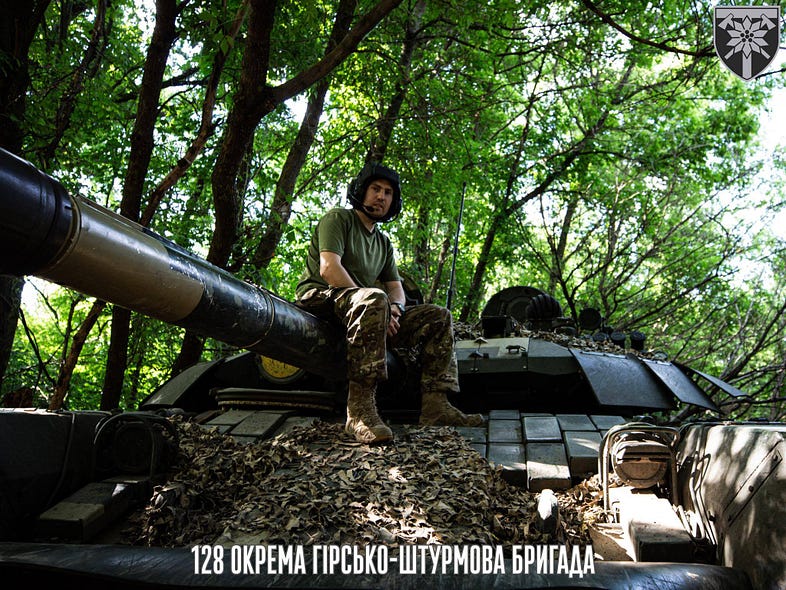
A tanker of the 128th Mountain during a break. As usually, his tank is hidden between the trees.
The reason is that tanks (and other armoured vehicles) are big, loud vehicles, raising dust whenever they move — and the human eye is made to detect movement first. Thus, whenever a tank moves, it’s easy to detect. Especially so by any decent UAV, ‘hoovering’ 500–1,000 metres above ‘its own side’ of the frontline. Put two, three, six, ten or more tanks (or other armoured vehicles) together, and they’re hard not to detect: ‘even a blind man’ — is going to hear them, at least. Even if organised into a column or a wide front, and well spread out, tanks are usually detected well before reaching the frontline: especially on the frontline as saturated with reconnaissance UAVs as those in Ukraine, and definitely well before they can bring their own weapons to bear.
Usual result is unavoidable: the mass of tanks that gets destroyed or disabled are destroyed or disabled by artillery while still some 2,000–5,000m behind the frontline. The only way to bring them any closer to the frontline is to first destroy enemy UAVs, or at least run counter-battery action and thus either suppress or force the other side’s artillery to withdraw. To prevent the enemy from detecting tanks early, and then to prevent the enemy from targeting tanks by artillery. ….alternatively, one can always drive them out — and then watch them being destroyed, one after the other.
Once tanks are within 2000m from the frontline, they’re entering the range of enemy mortars (at least those calibre 120mm), and anti-tank guided missiles (ATGMs). Mortars are like artillery, just shorter-ranged: foremost, their bombs are travelling along ballistic trajectory and thus hitting top armour of tanks, where this is at its thinnest. Be sure: a single hit by 120mm bomb is going to disable — if not outright destroy — any of tank types deployed in this war (and it would do exactly the same with any of Western tank-types, too).
As next, there are ATGMs: ATGMs operated by the Russians and Ukrainians have a range of 4,000–5,000 metres. This is a longer range than the one of 125mm smooth-bore guns that are the primary armament of tanks deployed on both sides of this war, tanks like T-64, T-72, T-80, and T-90 (arguably, that gun has a range of out to 11,000 metres, however: in the direct-fire mode, this is down to about 1,500m).
Means: by the point in time when they are within 2,000 metres of the frontline, tanks are almost certain to come under both the fire of enemy artillery, and mortars, and ATGMs.
As next, there are mines. Mines are ‘not sexy’: any sane soldier is despising them. They are destroying, killing, at least maiming in a way widely perceived as ‘perfidious’. Minefields are always positioned where the least expected, and anything else than ‘easy to find’: nobody is as crazy as to clearly mark a minefield for the enemy. In this war mines are used in insane numbers. Just one example: about a week ago, Ukrainians have started de-mining an area of about 1,000 square kilometres recently liberated from the Russians: While de-mining the first square kilometre, they have found 12,000 mines.
Favourite way of defence on both sides of this war is to combine all of this: artillery, mortars, ATGMs, and mines. Say: let the enemy drive out his tanks into an attack, then let these run into a minefield at a selected, exposed point, then smash him with artillery, mortars and ATGMs. They call that a ‘kill zone’. We’ve already seen dozens of videos of this happening to the Russian tankers in particular: no need to have any doubts, in more recent days the Russians did the same — and not only a few times — to Ukrainian tanks, too. Afterwards, we get to see photos of this kind:
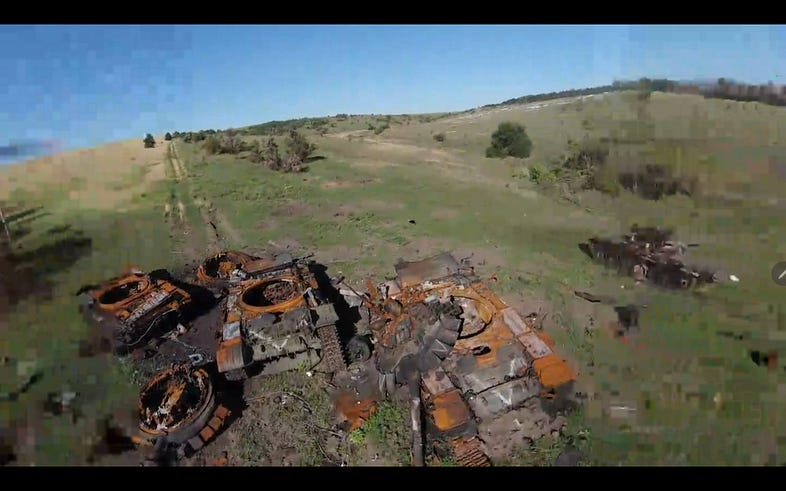
Four Russian main battle tanks knocked out by a combination of mines, ATGMs and artillery fire, somewhere in the Donbass.
Under these circumstances there’s no place for ‘chivalry tank-vs-tank battle’. This is no war of kamikaze-troops: with few (usually: alcoholised or panicked) exceptions, nobody is running around screaming ‘kill me, kill me first’. And, why should the defending side expose its tanks to the assailant’s artillery by driving them out of their hideouts — if assailant’s tanks can get smashed to pieces by the artillery, and — if artillery is not enough — then by a combination of artillery, mortars, ATGMs, and mines, and that from safe distance, without own losses…?
Even in the few cases where tanks did get as far as to engage enemy tanks, artillery and ATGMs became involved in a matter of 1–2 minutes, always with the same result: tanks must run away, or they’re knocked out. Unsurprisingly, the number of documented ‘classic tank-vs-tank battles’ in this war can be counted on fingers of one, perhaps two hands. Here a good example:
And mind: only then, once all of this has happened, is one or the other side serving us selected, ‘spectacular’ videos, shown tanks of the other side getting pulverised.
Should this mean ‘tank is obsolete’?
Nope.
Foremost, it means that neither side is keen to show us videos when its own forces have suffered losses.
After that, it’s ‘just so’ that in the first seven months of this war, neither side found a solution for the superiority of artillery. That’s the core reason: like any other weapons system, tank ‘works’ when deployed in so-called combined arms operations: essentially an effective system of fighting a war, including tanks, artillery, infantry etc.. If left at its own, it’s as useless as any other weapon system deployed at its own.
Sure, next to nobody else (bar Iran and Iraq of 1980–1988) has fought a war of this volume in ages, and thus, actually: there are no comparable experiences. Indeed, the modern-day ‘social media generation’ simply does not know wars of this size and scope. But, it can be assumed that specific other belligerents — especially some ‘Western/NATO’ party — would seek to neutralise the enemy artillery with help of air power. See: fighter-bombers equipped with precision guided munition, or mass deployment of loitering precision guided munition (PGMs). So far, Russia and Ukraine’s air defences, and lack of advanced PGMs have prevented the other side’s air power from providing effective close air support Despite some Western deliveries to Ukraine, and recent Iranian deliveries of loitering PGMs, neither side seems capable of deploying these in sufficient numbers to change the situation.
Overall: artillery continues dominating this war and I do not see this changing any time soon.
**
ADD-ON: a must-read here: FBI: We tracked who was printing secret documents to unmask ex-NSA suspect.
https://www.theregister.com/2022/10/03/ ... _espionage
It’s next to certain that the idiot in question was passing information about the ZSU — its communications, planning etc. — to the GRU.
-
statixx
- Posts: 9938
- Joined: 15/12/2011 14:40
- Location: Sarajevo
#122028 Re: Ukrajina
Otkud sad avijacija, zar nije unistena. 
-
lajkujMe
- Posts: 12945
- Joined: 06/04/2011 17:44
- Location: Na svom mocnom racunaru
#122029 Re: Ukrajina
Bez uvrede za Tom Coopera, vrsni je vojni stručnjak.
Ali njegove lokacije ko sta drži ne treba uzeti za ozbiljno.
Dosta dosta toga sto je on rekao gdje je ko se na kraju ispostavilo netačnim. (Vecina usudio bih se reci)
Konkretno u objavi iznad kaže da je Davydov Brod oslobođen.
Niko ama bas niko sem njega to nije objavio.
Dok ne vidim druge izvore ja Tomu više nevjerujem ništa što se tiče fronta tj ko je gdje.
Ali zato super izvor za vojne taktike, doktrine i ponašanja vojski
Ali njegove lokacije ko sta drži ne treba uzeti za ozbiljno.
Dosta dosta toga sto je on rekao gdje je ko se na kraju ispostavilo netačnim. (Vecina usudio bih se reci)
Konkretno u objavi iznad kaže da je Davydov Brod oslobođen.
Niko ama bas niko sem njega to nije objavio.
Dok ne vidim druge izvore ja Tomu više nevjerujem ništa što se tiče fronta tj ko je gdje.
Ali zato super izvor za vojne taktike, doktrine i ponašanja vojski
-
lajkujMe
- Posts: 12945
- Joined: 06/04/2011 17:44
- Location: Na svom mocnom racunaru
-
Haris.ba

- Posts: 35833
- Joined: 08/09/2005 20:08
#122031 Re: Ukrajina
Mislim da je mislio da bude u ekonomskom savezu.
A, Njemacka se nije nasukala, vec su je nasukali njeni bajni politicari.
-
Porodice Foht

- Posts: 3734
- Joined: 14/01/2019 04:56
#122032 Re: Ukrajina
Odakle sada 15000 lafo "najelitnijih Putkovih trupa" bas u hersonskom dzepu pred okruzenjem? Shvatam da su u bedaku, ali kako ce Orke koncentrisati na tako malom prostoru "najbolje sto imaju"?
-
sumirprimus
- Posts: 88927
- Joined: 10/02/2010 07:54
- Location: Bunker :D Saj ops
#122033 Re: Ukrajina
niko ne zna tacne lokacije trenutnih ukr snaga na mjestima napada. niko van okvira onih koji trebaju znati, sami ukr i to njihova komancda, obavjestajna i vejrovatno oni koji nadziru, opet mislim prvenstveno na amere. osint zajednica nagadja na osnovu snimaka i ko sta javi pojedinacno sa terena, opet nema siru sliku.lajkujMe wrote: ↑04/10/2022 10:47 Bez uvrede za Tom Coopera, vrsni je vojni stručnjak.
Ali njegove lokacije ko sta drži ne treba uzeti za ozbiljno.
Dosta dosta toga sto je on rekao gdje je ko se na kraju ispostavilo netačnim. (Vecina usudio bih se reci)
Konkretno u objavi iznad kaže da je Davydov Brod oslobođen.
Niko ama bas niko sem njega to nije objavio.
Dok ne vidim druge izvore ja Tomu više nevjerujem ništa što se tiče fronta tj ko je gdje.
Ali zato super izvor za vojne taktike, doktrine i ponašanja vojski
ali kupera ko nije procitao, ovo gore postavljeno, ne razumije onda ovu temu ukrajine niti rata sa rusijom. dalje od ovoga pojasnjenja za laike nema.
i zato svaka mu cast.
-
sumirprimus
- Posts: 88927
- Joined: 10/02/2010 07:54
- Location: Bunker :D Saj ops
#122034 Re: Ukrajina
SanskiBiser wrote: ↑04/10/2022 10:34
Tom Cooper o zadnjim vojnim aktivnostima na hersonskom ratistu.
[SpoilerShowquote]
Good morning everybody!
This morning, and amid an ‘entire string of counteroffensives’ run by the Ukrainian Armed Forces (ZSU) — I’ll, again, try to address just one of them, and then one about which there are many questions: the one in northern Kherson Oblast.
What happened there the last three days can be mostly deducted from Russian reports: so far, Ukrainians are rather reluctant to say what is going on.
Up front, it is obvious this operation was prepared in a much better fashion than the one from late August — even if its aims, probably even axes of advance, remained largely the same.
First problem was that during operations in northern Kherson in late August and early September, involved ZSU units quite quickly run out of artillery ammunition. The reason is that the ammunition expenditure in this war remains far higher than anybody expects. That said, the ammo was not spent for nothing: it severely depleted the opposition. Moreover, the ZSU offensives into eastern Kharkiv have forced the Russian Armed Forces (VSRF) to re-route lots of reinforcements and supplies in that direction: the concentration of VDV (Russian airborne units) and Separatist forces in Kherson Oblast — the two are commanded by the 49th Combined Arms Army (southern and western Kherson) and the XXII Army Corps (northern Kherson) could not yet receive similar reinforcements.
The next problem was improving both electronic warfare (EW) support and reconnaissance. That the severe EW was deployed can be deducted from Russian reports about a break-down in communications and lack of air support. Almost certainly, this caused a break-down in the artillery support, too. Reconnaissance was improved in so far that the ZSU took better care to find and neutralise Russian combat vehicles before launching its own attack. As a result, early reports indicated a loss of only one or two T-72Ms of the (‘destroyed’) 128th Mountain (compared to almost half a company during initial assaults of early August), in exchange for about half a battalion tactical group of the opposition (AFAIK, the total number of destroyed Russian vehicles reported by now includes about a dozen of tanks, a similar number of infantry fighting vehicles and armoured personnel carriers, and twice as many of other vehicles).
Another problem was that some of ZSU brigade commanders were still ‘leading from the front’: was ‘in’ — indeed: a sort of ‘status symbol’ — over much of the last 70 years, but is not ‘perfect’ for modern day warfare. Nowadays, COs are best serving if coordinating their troops from the safety of their HQs. They’ve got UAVs and the Kropyva automatic tactical management system, can monitor the battle ‘live’ and ‘from vantage point’, and see what’s going on much better than from the ground. Furthermore, I’m certain the ZSU deployed its special forces (apparently SSO Centre South Branch) behind enemy lines — in advance, and in order to provide additional info on enemy troop movements.
Finally, the opposition was of different ‘quality’: back in late August, the 128th Mountain was assaulting well-prepared positions of two BTGs of the crack VDV. As reported at the time, these suffered such losses that one had to be withdrawn from Kherson Oblast, completely. Thus, this time, the 128th Mountain was facing the (comparatively) poorly-armed 205th Cossack Motor Rifle Brigade (Separatists), and the depleted 83rd VDV Brigade.
Finally, this attack was to be supported by advances of the 35th Naval Infantry from the Inhulets Bridgehead, in northern (Davydiv Brid) and eastern direction (Bruskynske).
Action
On Sunday, 2 October, the Initial, multi-prong assault quickly collapsed positions of the 205th Cossack in Myroliubivka and Ljubymivka, causing its survivors to flee (reportedly: all the way to Beryslav, some 80km further south). This exposed the strongholds in Khreshchenivka and Zolota Balka: the 83rd VDV was meanwhile knocked out by a hit on its headquarters (causing at least the death of its deputy commander) and its survivors prompted into a quick withdrawal in direction of Dubchany.
The Russians ‘regrouped’ from Mykhailivka by Monday, 3 October, morning. When the VKS attempted to intervene, it quickly lost a Su-25, somewhere in the Novovoskresenske area.
By the time, the ‘regrouping’ turned into a rout, with the Russians abandoning Ukrainka and Bilvaivka, and fleeing south: as of yesterday, Ukrainians have liberated Novooleksandrivka, Havrylivka, and the Russians — after blowing up the local bridge on the T0403 road — abandoned even Dubchany, prending ‘complete and successful regrouping in Beryslav’.
Further east, as a sign of its goodwill, and in confirmation of Shoygu’s statement that everything is going along the plan, the VDV regrouped from Arhanhelske and Myrolyubivka.
The 35th Naval Infantry seems to have had a had a bad start when one of its columns was pinned down by the Russian artillery, and lost a number of vehicles (this video is played up and down the Russian social media for at least three days now). However, eventually, it came through and seems to have liberated Davydiv Brid, capturing a few Separatists.
Map of the ZSU operation in northern Kherson since 2 October. Mind: this was drawn yesterday, when it was not yet clear that the VDV ‘regroupped’ from Arhanhelske, and then abandoned all of its positions along the northern Inhulets river (that’s why the three question signs over its positions there).
The Game of Seek and Hide
Now, how comes all of this?
In reaction to quite a few questions of the last few days, let me try to explain how is the war in Ukraine fought, how certain things ‘work’ (or not at all), and perhaps even what it is to serve as a ‘soldier’ there — whether in the infantry, armoured/mechanised formations, artillery, logistics or else.
Foremost, plenty of people seem to wonder ‘where are tanks’, and — even after seven months of this war — can’t wait for something like ‘big mechanised formations to run sweeping manoeuvres’, drive through enemy positions shooting broadsides like line-ships of the Napoleonic times (or, should I say: Nelson’s times?) as they go… And if tanks do not do that, or if a few of them get shot to pieces whenever they try, then the conclusions are getting rather hysteric. In the style of: ‘tank is obsolete’…
Beg your pardon, everybody: this is simply not how the ‘war works’. It didn’t work that way even in France of mid-May 1940. No surprise it doesn’t now.
The battlefield in Ukraine is dominated by one thing. Two things, if you like.
UAV-guided artillery.
….and then ‘not just some UAV-guided artillery’, but UAV-guided artillery networked with help of automatic tactical management systems (ATMS) — like Kropyva/Urtica (Ukraine) and Sozvezdiye/Constellation (Russia).
That means not only that both sides are deploying ‘plenty of artillery’: both the Russians and Ukrainians are deploying hundreds of UAVs on a constant search for enemy troops and vehicles. With help of ATMS, these UAVs are in constant contact with field headquarters. As soon as UAVs find something of particular interest: the object in question is subjected to artillery fire.
Unsurprisingly, UAVs — no aircraft and no helicopters — are the primary target of air defences on both sides, and both are shooting down UAVs in droves, every single day. Whenever they fail to do so, whoever and whatever is found by an UAV within 10–15km from the ‘frontline’, is shelled by artillery in a matter of 1–5 minutes.
This is getting so far that there are times and sectors of the frontline where Ukrainians — who, arguably, are better equipped with UAVs — are spending 30, 40, 50% of the flight time of their UAVs to run reconnaissance of their own positions, just in order to make sure these couldn’t be found by the Russian UAVs.
This is why artillery of both sides is hiding most of the times. Yes: it’s frequently hiding even when involved in fire action.
Sometimes, this is reaching such proportions that Ukrainians are protecting their ‘most precious’ self-propelled artillery pieces 1-for-1 by such rare stuff like German-made Gepard Flakpanzer: whenever the artillery piece in question goes into fire action, the Flakpanzer is responsible to protect it — from enemy UAVs, and thus from enemy artillery.
In turn, UAVs are foremost searching for enemy artillery. Whenever they find some, this is shelled until either destroyed, or until it runs away outside the range. That’s what they call ‘counter-battery action/fire’.
Sometimes, enemy artillery is not going to run away when targeted, but — preferably with help of UAVs, but sometimes with support of artillery radars — shoot back at the artillery that’s shooting at it. That’s what they call ‘artillery duels’.
Second principal target of artillery are fortifications: especially fortifications behind the frontline, like those used to protect headquarters, specific objects and/or vehicles — but also fortifications along the frontline. Fortifications are constructions designed to protect people and equipment: they can be anywhere between ‘relatively primitive’ (like a ‘simple, shallow trench’), and ‘elaborate’ (say, a bunker made of 1m thick concrete, with specially designed openings for fire-arms, which can be shut down with help of armoured covers etc.).
This is why whoever only can is doing his/her best to hide fortifications — to camouflage them, foremost with help of vegetation, or by ‘embedding’ them into terrain and vegetation; and why, in turn, why whoever only can is trying to find such objects, and then shell them, too.
Now, pay attention: I’ve just spent more than a full DIN A4 page (and that in fonts 10) to explain ‘just the basics’ — and haven’t even come as far as to ‘explain that with infantry and/or tanks’.
The reason is that these are the ‘fundamentals’ of this war. This is how 80–90% of action is fought — both by the Russians and Ukrainians. Should there be any doubts, invest 5–10 minutes of googling around to find articles quoting 80–90% of casualties on either side being caused by artillery.
Bottom line: most of the time, and regardless if on the move or standing still, everybody is hiding: hiding from UAVs, and from artillery.
Now, as a retired Lieutenant-Colonel of the US Marines nicely commented in a private chat, yesterday, this is where Ukrainians are enjoying quite some advantage. Reason? Whether motorised or airborne, the Russian infantry is ‘vehicle tied’. Its troops rarely venture more than 100 metres away from their vehicles. Because these vehicles are easy to detect and track — whether by radars, by infra-red or low-light TV systems — the Russian infantry is quite easy to find, too. On the contrary, Ukrainian infantry is frequently operating ‘miles away’ from its supporting vehicles. I.e. ZSU infantry is much harder to find.
So, where’s then the tank’s place in all of this?
Guess what: they’re hidden. Scattered and hidden, to be more precise. Indeed: most of the time, and whenever within 10–15km from the frontline, they’re just as well-hidden as anything else that wants to survive.
A tanker of the 128th Mountain during a break. As usually, his tank is hidden between the trees.
The reason is that tanks (and other armoured vehicles) are big, loud vehicles, raising dust whenever they move — and the human eye is made to detect movement first. Thus, whenever a tank moves, it’s easy to detect. Especially so by any decent UAV, ‘hoovering’ 500–1,000 metres above ‘its own side’ of the frontline. Put two, three, six, ten or more tanks (or other armoured vehicles) together, and they’re hard not to detect: ‘even a blind man’ — is going to hear them, at least. Even if organised into a column or a wide front, and well spread out, tanks are usually detected well before reaching the frontline: especially on the frontline as saturated with reconnaissance UAVs as those in Ukraine, and definitely well before they can bring their own weapons to bear.
Usual result is unavoidable: the mass of tanks that gets destroyed or disabled are destroyed or disabled by artillery while still some 2,000–5,000m behind the frontline. The only way to bring them any closer to the frontline is to first destroy enemy UAVs, or at least run counter-battery action and thus either suppress or force the other side’s artillery to withdraw. To prevent the enemy from detecting tanks early, and then to prevent the enemy from targeting tanks by artillery. ….alternatively, one can always drive them out — and then watch them being destroyed, one after the other.
Once tanks are within 2000m from the frontline, they’re entering the range of enemy mortars (at least those calibre 120mm), and anti-tank guided missiles (ATGMs). Mortars are like artillery, just shorter-ranged: foremost, their bombs are travelling along ballistic trajectory and thus hitting top armour of tanks, where this is at its thinnest. Be sure: a single hit by 120mm bomb is going to disable — if not outright destroy — any of tank types deployed in this war (and it would do exactly the same with any of Western tank-types, too).
As next, there are ATGMs: ATGMs operated by the Russians and Ukrainians have a range of 4,000–5,000 metres. This is a longer range than the one of 125mm smooth-bore guns that are the primary armament of tanks deployed on both sides of this war, tanks like T-64, T-72, T-80, and T-90 (arguably, that gun has a range of out to 11,000 metres, however: in the direct-fire mode, this is down to about 1,500m).
Means: by the point in time when they are within 2,000 metres of the frontline, tanks are almost certain to come under both the fire of enemy artillery, and mortars, and ATGMs.
As next, there are mines. Mines are ‘not sexy’: any sane soldier is despising them. They are destroying, killing, at least maiming in a way widely perceived as ‘perfidious’. Minefields are always positioned where the least expected, and anything else than ‘easy to find’: nobody is as crazy as to clearly mark a minefield for the enemy. In this war mines are used in insane numbers. Just one example: about a week ago, Ukrainians have started de-mining an area of about 1,000 square kilometres recently liberated from the Russians: While de-mining the first square kilometre, they have found 12,000 mines.
Favourite way of defence on both sides of this war is to combine all of this: artillery, mortars, ATGMs, and mines. Say: let the enemy drive out his tanks into an attack, then let these run into a minefield at a selected, exposed point, then smash him with artillery, mortars and ATGMs. They call that a ‘kill zone’. We’ve already seen dozens of videos of this happening to the Russian tankers in particular: no need to have any doubts, in more recent days the Russians did the same — and not only a few times — to Ukrainian tanks, too. Afterwards, we get to see photos of this kind:
Four Russian main battle tanks knocked out by a combination of mines, ATGMs and artillery fire, somewhere in the Donbass.
Under these circumstances there’s no place for ‘chivalry tank-vs-tank battle’. This is no war of kamikaze-troops: with few (usually: alcoholised or panicked) exceptions, nobody is running around screaming ‘kill me, kill me first’. And, why should the defending side expose its tanks to the assailant’s artillery by driving them out of their hideouts — if assailant’s tanks can get smashed to pieces by the artillery, and — if artillery is not enough — then by a combination of artillery, mortars, ATGMs, and mines, and that from safe distance, without own losses…?
Even in the few cases where tanks did get as far as to engage enemy tanks, artillery and ATGMs became involved in a matter of 1–2 minutes, always with the same result: tanks must run away, or they’re knocked out. Unsurprisingly, the number of documented ‘classic tank-vs-tank battles’ in this war can be counted on fingers of one, perhaps two hands. Here a good example:
And mind: only then, once all of this has happened, is one or the other side serving us selected, ‘spectacular’ videos, shown tanks of the other side getting pulverised.
Should this mean ‘tank is obsolete’?
Nope.
Foremost, it means that neither side is keen to show us videos when its own forces have suffered losses.
After that, it’s ‘just so’ that in the first seven months of this war, neither side found a solution for the superiority of artillery. That’s the core reason: like any other weapons system, tank ‘works’ when deployed in so-called combined arms operations: essentially an effective system of fighting a war, including tanks, artillery, infantry etc.. If left at its own, it’s as useless as any other weapon system deployed at its own.
Sure, next to nobody else (bar Iran and Iraq of 1980–1988) has fought a war of this volume in ages, and thus, actually: there are no comparable experiences. Indeed, the modern-day ‘social media generation’ simply does not know wars of this size and scope. But, it can be assumed that specific other belligerents — especially some ‘Western/NATO’ party — would seek to neutralise the enemy artillery with help of air power. See: fighter-bombers equipped with precision guided munition, or mass deployment of loitering precision guided munition (PGMs). So far, Russia and Ukraine’s air defences, and lack of advanced PGMs have prevented the other side’s air power from providing effective close air support Despite some Western deliveries to Ukraine, and recent Iranian deliveries of loitering PGMs, neither side seems capable of deploying these in sufficient numbers to change the situation.
Overall: artillery continues dominating this war and I do not see this changing any time soon.
**
ADD-ON: a must-read here: FBI: We tracked who was printing secret documents to unmask ex-NSA suspect.
https://www.theregister.com/2022/10/03/ ... _espionage
It’s next to certain that the idiot in question was passing information about the ZSU — its communications, planning etc. — to the GRU.
[/quote]
k nije procitao obavezno az razumijevanje fronta u ukrajini...
-
sumirprimus
- Posts: 88927
- Joined: 10/02/2010 07:54
- Location: Bunker :D Saj ops
#122035 Re: Ukrajina
ko to nas trza, ko to nas trzaa

-
sumirprimus
- Posts: 88927
- Joined: 10/02/2010 07:54
- Location: Bunker :D Saj ops
#122036 Re: Ukrajina
kazu to je to od pregovora sa putlerom. sad valja cekat njegov pad i novog putka
-
sumirprimus
- Posts: 88927
- Joined: 10/02/2010 07:54
- Location: Bunker :D Saj ops

-
Romanija
- Posts: 2572
- Joined: 02/10/2008 15:56
- Location: Brexitland
#122038 Re: Ukrajina
Po nekim podacima i mnogo vise, preko dvadeset hiljada. Tamo su jos od pokusaja da se uzme Nikolajev, a onda ostali da brane za njih strateske pozicije, nenaceti u borbama na pogodnom terenu za njihove formacije. Dok su s te strane Dnjepra uvjem ce Putler drzati u rukama kartu 'ruske Odese', pa i za dvadeset godina.Porodice Foht wrote: ↑04/10/2022 11:02 Odakle sada 15000 lafo "najelitnijih Putkovih trupa" bas u hersonskom dzepu pred okruzenjem? Shvatam da su u bedaku, ali kako ce Orke koncentrisati na tako malom prostoru "najbolje sto imaju"?
-
sumirprimus
- Posts: 88927
- Joined: 10/02/2010 07:54
- Location: Bunker :D Saj ops
#122039 Re: Ukrajina
mene ruje podsjecaju na jna sa pocetka devedesetih i ratova ovde. skoro isto vode vojsku u kanal. totalno odrodjeni od desavanja oko jnih, rade po svom sablonu pa i ako ne ide, nisu skloni promjenama .
-
sumirprimus
- Posts: 88927
- Joined: 10/02/2010 07:54
- Location: Bunker :D Saj ops
#122040 Re: Ukrajina

Ukrainian forces continue to push south of Dudchany Russian forces have regrouped around the town of Mylove.
-
anelsol

- Posts: 3957
- Joined: 10/05/2017 22:41
#122041 Re: Ukrajina
Meni je nevjerovatno da su u stanju paralelno voditi dvije ofanzive, a mozda uskoro i treću paralelno. Trebalo je to sve pripremiti i logistički snadbjeti, posebno kada se vidi da Ukrajinci zaista imaju na stanju sve moguće zapadne i istočne kalibre oružja, od malokalibarskih 5.56 mm, 7, 62 mm pa do 105, 125, 122, 152, 155 mm. To je noćna mora za logistiku, ali kod njih to funkcioniše.
Last edited by anelsol on 04/10/2022 11:34, edited 2 times in total.
-
statixx
- Posts: 9938
- Joined: 15/12/2011 14:40
- Location: Sarajevo
#122042 Re: Ukrajina
Ako se regrupisu i ovi iz D. broda nema nista od Milova.sumirprimus wrote: ↑04/10/2022 11:13 Ukrainian forces continue to push south of Dudchany Russian forces have regrouped around the town of Mylove.
-
lajkujMe
- Posts: 12945
- Joined: 06/04/2011 17:44
- Location: Na svom mocnom racunaru
#122043 Re: Ukrajina
Prva video potvrda da je AFU u Dudchany
-
lajkujMe
- Posts: 12945
- Joined: 06/04/2011 17:44
- Location: Na svom mocnom racunaru
#122044 Re: Ukrajina
Ovo treba pratiti
Već je gore postavljeno
Velika stvar ako je tačno. Pitanje dokle se vraćaju jer napuštaju strateški bitne lokacije
Već je gore postavljeno
Velika stvar ako je tačno. Pitanje dokle se vraćaju jer napuštaju strateški bitne lokacije
-
Čitalac

- Posts: 8186
- Joined: 08/03/2011 07:45
- Location: mediteran, uglavnom
#122045 Re: Ukrajina
Doba bajki i fantazija o ruskoj vojnoj snazi očito je završeno. Komentator državne agencije RIA Pjotr Akopov (na listi sankcionisanih od strane EU) piše kako su u Moskvi sve glasniji oni koji traže da se priznaju greške u pripremi i sprovođenju "specijalne operacije", da se kazne odgovorni za poraze na frontu te da se sprovede čistka među generalima. „Moramo početi da govorimo istinu, ma koliko ona gorka bila. U suprotnom, bićemo poraženi, ne samo u Ukrajini već i u borbi za Rusiju“, piše Akopov koji je, inače, prošle sedmice javno priznao ono što se u Moskvi ne govori glasno: „Rusija u tehnološkom smislu za Zapadom zaostaje decenijama“.
Ovaj propagandista oslobađa Putina svake odgovornosti i krivce pronalazi u ruskim elitama pa upozorava da su pred Rusijom dva puta: ili će Ukrajina biti vraćena u rusku sferu ili će se sama ruska država raspasti. Po njemu, sve zavisi od – naroda.
Ovaj propagandista oslobađa Putina svake odgovornosti i krivce pronalazi u ruskim elitama pa upozorava da su pred Rusijom dva puta: ili će Ukrajina biti vraćena u rusku sferu ili će se sama ruska država raspasti. Po njemu, sve zavisi od – naroda.
Akopov najavljuje velike reforme ekonomije, kulture i društva, ali prvenstveno ruske armije koja je slika i prilika današnje „nedovršene Rusije“ i bez koje država nema budućnost.This is not an exaggeration – there are laws of life of Russian civilization, the Russian state: after each trouble and disintegration, it gathers again. If it does not gather this time, it means that the forces of the people have dried up, they do not want to continue their history. Could that happen? Yes, if the Russians give up and accept the role of losers and if there are no people who can change the decadent mood.
https://ria.ru/20221004/sila-1821267129.htmlBut this is the Russian army – and its role in the birth of a new state, in the process of transition to it, is simply enormous. Because without her victory, there will be nothing. The old state will go away, but we will not form a new one.
-
drug_profi

- Posts: 66225
- Joined: 16/07/2012 16:00
#122046 Re: Ukrajina
Republikanci nisu blesavi. Politika je jedno, a interesi USA su drugo.
Nastavice se potpora samounistenju Rusije, ko god je na vlasti.
-
zigzag
- Posts: 9564
- Joined: 18/04/2014 11:26
#122047 Re: Ukrajina
To znači, vođa je dobar ali narod ne valja pa ćemo mijenjati narod.
-
SanskiBiser
- Posts: 9159
- Joined: 14/05/2007 02:18
- Location: Unsko-Sansko-Migrantski Kanton
#122048 Re: Ukrajina
nije tebi engleski nesto najbolji a nije ni njegov pretjerano dobar.lajkujMe wrote: ↑04/10/2022 10:47 Bez uvrede za Tom Coopera, vrsni je vojni stručnjak.
Ali njegove lokacije ko sta drži ne treba uzeti za ozbiljno.
Dosta dosta toga sto je on rekao gdje je ko se na kraju ispostavilo netačnim. (Vecina usudio bih se reci)
Konkretno u objavi iznad kaže da je Davydov Brod oslobođen.
Niko ama bas niko sem njega to nije objavio.
Dok ne vidim druge izvore ja Tomu više nevjerujem ništa što se tiče fronta tj ko je gdje.
Ali zato super izvor za vojne taktike, doktrine i ponašanja vojski

35 brigada pomorske pjesadije je krenula u napad i prvi dan su bili na udaru ruske artiljerije i ostali su bez odredjenog broja tenkova i transportera ali su nastavili manevar i probili se u Davidov Brid pri cemu su zarobili nekoliko separatista. Akcenat je na to da su napravili proboj kod Davidovog Brida i da se ČINI tj. da je on pod utiskom da su tom prilikom i oslobodili Davydiv Brid. a ne da je 100% potvrdjeno oslobodjen.However, eventually, it came through and seems to have liberated Davydiv Brid, capturing a few Separatists.
Spoiler
Show

-
derion

- Posts: 1117
- Joined: 06/01/2008 17:08
#122049 Re: Ukrajina
Da, to je već ista priča kao što je i Hitleru bilo svejedno da li će njemački narod skroz nestati, jer nije bio spreman dati sve od sebe i žrtvovati se za njegove sulude ciljeve.
Idealno bi bilo da se Rusi kao narod moraju silom ili milom moralno i duševno otrijezniti i očistiti klerikalnog šovinizma i ultranacionalizma (rusizma). Međutim, nažalost to je mnogo lakše reći nego uraditi, ali u suprotnom zaglibit će u moralnu i kulturalnu žabokrečinu decenijama, koja neće samo imati posljedice za Ruse, nego i mnogo šire. Ovo je civilizacijska borba između dobra i zla.
-
zigzag
- Posts: 9564
- Joined: 18/04/2014 11:26
#122050 Re: Ukrajina
Guranje u ukrajinsko blato će im pomoći da se osvijeste.