Stocharov i Pittov NHL kutak
Moderators: _BataZiv_0809, Charuga, Tomahawk11
- pitt
- Posts: 27093
- Joined: 03/12/2002 00:00
- Location: Steelers Nation
#526 Re: Stocharov i Pittov NHL kutak
opet deracina 4:2 i vec vodimo 2:0 u pobjedama
LET'S GO PENS!!!!!!!!!!!!!!


- Admir_1984
- Posts: 7640
- Joined: 13/03/2006 01:33
- Location: Slabo poznajem Szenttamas, ali stignem do tvoje kuće
#527 Re: Stocharov i Pittov NHL kutak
Urekoh ja Malkina malo. Sinoc kriv za drugi gol i uopce nije dobro igrao
Sreca pa je Roberts kod treceg gola majstorski reagovao, i Talbotu servirao gol na tanjir
Al odavno nisam gledao cudniju tekmu kao sinoc. More shuteva, startova, dobacivanja.... Ona prva trecina imam osjecaj da je trajala cijelu vjecnost
Jel dobro onaj iz Flayersa sto ga je pak pogodio? Joj i mene je sinoc zabolilo kad ga spuca
A sta kazes Malkin jos ne zna engleski
Pa za cijelu godinu da ne nauci

Jel dobro onaj iz Flayersa sto ga je pak pogodio? Joj i mene je sinoc zabolilo kad ga spuca
A sta kazes Malkin jos ne zna engleski
- pitt
- Posts: 27093
- Joined: 03/12/2002 00:00
- Location: Steelers Nation
#528 Re: Stocharov i Pittov NHL kutak
ma natuca pomalo....na jedvite jade. Ima prevodica stalno uz sebe a i ganchar je tu da mu pomogne vazda.
Ma skroz cuda tekma.....i ono je bio gol sto nam pionistise al sta ces....
- pitt
- Posts: 27093
- Joined: 03/12/2002 00:00
- Location: Steelers Nation
#529 Re: Stocharov i Pittov NHL kutak
hihihihihiihihihihihih 3:0

JOIN THE FLOCK - MARCH TO THE CUP!!!!!!

JOIN THE FLOCK - MARCH TO THE CUP!!!!!!

-
bos
- Posts: 538
- Joined: 14/08/2006 00:51
- Location: Sarajevo
#530 Re: Stocharov i Pittov NHL kutak
Nisu im pomogle ni ove majice sa kul parolama.

- pitt
- Posts: 27093
- Joined: 03/12/2002 00:00
- Location: Steelers Nation
#531 Re: Stocharov i Pittov NHL kutak
kakve majice.....u 2-3 minute 2 gola......i usutila se cijela dvorana

- Admir_1984
- Posts: 7640
- Joined: 13/03/2006 01:33
- Location: Slabo poznajem Szenttamas, ali stignem do tvoje kuće
#532 Re: Stocharov i Pittov NHL kutak
Prvi gol Hosse, poezija!
Ovi flyersi su svu srecu svijeta ispucali protiv Montreala

Ovi flyersi su svu srecu svijeta ispucali protiv Montreala
- pitt
- Posts: 27093
- Joined: 03/12/2002 00:00
- Location: Steelers Nation
#533 Re: Stocharov i Pittov NHL kutak
pih....izgubismo 4:2
Stocko ovo si ti suhvu svezao
U nedelju igramo kuci.....
-
bos
- Posts: 538
- Joined: 14/08/2006 00:51
- Location: Sarajevo
#534 Re: Stocharov i Pittov NHL kutak
Veceras hockey night in Bosnia. 
U 7 finale svjetskog Rusija-Kanada pa u 9 Pingvini zavrsavaju seriju sa Flyersima...

U 7 finale svjetskog Rusija-Kanada pa u 9 Pingvini zavrsavaju seriju sa Flyersima...
- pitt
- Posts: 27093
- Joined: 03/12/2002 00:00
- Location: Steelers Nation
#535 Re: Stocharov i Pittov NHL kutak
malone.......1:0

- pitt
- Posts: 27093
- Joined: 03/12/2002 00:00
- Location: Steelers Nation
#536 Re: Stocharov i Pittov NHL kutak
2:0 Malkin
: D
- pitt
- Posts: 27093
- Joined: 03/12/2002 00:00
- Location: Steelers Nation
- pitt
- Posts: 27093
- Joined: 03/12/2002 00:00
- Location: Steelers Nation
#538 Re: Stocharov i Pittov NHL kutak
4:0 Malone ili Crosby.......jos s ene zna od koga se odbilo
:D

- pitt
- Posts: 27093
- Joined: 03/12/2002 00:00
- Location: Steelers Nation
#539 Re: Stocharov i Pittov NHL kutak
ipak je malone bio 
5:0 Staal

5:0 Staal
- pitt
- Posts: 27093
- Joined: 03/12/2002 00:00
- Location: Steelers Nation
#540 Re: Stocharov i Pittov NHL kutak
6:0 Hossa opet ili dupri
ubismo ih rikosetima 
- pitt
- Posts: 27093
- Joined: 03/12/2002 00:00
- Location: Steelers Nation
#541 Re: Stocharov i Pittov NHL kutak
Famose......famose.....eto flyresa tamo se

East Beasts


East Beasts


-
bos
- Posts: 538
- Joined: 14/08/2006 00:51
- Location: Sarajevo
#542 Re: Stocharov i Pittov NHL kutak
I eto ga veliko finale sa Detroitom, 1. tekma u subotu.
Idemo po 3. Stanley Cup...Goooooooooooo Pens!!!!!!!!

Idemo po 3. Stanley Cup...Goooooooooooo Pens!!!!!!!!
- pitt
- Posts: 27093
- Joined: 03/12/2002 00:00
- Location: Steelers Nation
#543 Re: Stocharov i Pittov NHL kutak
Akobogda.....mada sam se nadao da ce dalas uzeti pa da imamo domacu prednost. Ovako prve dvije u mo-town idemo
Detroit je opasan ispred mreze, nadam se da ce flower biti na nivou 
- pitt
- Posts: 27093
- Joined: 03/12/2002 00:00
- Location: Steelers Nation
- pitt
- Posts: 27093
- Joined: 03/12/2002 00:00
- Location: Steelers Nation
#545 Re: Stocharov i Pittov NHL kutak
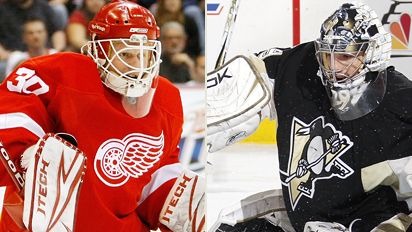
Stanley Cup finals breakdown: Red Wings vs. Penguins
By Scott Burnside

There's no right answer (just wrong ones, more often than not), but no matter how you cut it, the 2008 Stanley Cup finals have all the makings of a classic matchup between some of the most skilled players in the game.
The Detroit Red Wings are trying to win their fourth Stanley Cup since 1997. They are led by captain Nicklas Lidstrom, who will make his case as the greatest defenseman of all time before he's done. The Pittsburgh Penguins, meanwhile, are led by the finest 1-2 punch in the NHL in Sidney Crosby and Evgeni Malkin. Pittsburgh is in the finals for the first time since 1992, when now-owner Mario Lemieux was leading the club to the second of back-to-back Cup wins. The Red Wings and Pens are the only teams to successfully defend a Cup championship since that year (Detroit won in 1997 and 1998).
While the Red Wings wobbled a bit in the first round (versus Nashville) and the West finals (Dallas), the Penguins will hit the finals boasting a 12-2 postseason record, just slightly more impressive than the Wings' 12-4 record.
1. Asked and answered. You'd think folks would be talking about a goaltending duel. After all, Detroit's Chris Osgood had the top goals-against average (1.65) and third-best save percentage (.927) heading into a sensational outing Monday versus the Stars and Pittsburgh's Marc-Andre Fleury had a 1.70 GAA and .938 save percentage after three rounds.
Yet both netminders are still struggling for respect and you can bet many will be asking if one, or both, will fold under the pressure of being in the finals. It says here goaltending will be a factor, but only in a good way. Osgood has been here before, winning as a backup to Mike Vernon in 1997 and as a starter in 1998. He's been stellar in relief of Dominik Hasek, who went sideways in Game 3 of the opening round against Nashville. Osgood, now 10-2, hasn't faced a ton of shots (fewer than 22 a night on average), but he's been good when needed (witness his 15-save performance in the third period of Monday's Game 6).
Fleury represents the more impressive of the two, given this is just his second playoff experience. You can count on one hand the number of questionable goals Fleury has allowed this postseason. When the team has needed timely saves, he has provided them as he did early in Sunday's 6-0 series-clinching victory over Philadelphia. He has shown nothing approaching nerves, although he will face a much more talented offensive team than he has seen in the first three rounds. Still, the Pens should hit the finals with a slight edge between the pipes.
2. Wither "The Mule?" Both of these teams are loaded when it comes to offense, but if there is a chink in the Wings' armor, it is their scoring balance up front. Since goal machine Johan Franzen went down with concussion-like symptoms after the Wings' second-round sweep of Colorado, Detroit has struggled at times to produce offense (the Wings scored two or fewer goals three times in six games versus the Stars). Franzen still leads all players with 12 goals and five game-winners. Without him, the pressure on the Wings' top line of Henrik Zetterberg, Pavel Datsyuk and Tomas Holmstrom is significant. Shut them down, as the Stars did in the middle of the West finals, and the door will be open for the Penguins, whose offensive depth is so impressive. If Franzen comes back (he hasn't been cleared to practice, according to reports out of Detroit), the offensive table will be quickly leveled.
3. Pick your poison. We haven't seen a team boast this much world-class talent down the middle since maybe Joe Sakic and Peter Forsberg were in their prime in Colorado. Start with Crosby, who centers the Pens' "1A" line. Then go to Malkin, who centers line "1B." The Wings will have their hands full regardless of how good their defense is (and it's plenty good). Crosby and Malkin have combined for 40 points in 14 postseason games, and Crosby will hit the finals tied with Zetterberg for the playoffs scoring lead. Almost lost in the shuffle is Pittsburgh third-line center Jordan Staal, who had a terrific series against Philadelphia (four goals). Although his grandfather passed away in the middle of the East finals, Staal is playing like a man possessed at age 19. All three spend considerable time on the power play, which ranks second in postseason efficiency. The challenge for Detroit coach Mike Babcock will be in getting out the defensive matchup he wants against either Crosby or Malkin. Watch for Lidstrom and Brian Rafalski to play against Crosby and Niklas Kronwall and Brad Stuart against Malkin.
4. The thin blue line. Talking about the Penguins' blue line has almost become urban legend. At the start of the playoffs, the Penguins' blueliners were supposed to be their Achilles' heel (that, and Fleury) and their team defense was thought to be suspect. But the stats suggest the opposite: Pittsburgh has allowed an NHL-best 1.86 goals against per game. The Penguins have also consistently built leads and defended them with sound play from the goal on out. That said, the Wings will try to put as much pressure as possible on the Penguins' D. Hal Gill has enjoyed a strong playoffs and was especially effective in the second round in shutting down Jaromir Jagr. But he is still Hal Gill, and if the Wings can pressure him into overhandling the puck, that's a bad thing for the Penguins. Ryan Whitney and Kris Letang are a talented young defensive duo, but lack experience. Watch for the top duo of Sergei Gonchar and Brooks Orpik to draw the assignment of trying to shut down the Wings' big line.
5. The Big Bang theory. One of the ways to beat a team like the Penguins is to keep the puck away from them, and the Red Wings are one of the best puck-possession teams in the NHL. Another way is to knock the Pens off the puck. Philadelphia tried with limited success, as did the New York Rangers. Detroit does boast one element that will be new to the Penguins in these playoffs, and that's a big-time open-ice hitter like Kronwall. The talented Swede, who is enjoying his first injury-free playoffs for the Wings, has been a difference-maker at both ends of the ice. He leads all playoff defenders with 12 points, one more than Gonchar. But he also has the potential to deliver devastating hits and punish opposing forwards in the Detroit zone. If he can make life interesting for players like Malkin, who likes to weave in and out of traffic moving through the neutral zone, that will be a bonus for the Wings.
• Defense vs. defense: If, as we imagine, this is going to be a clash of skilled titans, then the Wings will start the series with a huge edge on the back end. Lidstrom, Kronwall and Rafalski have combined for 32 points. While Gonchar is steady, the production from the back end drops off pretty quickly with Whitney (six points) and Rob Scuderi (three). That's a mismatch the Penguins will have to compensate for with more scoring from their forwards or exceptional team defense that takes away the Red Wings' threat from the back end.
• Red Wings: Zetterberg, who had two points in Monday's series-clinching victory over Dallas, has points in 10 of his past 11 playoff games. He has three game winners. Valtteri Filppula has one point in his past five games.
• Penguins: Crosby has nine multipoint games this spring. Gary Roberts has played in just six of the Pens' 14 postseason games after suffering a groin injury and then a mild case of pneumonia. He did not play in Game 5 on Sunday, but did practice the day before. He has also been a healthy scratch this postseason.
For the record, we are 10-4 through the first three rounds and have successfully picked the Penguins and Red Wings to reach the Cup finals. All of which means nothing, but we thought we'd say it anyway. Even though the Red Wings boast a much more talented blue line (at least on paper), we like Fleury's toothy confidence and think the Wings aren't going to have an answer for Crosby, Malkin and Staal down the middle.In the end, it will be the Penguins. Penguins in seven.
By Scott Burnside

There's no right answer (just wrong ones, more often than not), but no matter how you cut it, the 2008 Stanley Cup finals have all the makings of a classic matchup between some of the most skilled players in the game.
The Detroit Red Wings are trying to win their fourth Stanley Cup since 1997. They are led by captain Nicklas Lidstrom, who will make his case as the greatest defenseman of all time before he's done. The Pittsburgh Penguins, meanwhile, are led by the finest 1-2 punch in the NHL in Sidney Crosby and Evgeni Malkin. Pittsburgh is in the finals for the first time since 1992, when now-owner Mario Lemieux was leading the club to the second of back-to-back Cup wins. The Red Wings and Pens are the only teams to successfully defend a Cup championship since that year (Detroit won in 1997 and 1998).
While the Red Wings wobbled a bit in the first round (versus Nashville) and the West finals (Dallas), the Penguins will hit the finals boasting a 12-2 postseason record, just slightly more impressive than the Wings' 12-4 record.
1. Asked and answered. You'd think folks would be talking about a goaltending duel. After all, Detroit's Chris Osgood had the top goals-against average (1.65) and third-best save percentage (.927) heading into a sensational outing Monday versus the Stars and Pittsburgh's Marc-Andre Fleury had a 1.70 GAA and .938 save percentage after three rounds.
Yet both netminders are still struggling for respect and you can bet many will be asking if one, or both, will fold under the pressure of being in the finals. It says here goaltending will be a factor, but only in a good way. Osgood has been here before, winning as a backup to Mike Vernon in 1997 and as a starter in 1998. He's been stellar in relief of Dominik Hasek, who went sideways in Game 3 of the opening round against Nashville. Osgood, now 10-2, hasn't faced a ton of shots (fewer than 22 a night on average), but he's been good when needed (witness his 15-save performance in the third period of Monday's Game 6).
Fleury represents the more impressive of the two, given this is just his second playoff experience. You can count on one hand the number of questionable goals Fleury has allowed this postseason. When the team has needed timely saves, he has provided them as he did early in Sunday's 6-0 series-clinching victory over Philadelphia. He has shown nothing approaching nerves, although he will face a much more talented offensive team than he has seen in the first three rounds. Still, the Pens should hit the finals with a slight edge between the pipes.
2. Wither "The Mule?" Both of these teams are loaded when it comes to offense, but if there is a chink in the Wings' armor, it is their scoring balance up front. Since goal machine Johan Franzen went down with concussion-like symptoms after the Wings' second-round sweep of Colorado, Detroit has struggled at times to produce offense (the Wings scored two or fewer goals three times in six games versus the Stars). Franzen still leads all players with 12 goals and five game-winners. Without him, the pressure on the Wings' top line of Henrik Zetterberg, Pavel Datsyuk and Tomas Holmstrom is significant. Shut them down, as the Stars did in the middle of the West finals, and the door will be open for the Penguins, whose offensive depth is so impressive. If Franzen comes back (he hasn't been cleared to practice, according to reports out of Detroit), the offensive table will be quickly leveled.
3. Pick your poison. We haven't seen a team boast this much world-class talent down the middle since maybe Joe Sakic and Peter Forsberg were in their prime in Colorado. Start with Crosby, who centers the Pens' "1A" line. Then go to Malkin, who centers line "1B." The Wings will have their hands full regardless of how good their defense is (and it's plenty good). Crosby and Malkin have combined for 40 points in 14 postseason games, and Crosby will hit the finals tied with Zetterberg for the playoffs scoring lead. Almost lost in the shuffle is Pittsburgh third-line center Jordan Staal, who had a terrific series against Philadelphia (four goals). Although his grandfather passed away in the middle of the East finals, Staal is playing like a man possessed at age 19. All three spend considerable time on the power play, which ranks second in postseason efficiency. The challenge for Detroit coach Mike Babcock will be in getting out the defensive matchup he wants against either Crosby or Malkin. Watch for Lidstrom and Brian Rafalski to play against Crosby and Niklas Kronwall and Brad Stuart against Malkin.
4. The thin blue line. Talking about the Penguins' blue line has almost become urban legend. At the start of the playoffs, the Penguins' blueliners were supposed to be their Achilles' heel (that, and Fleury) and their team defense was thought to be suspect. But the stats suggest the opposite: Pittsburgh has allowed an NHL-best 1.86 goals against per game. The Penguins have also consistently built leads and defended them with sound play from the goal on out. That said, the Wings will try to put as much pressure as possible on the Penguins' D. Hal Gill has enjoyed a strong playoffs and was especially effective in the second round in shutting down Jaromir Jagr. But he is still Hal Gill, and if the Wings can pressure him into overhandling the puck, that's a bad thing for the Penguins. Ryan Whitney and Kris Letang are a talented young defensive duo, but lack experience. Watch for the top duo of Sergei Gonchar and Brooks Orpik to draw the assignment of trying to shut down the Wings' big line.
5. The Big Bang theory. One of the ways to beat a team like the Penguins is to keep the puck away from them, and the Red Wings are one of the best puck-possession teams in the NHL. Another way is to knock the Pens off the puck. Philadelphia tried with limited success, as did the New York Rangers. Detroit does boast one element that will be new to the Penguins in these playoffs, and that's a big-time open-ice hitter like Kronwall. The talented Swede, who is enjoying his first injury-free playoffs for the Wings, has been a difference-maker at both ends of the ice. He leads all playoff defenders with 12 points, one more than Gonchar. But he also has the potential to deliver devastating hits and punish opposing forwards in the Detroit zone. If he can make life interesting for players like Malkin, who likes to weave in and out of traffic moving through the neutral zone, that will be a bonus for the Wings.
• Defense vs. defense: If, as we imagine, this is going to be a clash of skilled titans, then the Wings will start the series with a huge edge on the back end. Lidstrom, Kronwall and Rafalski have combined for 32 points. While Gonchar is steady, the production from the back end drops off pretty quickly with Whitney (six points) and Rob Scuderi (three). That's a mismatch the Penguins will have to compensate for with more scoring from their forwards or exceptional team defense that takes away the Red Wings' threat from the back end.
• Red Wings: Zetterberg, who had two points in Monday's series-clinching victory over Dallas, has points in 10 of his past 11 playoff games. He has three game winners. Valtteri Filppula has one point in his past five games.
• Penguins: Crosby has nine multipoint games this spring. Gary Roberts has played in just six of the Pens' 14 postseason games after suffering a groin injury and then a mild case of pneumonia. He did not play in Game 5 on Sunday, but did practice the day before. He has also been a healthy scratch this postseason.
For the record, we are 10-4 through the first three rounds and have successfully picked the Penguins and Red Wings to reach the Cup finals. All of which means nothing, but we thought we'd say it anyway. Even though the Red Wings boast a much more talented blue line (at least on paper), we like Fleury's toothy confidence and think the Wings aren't going to have an answer for Crosby, Malkin and Staal down the middle.In the end, it will be the Penguins. Penguins in seven.
- pitt
- Posts: 27093
- Joined: 03/12/2002 00:00
- Location: Steelers Nation
#546 Re: Stocharov i Pittov NHL kutak
malo o lokalnom talentu 
Pittsburgh's Own
Malone just like Pittsburgh -- blue-collar tough, hometown proud
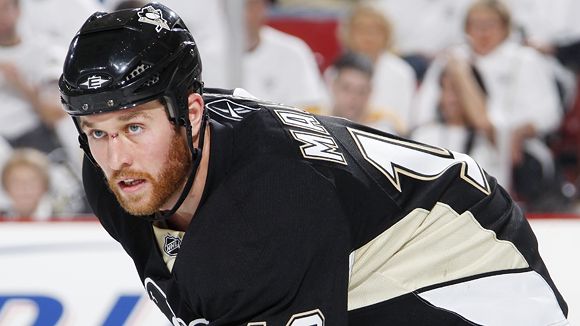
PITTSBURGH -- When Ryan Malone looks up at the worn, empty seats at Mellon Arena, he doesn't see an aging hockey mausoleum, but rather something more comforting, something more closely akin to home.
Up there, near the private boxes, is where Malone and his younger brother Mark played hide-and-seek. Beyond the boxes was where they rollerbladed while their father, Greg, worked in the offices beneath the stands as the director of amateur scouting.
Out of sight, in the Penguins dressing room, is where NHL players quizzed the young Malone boys on how many pieces of gum they could cram in their mouth at the same time.
Just a few feet away, where the ice surface is now quiet and clean, is where Ryan, Mark and Greg played shinny with the kids of Pittsburgh icons such as Craig Patrick and Ed Johnston after Penguins practices.
"I can remember taking the diaper bag and taking them to the rink," Greg Malone recently told ESPN.com.
Many pro hockey players move in a straight line -- a dominating star in some small town, moving steadily forward to bigger and better things, the past and future somewhere else.
Ryan Malone's path to NHL stardom is more circular. The first and only Pittsburgh native to be drafted by and play for the Pittsburgh Penguins, Malone is, in many ways, this city, and the city is him.
At first glance, the 28-year-old is raw and tough with a tattoo-festooned body and fiery red hair. But that's not all there is to Malone, much like this blue-collar city with its hard ways and surprisingly beautiful waterfront and hidden architectural gems.
Every once in awhile, Malone will run into someone he went to high school with or played minor hockey against. "It's like, 'Hey, I remember playing against you,'" he said.
And then, maybe he gets a look of surprise or admiration or, heck, maybe even disbelief. But that's OK; Malone never imagined this is where his life would take him, never imagined he'd come home and be part of one of the great sports revivals in recent memory.
"It is weird," Malone said in a recent interview from the Mellon Arena seats. "Honestly, whenever I pull the sweater on, I look at it as a privilege and an honor."
When local All-Star teams were picked to play in tournaments in other cities, it wasn't a given Ryan would make the team. He often didn't. He tried out for the amateur Penguins team and made their "B" squad.
It didn't stop Malone from being on the ice all the time. He played high school and club hockey. Some days, he wouldn't get home until 11 p.m., which made it difficult to concentrate on school. "The last thing you feel like doing is school work," Malone said.
So, with marks an issue and hockey a dream, Malone talked to his dad about what he should do. For his junior year of high school, Malone attended Shattuck-St. Mary's, the hockey prep factory in Faribault, Minn., before heading to Omaha of the United States Hockey League.
Who knows what you think when you're 15 or 16 years old. Who knows what you think is possible or what you understand to be impossible. Being an NHL player and competing for the Stanley Cup didn't seem to be in the realm of possibility for Malone.
"I never thought at all I could make it," he said. "No one from Pittsburgh had ever been drafted or even went to Division I," Malone said. "We thought [playing on the Junior B team] was great because we didn't really know anything else."
As a scout, Greg understands the dream and the reality often exist on different planes for young hockey players.
"I don't think anybody should take [the dream] away and say, 'No, you're not good enough,'" Greg said. "I tell them, 'Take it as far as you can and be honest with yourself.'"
As for his son, Greg was pragmatic about Ryan's chances of playing pro hockey. In his mid-teens, Ryan was 6-foot-3, but only 170 pounds.
"He was really, really thin and he ate like a horse," Greg said. "I was more interested in him getting a scholarship and continuing to play hockey because that what he wanted to do."
Ryan ended up at Minnesota Hockey Camps, the brainchild of legendary U.S. national team coach Herb Brooks. Brooks established the camp at a former family resort near Brainerd, Minn., as a way of capitalizing on the growth of the game following the "Miracle on Ice" gold-medal win at the 1980 Olympics.
But this was no skate/swim/tan summer hockey experience; this was boot camp for the skate set. Malone, who gave up a promising baseball career to concentrate on hockey, went for seven weeks that first time. His mom called after the first week and asked him if he was having fun. "No," he told her.
He couldn't sit down his body ached so much. He couldn't go up stairs he was in such pain from the workouts. "It was awesome," he said.
He has been there pretty much every year since. Last summer, he was there for two weeks working out with NHLers Matt Greene and Scott Hartnell, among others.
"Ryan was probably a little bit behind at that time for his age," recalled camp co-founder Chuck Grillo, who continues to run the camps every summer. "He was in catch-up-and-pass mode. That's a monumental task. It takes unbelievable commitment.
"Right now, I would say he went from being one of the lower-end players in his age group in terms of ability [to one of the best]. He always had great hands and a good mind for the game."
A self-made hockey player?
"That's exactly what he did," Grillo said. "It would take a real special person to do what he did. And he's not done. He's only going to get better."
Malone ended up getting a scholarship to St. Cloud State, where he thought of little else beyond hockey. He thought about it so much, he forgot to pay his parking tickets. Oh, and Malone's truck was registered in his father's name, so those tickets steadily made their way back to Greg.
"He got a lot of parking tickets. I would get them all," Greg said. "I kept a ledger of them, and when he turned pro, I said, 'Here you go.'"
Ryan did just enough at school to keep his hockey plans on track. His parents would sometimes ask, "What about after college?"
"I didn't really have a back-up plan. I sort of had a one-track mind," Malone said. "It was all about playing hockey. The only thing that really mattered to me was hockey. When hockey wasn't going good, I didn't know how to leave it at the rink."
Although he was injured his senior year, Malone figured he was on some teams' radar, including the Penguins. He worked on his skating, defense and upper-body strength. He was faster, stronger (like an Olympics ad), and headed to Boston for the 1999 draft to see what would happen.
Greg Malone hails another blue-collar town, the Miramichi area of New Brunswick in Atlantic Canada. He was drafted by the Penguins (19th overall) in the 1976 draft and played 704 NHL games and scored a career-high 35 goals in 1978-79.
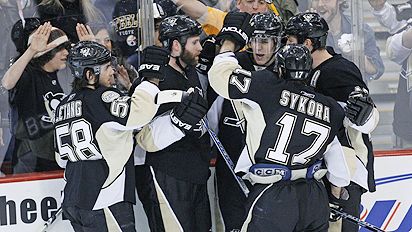
Ryan Malone, center, has played with Petr Sykora, left, and Evgeni Malkin for the latter part of this season to help form one of the Penguins' more potent lines.
He stayed with the organization after he retired, working as a scout and trying to spend as much time with the boys as possible after he and their mother split up when they were little.
"They were the main reason I stayed here," said the elder Malone, who is now a scout for the Phoenix Coyotes, but still lives in Pittsburgh.
A handful of rinks sprung up after Mario Lemieux saved the team the first time in the early 1980s, but the local minor hockey scene was still underdeveloped when the Malone boys were growing up.
"We used to have to practice at 4 in the morning," Greg said. "You'd come back home and go back to bed. It was almost like a dream."
Much like the day Ryan Malone was drafted.
Down on the draft floor, Greg and the rest of the Penguins draft team were prepping. The third round came around and the Pens were interested in Malone; but they also needed a goaltender and ended up taking Sebastien Caron. But, in the next round, there was more discussion about Malone and the decision was finally made -- Ryan Malone would be a Penguin.
But Greg, who always called out the draft selections for the Penguins, refused to do it.
"I said, 'I'm not doing it.' Herb Brooks [then a scout for the team] was the one who grabbed the mike and made the announcement in Boston," Greg said.
"I didn't think it was special at the time," he added. "I was just thinking about the draft, thinking about my job. Afterwards, that night and even the next morning, it started to sink in. 'Holy cow, Ryan got drafted by the Pittsburgh Penguins.'"
Although it's not unusual for young players to be drafted by teams for whom their fathers work, it does provide some incentive. "He was going to prove to everybody that he wasn't a 'daddy pick,'" Greg said. "I think it really pushed him."
Ryan Malone remains one of the most popular guys in the Penguins dressing room because of his upbeat nature. In fact, former road roommate Brooks Orpik acknowledged that the perpetual grin can sometimes drive teammates a bit crazy if things aren't going well.
But if the Penguins have had to mature quickly, almost defiantly as they march into their first Stanley Cup finals since 1992, Malone has also evolved.
Malone was a player with a reputation for loving a good time, so he spent time last offseason talking to coach Michel Therrien and GM Ray Shero about what he was going to be to the team. Malone had seen his goal totals drop from 22 in both 2003-04 and 2005-06 to 16 last season after missing 18 games to injury.
The message was simple: It's one thing to be a decent player on a bad team, which the Penguins were when Malone arrived. It's quite another to be a good player on a good (maybe great) team, which the Penguins are now. The choice was up to Malone.
So, he put in the work and went from being a happy-go-lucky Penguin to being a front-line player on a team full of front-line players.
Malone found himself playing with Evgeni Malkin and Petr Sykora for the latter part of the season, and collected a career-best 27 goals. He became a staple on the Penguins' power play, scoring 11 times. He kills penalties. In 27 of his past 34 regular-season games, Malone played 20 minutes or more. In his first 41 games this season, he hit the 20-minute mark just twice. In the postseason, he has 15 points in 14 games and is a plus-6.
"The first time I saw Ryan Malone, I saw his potential," Therrien said. "And he's got tons of potential, but I don't think he realized it. There was some tough love with him at the beginning because I realized the potential that he's got.
"All the credit goes to him because, you know what, he's focusing a lot more than he was. He's playing a tough game. He's disciplined on and off the ice and he understands what it takes to be a true professional, and that's why this is what I respect about Ryan right now."
Married to his college sweetheart, whom he met while she was tending bar at St. Cloud State ("I was like, 'I'm going to marry that girl.' And I did," Malone said with a laugh), the couple had their first child, William Ryan Malone, three months ago. Young Will has been a constant reminder that the game is not life.
"You're doing this for them as well as for yourself," Ryan said.
In the offseason, Malone's life might change again as a potential unrestricted free agent. His combination of grit, skill and size will make him a coveted asset on the open market. Given the pressures on Shero to keep his core of talent in place, there are many who believe Malone will be hard to re-sign. Still, it's hard to imagine both he and the Penguins won't try to get a deal done.
"This has been a career year for him, obviously," Shero said. "This has been a perfect storm for him, family-wise, career-wise."
From hide-and-seek to his own place of business, the distance between here and there appears short; but Malone knows the true length of the journey.
Scott Burnside is the NHL writer for ESPN.com.
Pittsburgh's Own
Malone just like Pittsburgh -- blue-collar tough, hometown proud

PITTSBURGH -- When Ryan Malone looks up at the worn, empty seats at Mellon Arena, he doesn't see an aging hockey mausoleum, but rather something more comforting, something more closely akin to home.
Up there, near the private boxes, is where Malone and his younger brother Mark played hide-and-seek. Beyond the boxes was where they rollerbladed while their father, Greg, worked in the offices beneath the stands as the director of amateur scouting.
Out of sight, in the Penguins dressing room, is where NHL players quizzed the young Malone boys on how many pieces of gum they could cram in their mouth at the same time.
Just a few feet away, where the ice surface is now quiet and clean, is where Ryan, Mark and Greg played shinny with the kids of Pittsburgh icons such as Craig Patrick and Ed Johnston after Penguins practices.
"I can remember taking the diaper bag and taking them to the rink," Greg Malone recently told ESPN.com.
Many pro hockey players move in a straight line -- a dominating star in some small town, moving steadily forward to bigger and better things, the past and future somewhere else.
Ryan Malone's path to NHL stardom is more circular. The first and only Pittsburgh native to be drafted by and play for the Pittsburgh Penguins, Malone is, in many ways, this city, and the city is him.
At first glance, the 28-year-old is raw and tough with a tattoo-festooned body and fiery red hair. But that's not all there is to Malone, much like this blue-collar city with its hard ways and surprisingly beautiful waterfront and hidden architectural gems.
Every once in awhile, Malone will run into someone he went to high school with or played minor hockey against. "It's like, 'Hey, I remember playing against you,'" he said.
And then, maybe he gets a look of surprise or admiration or, heck, maybe even disbelief. But that's OK; Malone never imagined this is where his life would take him, never imagined he'd come home and be part of one of the great sports revivals in recent memory.
"It is weird," Malone said in a recent interview from the Mellon Arena seats. "Honestly, whenever I pull the sweater on, I look at it as a privilege and an honor."
When local All-Star teams were picked to play in tournaments in other cities, it wasn't a given Ryan would make the team. He often didn't. He tried out for the amateur Penguins team and made their "B" squad.
It didn't stop Malone from being on the ice all the time. He played high school and club hockey. Some days, he wouldn't get home until 11 p.m., which made it difficult to concentrate on school. "The last thing you feel like doing is school work," Malone said.
And about those tattoos …
So, about the tattoos.
"They're a bad habit. I love them," Malone said.
Think Ray Bradbury's "The Illustrated Man" and you've got a sense of the body art that covers most of Malone's body (at least the parts that are revealed during the normal course of business in a hockey dressing room).
He and his wife have matching tattoos with a giant rose motif, although they stopped short of having each other's names tattooed on the design. "We didn't want to jinx it," Malone said.
Malone and his brother Mark have matching tattoos of the family's Irish crest.
There is now the date of his wedding and his son Will's birthday.
Malone insists that if the Penguins win a Stanley Cup, he will lead all his teammates in getting matching tattoos of the Cup.
They'd better get that Cup soon, joked former road roomie Brooks Orpik. "He's running out of room."
So, with marks an issue and hockey a dream, Malone talked to his dad about what he should do. For his junior year of high school, Malone attended Shattuck-St. Mary's, the hockey prep factory in Faribault, Minn., before heading to Omaha of the United States Hockey League.
Who knows what you think when you're 15 or 16 years old. Who knows what you think is possible or what you understand to be impossible. Being an NHL player and competing for the Stanley Cup didn't seem to be in the realm of possibility for Malone.
"I never thought at all I could make it," he said. "No one from Pittsburgh had ever been drafted or even went to Division I," Malone said. "We thought [playing on the Junior B team] was great because we didn't really know anything else."
As a scout, Greg understands the dream and the reality often exist on different planes for young hockey players.
"I don't think anybody should take [the dream] away and say, 'No, you're not good enough,'" Greg said. "I tell them, 'Take it as far as you can and be honest with yourself.'"
As for his son, Greg was pragmatic about Ryan's chances of playing pro hockey. In his mid-teens, Ryan was 6-foot-3, but only 170 pounds.
"He was really, really thin and he ate like a horse," Greg said. "I was more interested in him getting a scholarship and continuing to play hockey because that what he wanted to do."
Ryan ended up at Minnesota Hockey Camps, the brainchild of legendary U.S. national team coach Herb Brooks. Brooks established the camp at a former family resort near Brainerd, Minn., as a way of capitalizing on the growth of the game following the "Miracle on Ice" gold-medal win at the 1980 Olympics.
But this was no skate/swim/tan summer hockey experience; this was boot camp for the skate set. Malone, who gave up a promising baseball career to concentrate on hockey, went for seven weeks that first time. His mom called after the first week and asked him if he was having fun. "No," he told her.
He couldn't sit down his body ached so much. He couldn't go up stairs he was in such pain from the workouts. "It was awesome," he said.
He has been there pretty much every year since. Last summer, he was there for two weeks working out with NHLers Matt Greene and Scott Hartnell, among others.
"Ryan was probably a little bit behind at that time for his age," recalled camp co-founder Chuck Grillo, who continues to run the camps every summer. "He was in catch-up-and-pass mode. That's a monumental task. It takes unbelievable commitment.
"Right now, I would say he went from being one of the lower-end players in his age group in terms of ability [to one of the best]. He always had great hands and a good mind for the game."
A self-made hockey player?
"That's exactly what he did," Grillo said. "It would take a real special person to do what he did. And he's not done. He's only going to get better."
Malone ended up getting a scholarship to St. Cloud State, where he thought of little else beyond hockey. He thought about it so much, he forgot to pay his parking tickets. Oh, and Malone's truck was registered in his father's name, so those tickets steadily made their way back to Greg.
"He got a lot of parking tickets. I would get them all," Greg said. "I kept a ledger of them, and when he turned pro, I said, 'Here you go.'"
Ryan did just enough at school to keep his hockey plans on track. His parents would sometimes ask, "What about after college?"
"I didn't really have a back-up plan. I sort of had a one-track mind," Malone said. "It was all about playing hockey. The only thing that really mattered to me was hockey. When hockey wasn't going good, I didn't know how to leave it at the rink."
Although he was injured his senior year, Malone figured he was on some teams' radar, including the Penguins. He worked on his skating, defense and upper-body strength. He was faster, stronger (like an Olympics ad), and headed to Boston for the 1999 draft to see what would happen.
Greg Malone hails another blue-collar town, the Miramichi area of New Brunswick in Atlantic Canada. He was drafted by the Penguins (19th overall) in the 1976 draft and played 704 NHL games and scored a career-high 35 goals in 1978-79.
Ryan Malone, center, has played with Petr Sykora, left, and Evgeni Malkin for the latter part of this season to help form one of the Penguins' more potent lines.
He stayed with the organization after he retired, working as a scout and trying to spend as much time with the boys as possible after he and their mother split up when they were little.
"They were the main reason I stayed here," said the elder Malone, who is now a scout for the Phoenix Coyotes, but still lives in Pittsburgh.
A handful of rinks sprung up after Mario Lemieux saved the team the first time in the early 1980s, but the local minor hockey scene was still underdeveloped when the Malone boys were growing up.
"We used to have to practice at 4 in the morning," Greg said. "You'd come back home and go back to bed. It was almost like a dream."
Much like the day Ryan Malone was drafted.
Down on the draft floor, Greg and the rest of the Penguins draft team were prepping. The third round came around and the Pens were interested in Malone; but they also needed a goaltender and ended up taking Sebastien Caron. But, in the next round, there was more discussion about Malone and the decision was finally made -- Ryan Malone would be a Penguin.
But Greg, who always called out the draft selections for the Penguins, refused to do it.
"I said, 'I'm not doing it.' Herb Brooks [then a scout for the team] was the one who grabbed the mike and made the announcement in Boston," Greg said.
"I didn't think it was special at the time," he added. "I was just thinking about the draft, thinking about my job. Afterwards, that night and even the next morning, it started to sink in. 'Holy cow, Ryan got drafted by the Pittsburgh Penguins.'"
Although it's not unusual for young players to be drafted by teams for whom their fathers work, it does provide some incentive. "He was going to prove to everybody that he wasn't a 'daddy pick,'" Greg said. "I think it really pushed him."
Ryan Malone remains one of the most popular guys in the Penguins dressing room because of his upbeat nature. In fact, former road roommate Brooks Orpik acknowledged that the perpetual grin can sometimes drive teammates a bit crazy if things aren't going well.
But if the Penguins have had to mature quickly, almost defiantly as they march into their first Stanley Cup finals since 1992, Malone has also evolved.
Malone was a player with a reputation for loving a good time, so he spent time last offseason talking to coach Michel Therrien and GM Ray Shero about what he was going to be to the team. Malone had seen his goal totals drop from 22 in both 2003-04 and 2005-06 to 16 last season after missing 18 games to injury.
The message was simple: It's one thing to be a decent player on a bad team, which the Penguins were when Malone arrived. It's quite another to be a good player on a good (maybe great) team, which the Penguins are now. The choice was up to Malone.
So, he put in the work and went from being a happy-go-lucky Penguin to being a front-line player on a team full of front-line players.
Malone found himself playing with Evgeni Malkin and Petr Sykora for the latter part of the season, and collected a career-best 27 goals. He became a staple on the Penguins' power play, scoring 11 times. He kills penalties. In 27 of his past 34 regular-season games, Malone played 20 minutes or more. In his first 41 games this season, he hit the 20-minute mark just twice. In the postseason, he has 15 points in 14 games and is a plus-6.
"The first time I saw Ryan Malone, I saw his potential," Therrien said. "And he's got tons of potential, but I don't think he realized it. There was some tough love with him at the beginning because I realized the potential that he's got.
"All the credit goes to him because, you know what, he's focusing a lot more than he was. He's playing a tough game. He's disciplined on and off the ice and he understands what it takes to be a true professional, and that's why this is what I respect about Ryan right now."
Married to his college sweetheart, whom he met while she was tending bar at St. Cloud State ("I was like, 'I'm going to marry that girl.' And I did," Malone said with a laugh), the couple had their first child, William Ryan Malone, three months ago. Young Will has been a constant reminder that the game is not life.
"You're doing this for them as well as for yourself," Ryan said.
In the offseason, Malone's life might change again as a potential unrestricted free agent. His combination of grit, skill and size will make him a coveted asset on the open market. Given the pressures on Shero to keep his core of talent in place, there are many who believe Malone will be hard to re-sign. Still, it's hard to imagine both he and the Penguins won't try to get a deal done.
"This has been a career year for him, obviously," Shero said. "This has been a perfect storm for him, family-wise, career-wise."
From hide-and-seek to his own place of business, the distance between here and there appears short; but Malone knows the true length of the journey.
Scott Burnside is the NHL writer for ESPN.com.

- pitt
- Posts: 27093
- Joined: 03/12/2002 00:00
- Location: Steelers Nation
#547 Re: Stocharov i Pittov NHL kutak
Savior

Some expect Crosby to elevate NHL in first Cup finals, but is that fair?
There is a sense that an enormous opportunity is at hand for the National Hockey League with this year's Stanley Cup finals.
Perhaps, just perhaps, it's the most significant chance for the NHL's Great Leap Forward since the New York Rangers snared the Stanley Cup in 1994, an opportunity squandered through a host of problems, including a deadly boring style of game, labor issues, reckless expansion and an inability to cement a major U.S. television presence.

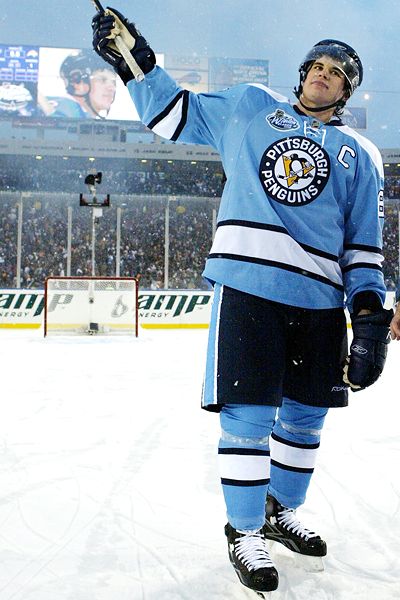
Sidney Crosby's Winter Classic shootout winner drew raves even from casual hockey fans.
Fourteen years later, more than a few people are suggesting that what the Rangers and Broadway could not do, Sidney Crosby may be able to accomplish.
Poor kid, just 20 years of age. Labeled the next Wayne Gretzky before he played an NHL game, he's already been asked to save the Pittsburgh Penguins from insolvency and be the flag bearer for the "new NHL" as it emerged from the destructive lockout of 2004-05.
Now, with the Penguins about to face the Detroit Red Wings in a glitzy 2008 Stanley Cup finals filled with marquee names and intriguing story lines, Crosby, as the league's top individual marketing tool, is being asked to deliver a virtuoso performance that will somehow vault the NHL into a new level of success and profitability.
Oh yes, and be a humble, unselfish teammate at the same time while figuring out a way to outfox the Red Wings, merely the NHL's best team this season.
Sounds doable for a 20-year-old, yes?
Just over four months after providing the NHL with a wonderful Kodak moment -- his shootout winner in a snowstorm at the feel-good Winter Classic at Ralph Wilson Stadium in the suburbs of Buffalo -- Crosby arrives at his first Stanley Cup finals as the youngest to captain a team this far and the first NHLer with a national presence in the U.S. and Canada since, well, Gretzky.
Some even suggest that having Crosby in the Cup finals could give the NHL the same enormous boost in popularity the NBA received way back in 1984, when Magic Johnson of the Los Angeles Lakers and Larry Bird of the Boston Celtics met in that league's championship series.
The comparison is, at best, raw.
The Magic-Bird rivalry had actually been born five years earlier when their schools met in the 1979 NCAA title game, and then stretched out to opposite coasts to the powerful media markets of Los Angeles and Boston. In the early 1980s the NBA was, in some ways, almost a niche sport, with an outlaw, drug-infested image it could not shake, and the 1984 NBA Finals were a turning point.
Some credit Bird and Magic. Some credit the ascendancy to power of David Stern, who also became NBA commissioner in 1984. Many suggest the saving grace for the league was the institution of the salary cap, which arrived a year before Stern.
Most agree, however, that the 1984 Finals that went seven games before the Celtics prevailed provided a powerful gravitational force that pulled the rest of the NBA upward. Stern saw the power of promoting the stars and the globalization of the game, franchise values skyrocketed and the NBA entered a golden age.
Asking Crosby to provide an equivalent push over the next two weeks is, well, probably wholly unrealistic.
For starters, he's only one player. Bird and Magic had each other to double the impact. The NHL in 2008, meanwhile, isn't the NBA circa 1984. Then, the NBA was a largely untapped mine that needed organization, discipline and clear vision. Today's NHL has a veteran commissioner, an international presence and 12-18 solid franchises, yet its roots seem to go barely below the surface in the South and Southwest of the United States, salary costs are again on the rise and Detroit (an Original Six team and "Hockeytown" to some) has seen thousands of empty seats in the playoffs.
The NHL today is on more solid footing than the NBA was back then. But the North American sports and sports-media landscapes are infinitely more complex, and too often the NHL has seemed uncertain or aimless, unwilling to rely on the greatness of the game itself and the extraordinary athletes who play it.
Bird and Johnson, meanwhile, played a sport in which their excellence could be celebrated with noteworthy statistical achievements; Crosby labors in a league that, after an explosion of scoring in the first year after the lockout, has slowly gone back to a game in which defense trumps offense.
Indeed, the Penguins, while owning a host of talented attackers like Evgeni Malkin and Marian Hossa, have made it this far by becoming the NHL's best defensive team in the playoffs. Conceivably, Crosby could have a terrific final, provide tour de force moments throughout and end up scoring only two or three goals.
In other words, the ability of any NHL player to stir the imagination is, to some degree, limited by the nature of the modern game itself; the sport is still hidebound by the "Slap Shot" attitudes of those who prefer broken teeth and runnin' the goalie to speed, gorgeous goals and exhibitions of superb skill.
Crosby, meanwhile, plays in Pittsburgh, which doesn't quite pack the punching power of Boston or Los Angeles. The Penguins, because of poor on-ice performance and destructive ownership, were bankrupt and on the edge of moving out of town three years ago before team owner Mario Lemieux bailed out the franchise and helped forge an agreement with casino operators to fund a new hockey arena for the Pens.
Pittsburgh is the 22nd-largest TV market in the U.S., a town in which the football Steelers are king, and the NBA has not bothered to tread there since the days of the Pittsburgh Ironmen more than 60 years ago.
So Crosby's primary launching pad isn't quite equivalent to that of Bird or Magic, although the collaboration with Detroit enhances his potential reach, and Brett Favre surely proved that playing in Green Bay wasn't an impediment to fame.
Meanwhile, this gem of a Cup finals comes at a time when television ratings for the NHL, always strong in Canada but usually minuscule on a national basis in the U.S., have shown some significant upward trends in these playoffs on both NBC and Versus. In fact, only the Canadian Broadcasting Corporation, which carries "Hockey Night in Canada," has shown decreasing ratings so far this spring.
So maybe a few more eyeballs are watching. Some have probably heard about this Crosby kid, and maybe want to see what the fuss is all about, even if they still can't see that dang puck. Back in '84, however, they already knew who Bird and Magic were.
So, is Crosby, described by some as the NHL's franchise player, ready to lead the way?
Bird was 27 and Magic was 24 back in 1984, don't forget, while Crosby is in only his third NHL season. He won the NHL's Hart Trophy as league MVP last season, but this season he struggled with a problematic high-ankle sprain while Malkin led the Penguins offensively for key parts of the season and became a Hart Trophy finalist himself. Even in these playoffs, with both players healthy, Malkin has been the more dominant performer.
Personality-wise, Crosby is more Bird, who while a notorious trash-talker on the court was never perceived that way in public; effervescent Washington sniper Alexander Ovechkin is more Magic. That said, Crosby is also like Gretzky, soft-spoken and reserved, more inclined to shield himself under the umbrella of the team concept than be seen as an individual star courting attention.
Crosby fits nicely within the hockey culture, one in which loudmouth Sean Avery of the Rangers is seen as boorish and self-promoting.
But in 2008, will Ozzie and Harriet manners and throwback decency (Crosby still lives with Lemieux and his family, for goodness sakes!) be enough for the NHL to get what it wants out of this terrific Stanley Cup finals matchup?
Probably not. But if the hockey is good and the series is long and hard-fought, if the Red Wings can shake some of the attention away from the NBA's Pistons, if there is another special Crosby moment like there was on that wintry New Year's Day or in his rookie season when he signaled his arrival with a spectacular shootout goal against the Montreal Canadiens, there is the chance for the NHL to get back to where it thought it was in 1994.
It's extraordinary to consider what someone so young has already delivered to a league, particularly a league that in so many ways has been almost self-destructive over the past 15 years.
Crosby helped save the Penguins. He helped save the NHL from its own greed and stupidity.
Maybe he could be permitted to celebrate his 21st birthday (on Aug. 7, for those of you scoring at home) before being asked to deliver the NHL to the promised land.
Damien Cox, a columnist for The Toronto Star, is a regular contributor to ESPN.com. He is the author of "Brodeur: Beyond The Crease" and "67: The Maple Leafs, Their Sensational Victory, and the End of an Empire."
http://sports.espn.go.com/espn/flash/zo ... Id=3215922
Some expect Crosby to elevate NHL in first Cup finals, but is that fair?
There is a sense that an enormous opportunity is at hand for the National Hockey League with this year's Stanley Cup finals.
Perhaps, just perhaps, it's the most significant chance for the NHL's Great Leap Forward since the New York Rangers snared the Stanley Cup in 1994, an opportunity squandered through a host of problems, including a deadly boring style of game, labor issues, reckless expansion and an inability to cement a major U.S. television presence.

Sidney Crosby's Winter Classic shootout winner drew raves even from casual hockey fans.
Fourteen years later, more than a few people are suggesting that what the Rangers and Broadway could not do, Sidney Crosby may be able to accomplish.
Poor kid, just 20 years of age. Labeled the next Wayne Gretzky before he played an NHL game, he's already been asked to save the Pittsburgh Penguins from insolvency and be the flag bearer for the "new NHL" as it emerged from the destructive lockout of 2004-05.
Now, with the Penguins about to face the Detroit Red Wings in a glitzy 2008 Stanley Cup finals filled with marquee names and intriguing story lines, Crosby, as the league's top individual marketing tool, is being asked to deliver a virtuoso performance that will somehow vault the NHL into a new level of success and profitability.
Oh yes, and be a humble, unselfish teammate at the same time while figuring out a way to outfox the Red Wings, merely the NHL's best team this season.
Sounds doable for a 20-year-old, yes?
Just over four months after providing the NHL with a wonderful Kodak moment -- his shootout winner in a snowstorm at the feel-good Winter Classic at Ralph Wilson Stadium in the suburbs of Buffalo -- Crosby arrives at his first Stanley Cup finals as the youngest to captain a team this far and the first NHLer with a national presence in the U.S. and Canada since, well, Gretzky.
Some even suggest that having Crosby in the Cup finals could give the NHL the same enormous boost in popularity the NBA received way back in 1984, when Magic Johnson of the Los Angeles Lakers and Larry Bird of the Boston Celtics met in that league's championship series.
The comparison is, at best, raw.
The Magic-Bird rivalry had actually been born five years earlier when their schools met in the 1979 NCAA title game, and then stretched out to opposite coasts to the powerful media markets of Los Angeles and Boston. In the early 1980s the NBA was, in some ways, almost a niche sport, with an outlaw, drug-infested image it could not shake, and the 1984 NBA Finals were a turning point.
Some credit Bird and Magic. Some credit the ascendancy to power of David Stern, who also became NBA commissioner in 1984. Many suggest the saving grace for the league was the institution of the salary cap, which arrived a year before Stern.
Most agree, however, that the 1984 Finals that went seven games before the Celtics prevailed provided a powerful gravitational force that pulled the rest of the NBA upward. Stern saw the power of promoting the stars and the globalization of the game, franchise values skyrocketed and the NBA entered a golden age.
Asking Crosby to provide an equivalent push over the next two weeks is, well, probably wholly unrealistic.
For starters, he's only one player. Bird and Magic had each other to double the impact. The NHL in 2008, meanwhile, isn't the NBA circa 1984. Then, the NBA was a largely untapped mine that needed organization, discipline and clear vision. Today's NHL has a veteran commissioner, an international presence and 12-18 solid franchises, yet its roots seem to go barely below the surface in the South and Southwest of the United States, salary costs are again on the rise and Detroit (an Original Six team and "Hockeytown" to some) has seen thousands of empty seats in the playoffs.
The NHL today is on more solid footing than the NBA was back then. But the North American sports and sports-media landscapes are infinitely more complex, and too often the NHL has seemed uncertain or aimless, unwilling to rely on the greatness of the game itself and the extraordinary athletes who play it.
Bird and Johnson, meanwhile, played a sport in which their excellence could be celebrated with noteworthy statistical achievements; Crosby labors in a league that, after an explosion of scoring in the first year after the lockout, has slowly gone back to a game in which defense trumps offense.
Indeed, the Penguins, while owning a host of talented attackers like Evgeni Malkin and Marian Hossa, have made it this far by becoming the NHL's best defensive team in the playoffs. Conceivably, Crosby could have a terrific final, provide tour de force moments throughout and end up scoring only two or three goals.
In other words, the ability of any NHL player to stir the imagination is, to some degree, limited by the nature of the modern game itself; the sport is still hidebound by the "Slap Shot" attitudes of those who prefer broken teeth and runnin' the goalie to speed, gorgeous goals and exhibitions of superb skill.
Crosby, meanwhile, plays in Pittsburgh, which doesn't quite pack the punching power of Boston or Los Angeles. The Penguins, because of poor on-ice performance and destructive ownership, were bankrupt and on the edge of moving out of town three years ago before team owner Mario Lemieux bailed out the franchise and helped forge an agreement with casino operators to fund a new hockey arena for the Pens.
Pittsburgh is the 22nd-largest TV market in the U.S., a town in which the football Steelers are king, and the NBA has not bothered to tread there since the days of the Pittsburgh Ironmen more than 60 years ago.
So Crosby's primary launching pad isn't quite equivalent to that of Bird or Magic, although the collaboration with Detroit enhances his potential reach, and Brett Favre surely proved that playing in Green Bay wasn't an impediment to fame.
Meanwhile, this gem of a Cup finals comes at a time when television ratings for the NHL, always strong in Canada but usually minuscule on a national basis in the U.S., have shown some significant upward trends in these playoffs on both NBC and Versus. In fact, only the Canadian Broadcasting Corporation, which carries "Hockey Night in Canada," has shown decreasing ratings so far this spring.
So maybe a few more eyeballs are watching. Some have probably heard about this Crosby kid, and maybe want to see what the fuss is all about, even if they still can't see that dang puck. Back in '84, however, they already knew who Bird and Magic were.
So, is Crosby, described by some as the NHL's franchise player, ready to lead the way?
Bird was 27 and Magic was 24 back in 1984, don't forget, while Crosby is in only his third NHL season. He won the NHL's Hart Trophy as league MVP last season, but this season he struggled with a problematic high-ankle sprain while Malkin led the Penguins offensively for key parts of the season and became a Hart Trophy finalist himself. Even in these playoffs, with both players healthy, Malkin has been the more dominant performer.
Personality-wise, Crosby is more Bird, who while a notorious trash-talker on the court was never perceived that way in public; effervescent Washington sniper Alexander Ovechkin is more Magic. That said, Crosby is also like Gretzky, soft-spoken and reserved, more inclined to shield himself under the umbrella of the team concept than be seen as an individual star courting attention.
Crosby fits nicely within the hockey culture, one in which loudmouth Sean Avery of the Rangers is seen as boorish and self-promoting.
But in 2008, will Ozzie and Harriet manners and throwback decency (Crosby still lives with Lemieux and his family, for goodness sakes!) be enough for the NHL to get what it wants out of this terrific Stanley Cup finals matchup?
Probably not. But if the hockey is good and the series is long and hard-fought, if the Red Wings can shake some of the attention away from the NBA's Pistons, if there is another special Crosby moment like there was on that wintry New Year's Day or in his rookie season when he signaled his arrival with a spectacular shootout goal against the Montreal Canadiens, there is the chance for the NHL to get back to where it thought it was in 1994.
It's extraordinary to consider what someone so young has already delivered to a league, particularly a league that in so many ways has been almost self-destructive over the past 15 years.
Crosby helped save the Penguins. He helped save the NHL from its own greed and stupidity.
Maybe he could be permitted to celebrate his 21st birthday (on Aug. 7, for those of you scoring at home) before being asked to deliver the NHL to the promised land.
Damien Cox, a columnist for The Toronto Star, is a regular contributor to ESPN.com. He is the author of "Brodeur: Beyond The Crease" and "67: The Maple Leafs, Their Sensational Victory, and the End of an Empire."
http://sports.espn.go.com/espn/flash/zo ... Id=3215922
- pitt
- Posts: 27093
- Joined: 03/12/2002 00:00
- Location: Steelers Nation
#548 Re: Stocharov i Pittov NHL kutak
odrase nas u prvoj.......sasvim zasluzeno

-
bos
- Posts: 538
- Joined: 14/08/2006 00:51
- Location: Sarajevo
#549 Re: Stocharov i Pittov NHL kutak
Rekoh, haj bar ce Pingvini da poprave dan poslije pobjede onog ruskog gaya u Bjelogradu.
Iskreno se nadam da losije nece moci od ovoga u nastavku serije, ko da su se prepali one "strasne" atmosfere u Detroitu sta li.
Posebno ne bi valjalo da odu Wingsi na 2-0 ...
Iskreno se nadam da losije nece moci od ovoga u nastavku serije, ko da su se prepali one "strasne" atmosfere u Detroitu sta li.
Posebno ne bi valjalo da odu Wingsi na 2-0 ...
- van Basten
- Posts: 7928
- Joined: 21/09/2006 02:59
#550 Re: Stocharov i Pittov NHL kutak
šta god da je bilo, nadati se da će se pingvini dozvati i malo dramatike unijeti u ovo finale, inače serija će završiti a da ni ne uđe u juni