
http://www.popsci.com/article/science/g ... SOC&dom=fb"I think it's fantastic, the most exciting research finding I've read in the last decade," Jonathan Losos, an evolutionary biologist at Harvard University who was not involved in the new research, told Weiner. The finding tops off decades of field observations that have provided crucial empirical evidence supporting the theory of evolution. Before Peter and Rosemary Grant of Princeton University began publishing their work, scientists didn't think evolution happened quickly enough for one researcher to watch it happen in his or her lifetime.
Evolucija
-
NIN

- Posts: 6187
- Joined: 15/02/2006 20:18
- Location: Via Lactea, Orion Arm
#5201 Re: Evolucija
Galapagos Scientists May Have Witnessed The Birth Of A New Species
-
BHCluster

- Posts: 23465
- Joined: 13/09/2007 18:41
- Location: Time to get schwifty in here!
- Contact:
#5202 Re: Evolucija

Jeste li ikada vidjeli lepše stablo života?
-
NIN
- Posts: 6187
- Joined: 15/02/2006 20:18
- Location: Via Lactea, Orion Arm
#5203 Re: Evolucija
Odlicno koncipirano! Pogotov mi se svidja kako su masovna unistenja postavili i predstavili.
-
GAU8

- Posts: 9145
- Joined: 05/01/2011 09:18
#5204 Re: Evolucija
Mogli su ih samo malo uočljivije predstaviti. Recimo završetak grane koja je izumrla da ima crvenu točkicu. Više bi upadalo u očiNIN wrote:Odlicno koncipirano! Pogotov mi se svidja kako su masovna unistenja postavili i predstavili.
-
statixx
- Posts: 9936
- Joined: 15/12/2011 14:40
- Location: Sarajevo
#5205 Re: Evolucija
Lijep članka za pročitati. Sadrzi odredjene zanimljivosti 25 godina dugackog evolucijskog eksperimenta Ricarda Lenskog i nekih drugih.
If the World Began Again, Would Life as We Know It Exist?
Experiments in evolution are exploring what would happen if we rewound the tape of life.
By Zach Zorich
If the World Began Again, Would Life as We Know It Exist?
Experiments in evolution are exploring what would happen if we rewound the tape of life.
By Zach Zorich
http://nautil.us/issue/14/mutation/if-t ... w-it-existEvery few months for the past 26 years, he or one of his students has frozen a sample of the bacteria. This archive of frozen microbes gives Lenski the ability to replay E. coli’s tape of life from any point he wishes, simply by thawing out the samples. Along the way, he can examine how the bacteria change both genetically and in ways that are visible under a microscope. Lenski says, “The whole experiment was set up to test how reproducible evolution was.”
In 2003, another contingent event took place. The number of E. coli in one of the flasks increased to the point where the normally translucent nutrient solution turned cloudy. At first Lenski thought that the flask had been contaminated, but it turned out that the E. coli, which normally just feed on glucose in the solution, had developed a way to consume a different chemical in the flasks, called citrate. After 15 years, or 31,500 generations, just one of the populations was able to consume the substance.2 Its population size quickly expanded by a factor of five.
This “historical contingency” gave Lenski and his graduate student Zachary Blount a chance to examine the likelihood that it would happen again if they rewound the tape. Blount went to the archive of frozen E. coli, and selected 72 samples collected at different periods in the experiment from the population that later evolved citrate metabolism. He thawed them out, and let them grow. Eventually, four out of the 72 samples acquired the ability. What’s more, the mutations only occurred in populations that had been frozen after 30,500 generations. Genetic analysis showed that several genes had undergone mutations that “potentiated” the evolution of citrate metabolism before that point. In other words, the ability to consume citrate was contingent upon other mutations that had come before it. Those formed a fork in the road, altering the path that generations after would be able to travel.
The early, bad mutations were essential to the fitness of later generations, perhaps because they added to the genetic variation that later random mutations could act upon.
-
statixx
- Posts: 9936
- Joined: 15/12/2011 14:40
- Location: Sarajevo
#5206 Re: Evolucija
Was the Golden Rule Born in the Mind of a Monkey?

Cijeli tekst:
http://nautil.us/blog/was-the-golden-ru ... f-a-monkey
1:55The video illustrates a famous 2003 experiment by de Waal and his colleague Sarah Brosnan. It begins with a capuchin monkey being rewarded with a cucumber slice for handing a rock to the experimenter. The monkey happily performs this task and collects her payment—until the monkey next to her is given a more desirable reward, a grape, for the same job. The first monkey then flings the unappetizing cucumber from her cage. In the study, the monkeys often refused to hand over a rock if they saw the other monkey get grapes while they themselves continued to get cucumbers.
Cijeli tekst:
http://nautil.us/blog/was-the-golden-ru ... f-a-monkey
-
Rampage

- Posts: 3196
- Joined: 07/08/2013 10:56
#5207 Re: Evolucija
BHCluster wrote:
Jeste li ikada vidjeli lepše stablo života?
Kako su samo bakterije zeznute, njima vrijeme baš ništa ne može
-
harač

- Posts: 5273
- Joined: 13/02/2006 13:30
-
BHCluster
- Posts: 23465
- Joined: 13/09/2007 18:41
- Location: Time to get schwifty in here!
- Contact:
-
apsidejzi

- Posts: 9947
- Joined: 25/05/2013 23:49
#5210 Re: Evolucija
Nesto mi pade na pamet a ne mogu se sjetiti da sam citao o tome pa rekoh da ovdje priupitam
Kako je doslo do prelaska sa jednocelijskog na visecelijski organizam? Jednocelijski organizmi imaju sve organele neophodne za zivot i razumljivo je da je DNA uzrok tome. Visecelijski organizmi imaju celije koje su podijelile funkciju izmedju. To znaci da celija iz visecelijskog organizma ima DNA da bude bilo koja celija u tijelu ali u zavisnosti koji se geni aktiviraju i u zavisnosti od okolnih faktora koje proizvode ostale celije, ona se diferencira u celiju mozga, celiju srca i sl s tim da ona ne moze samostalno postojati. Jednocelijski organizmi samostalno postoje i sad je moje pitanje vezno za njihovu mogucnost podjele funkcije sa drugim celijama. Da li jednocelijski organizmi imaju vec ugradjenu DNA da funkcionisu kao visecelijski organizam.
Ne znam koliko sam se dobro izrazio, ali ono sto mene posebno interesuje jeste mehanizam prelaska sa jednocelijskog na visecelijski organizam. Pretpostavljam (a mozda upravo tu grijesim) da jednocelijski organizmi nemaju DNA koja ce ih diferencirati u celiju odredjenog organa visecelijskog organizma. Ako je to tako, onda je moralo nekada doci do odredjene mutacije koja je omogucila neki prelazni oblik. Moje misljenje je da to ne moze biti neka jednostavna mutacija posto je u pitanju strukturoloska promjena: iz stanja nezavisnosti se prelazi u stanje zavisnosti. Da li je moguc screnario u kojem se neki virus uvukao u genetski materijal bakterije i oni su onda koegzistirali kao neka BETA verzija dvocelijskog organizma...
Ne mogu se sjetiti da sam o ovome citao a nemam mogucnost guglanja trenutno o tome. Zato me interesuje da li ima neko ko zna iz glave neki detalj vise a ja cu provjeriti kada stignem.
Kako je doslo do prelaska sa jednocelijskog na visecelijski organizam? Jednocelijski organizmi imaju sve organele neophodne za zivot i razumljivo je da je DNA uzrok tome. Visecelijski organizmi imaju celije koje su podijelile funkciju izmedju. To znaci da celija iz visecelijskog organizma ima DNA da bude bilo koja celija u tijelu ali u zavisnosti koji se geni aktiviraju i u zavisnosti od okolnih faktora koje proizvode ostale celije, ona se diferencira u celiju mozga, celiju srca i sl s tim da ona ne moze samostalno postojati. Jednocelijski organizmi samostalno postoje i sad je moje pitanje vezno za njihovu mogucnost podjele funkcije sa drugim celijama. Da li jednocelijski organizmi imaju vec ugradjenu DNA da funkcionisu kao visecelijski organizam.
Ne znam koliko sam se dobro izrazio, ali ono sto mene posebno interesuje jeste mehanizam prelaska sa jednocelijskog na visecelijski organizam. Pretpostavljam (a mozda upravo tu grijesim) da jednocelijski organizmi nemaju DNA koja ce ih diferencirati u celiju odredjenog organa visecelijskog organizma. Ako je to tako, onda je moralo nekada doci do odredjene mutacije koja je omogucila neki prelazni oblik. Moje misljenje je da to ne moze biti neka jednostavna mutacija posto je u pitanju strukturoloska promjena: iz stanja nezavisnosti se prelazi u stanje zavisnosti. Da li je moguc screnario u kojem se neki virus uvukao u genetski materijal bakterije i oni su onda koegzistirali kao neka BETA verzija dvocelijskog organizma...
Ne mogu se sjetiti da sam o ovome citao a nemam mogucnost guglanja trenutno o tome. Zato me interesuje da li ima neko ko zna iz glave neki detalj vise a ja cu provjeriti kada stignem.
-
statixx
- Posts: 9936
- Joined: 15/12/2011 14:40
- Location: Sarajevo
#5211 Re: Evolucija
@apsidejzi
Dobro pitanje, ali buduci da su razlike izmedju celija eukariota i prokariota velike - tesko je uci u trag detaljima svake pojedinacne tranzicije, a s druge strane slicnosti upucuju na evoluciju jednih iz drugih.
Razlike se mogu vidjeti u strukturi, membrani, velicini, nacinu diobe i funkcijama, koje su dosta kompleksnije kod eukariota. Kompleksnost podrazumijeva veci utrosak energije i s tog aspekta mitohondrije, koje primajuci hranu od celije proizvode ATP molekule tj. hemijsku energiju, igraju vaznu ulogu u celijskoj respiraciji. Ovo je karakteristika koju prokarioti nemaju, kao i recimo nukleus koji moze skladistiti mnogo veci genom kod eukariota.
Pomenuo si endosimbiozu - ova teorija objasnjava postojanje mitihondrija u eukariotskim celijama, a ciji DNK je nalik onom u bakterijama.
Pokusat cu naci jedan lijep clanak koji sam nekad procitao, pa cu postaviti.
Dobro pitanje, ali buduci da su razlike izmedju celija eukariota i prokariota velike - tesko je uci u trag detaljima svake pojedinacne tranzicije, a s druge strane slicnosti upucuju na evoluciju jednih iz drugih.
Razlike se mogu vidjeti u strukturi, membrani, velicini, nacinu diobe i funkcijama, koje su dosta kompleksnije kod eukariota. Kompleksnost podrazumijeva veci utrosak energije i s tog aspekta mitohondrije, koje primajuci hranu od celije proizvode ATP molekule tj. hemijsku energiju, igraju vaznu ulogu u celijskoj respiraciji. Ovo je karakteristika koju prokarioti nemaju, kao i recimo nukleus koji moze skladistiti mnogo veci genom kod eukariota.
Pomenuo si endosimbiozu - ova teorija objasnjava postojanje mitihondrija u eukariotskim celijama, a ciji DNK je nalik onom u bakterijama.
Pokusat cu naci jedan lijep clanak koji sam nekad procitao, pa cu postaviti.
-
statixx
- Posts: 9936
- Joined: 15/12/2011 14:40
- Location: Sarajevo
#5212 Re: Evolucija
A M E R I C A N S C I E N T I S T
Giardia: A Missing Link between Prokaryotes and Eukaryotes
The emergence of eukaryotic cells was important in the evolution of complex multicellular life. But how did eukaryotes evolve?
By KAREN S KABNICK and DEBRA A PEATTIE
Giardia: A Missing Link between Prokaryotes and Eukaryotes
The emergence of eukaryotic cells was important in the evolution of complex multicellular life. But how did eukaryotes evolve?
By KAREN S KABNICK and DEBRA A PEATTIE
Cijeli clanak: http://www2.nau.edu/~gaud/bio372/class/ ... /giard.htmScientists often consult the fossil record when considering issues of evolution. In this matter, the record would appear to support some of the ideas of Cavalier-Smith. Prokaryotic cells were present on the earth 3.5 to 4 billion years ago, and eukaryotic cells did not appear until 1.4 to 1.5 billion years ago. Eukaryotic cells that contained mitochondria and were oxygen users, however, were not in evidence until as recently as 850 million years ago. Data from the fossil record reinforce the idea that primitive anaerobic eukaryotes arose from prokaryotes and then gave rise to more complex aerobic eukaryotes. This theory would gain even more credence if an appropriate anaerobic eukaryote could be identified, and indeed one has.
The Missing Link
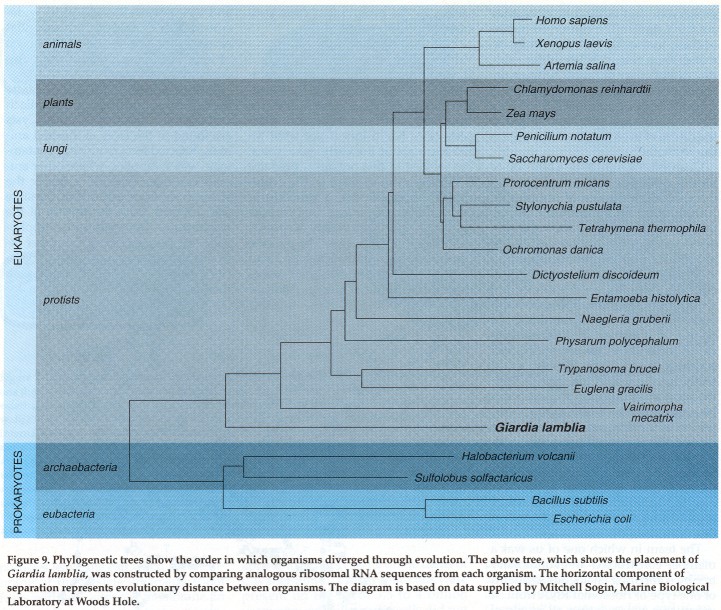
In 1987 Cavalier-Smith suggested that the single-celled, anaerobic eukaryote Giardia lamblia might in fact be the missing link. Giardia, he suggested, might be the anaerobic eukaryote that ingested an oxygen-using bacterium; this union could have yielded the first aerobic eukaryote, from which all others may have descended. He based his prediction on an analysis of the types and structures of the organelles in Giardia. One important observation is that Giardia lacks mitochondria and is an obligate anaerobe. In further support of this notion, experiments in which Giardia ingested a marker molecule visible in electron micrographs show that the organism is capable of endocytosing particles from the extracellular space. It is conceivable that Giardia could have taken up a mitochondrion-like organism in a similar manner.
The team in which one of us was a member constructed an evolutionary tree by comparing analogous segments of one type of ribosomal RNA from 54 organisms representing all levels of evolution. By this method we discovered that Giardia lamblia has a ribosomal-RNA sequence that is very close to that of prokaryotic cells. This Giardia ribosomal RNA shares more of its sequence with prokaryotes than does the corresponding RNA of any other eukaryote. Thus Giardia is evolutionarily closer to the prokaryotes than other eukaryotes are, and we can take this to mean that Giardia is a member of the earliest emerging eukaryotic lineage.
The amount of DNA in each cell, and its complexity, have been determined. Taken together, these data and other experiments suggest that each nucleus of Giardia is haploid; that is, each contains a single representation of the organism's genetic information. The entire trophozoite, which contains two nuclei, would therefore be diploid.
The diploid state can be greatly advantageous, and most highly evolved, complex organisms have adopted this arrangement. If a cell has only a single copy of genetic information, any alteration or mutation of that information could result in nonfunctional proteins, with dire and possibly lethal consequences for the cell. But if the cell has two sets of instructions and one of them becomes nonfunctional, the second set can serve as a backup, and may compensate for the loss of the first. Furthermore, if a segment of the first set undergoes a mutation that provides a new beneficial function, the other copy can still perform the original function. With only one set of instructions, the organism risks losing an existing function to gain a new one. Again, this could ultimately lead to the cell's demise. A diploid organism has the advantage of retaining the old while developing new, advantageous functions.
-
MeSko Hz

- Posts: 2157
- Joined: 17/09/2014 13:34
#5213 Re: Evolucija
Veoma zanimljivo i interesantno za vidjeti !BHCluster wrote:
Jeste li ikada vidjeli lepše stablo života?

-
__Phoenix__
- Posts: 2758
- Joined: 25/10/2013 20:44
#5214 Re: Evolucija
Ima li negdje interaktivna mapa kompletnog puta evolucije, treba mi za jedno dijete...
-
Byskell

- Posts: 59
- Joined: 15/07/2014 00:03
#5215 Re: Evolucija

"O zupčanicima obično mislimo kao o nečemu što se može vidjeti samo u mašinama koje su konstruisali ljudi, ali sada smo ustanovili da je to samo zato što nismo dovoljno gledali oko sebe." Gregori Saton
P.S. Evolucija na djelu...
-
nocnaptica986
- Posts: 401
- Joined: 24/10/2014 14:10
#5216 Re: Evolucija
stvar je jasna i neznam kako netko u 21 st moze dovesti u pitanje teoriju evolucije
mnogobrojni dokazi koji potvrdjuju ispravnost teorije evolucije su jasni i argumentovati za razliku od kreacionista koji nemaju niti jedan jedini dokaz za svoje tvrdnje,osim naravno,da trebamo vjerovati
mnogobrojni dokazi koji potvrdjuju ispravnost teorije evolucije su jasni i argumentovati za razliku od kreacionista koji nemaju niti jedan jedini dokaz za svoje tvrdnje,osim naravno,da trebamo vjerovati
-
Pandapp
- Posts: 20
- Joined: 07/11/2014 07:41
- Contact:
#5217 Re: Evolucija
Gledao sam...
Ova zena je nevjerovatna.
Ova zena je nevjerovatna.
-
statixx
- Posts: 9936
- Joined: 15/12/2011 14:40
- Location: Sarajevo
#5218 Re: Evolucija
News release, November 26, 2014
DNA survives critical entry into Earth’s atmosphere
The genetic material DNA can survive a flight through space and re-entry into the earth’s atmosphere – and still pass on genetic information. A team of scientists from UZH obtained these astonishing results during an experiment on the TEXUS-49 research rocket mission.
http://www.mediadesk.uzh.ch/articles/20 ... re_en.html
DNA survives critical entry into Earth’s atmosphere
The genetic material DNA can survive a flight through space and re-entry into the earth’s atmosphere – and still pass on genetic information. A team of scientists from UZH obtained these astonishing results during an experiment on the TEXUS-49 research rocket mission.
http://www.mediadesk.uzh.ch/articles/20 ... re_en.html
-
GaRGa
- Posts: 2836
- Joined: 25/02/2009 15:00
#5219 Re: Evolucija
Dobra je evolucija, samo ne kontam jel selektivna il joj pravo dugo treba...
http://www.iflscience.com/environment/s ... lion-years
http://www.iflscience.com/environment/s ... lion-years
-
hrastov žižak

- Posts: 4942
- Joined: 31/07/2012 02:00
#5220 Re: Evolucija
bezbeli i ne želiš skontat...to dvoje što si naveo uopće nisu u ili-ili opreci.GaRGa wrote:Dobra je evolucija, samo ne kontam jel selektivna il joj pravo dugo treba...
http://www.iflscience.com/environment/s ... lion-years
-
fortaleza

- Posts: 6220
- Joined: 05/03/2012 23:16
- Location: https://www.youtube.com/watch?v=Vh4QWmx50qA
#5221 Re: Evolucija
https://www.youtube.com/watch?v=c1ufK04tjOI
Evo jedan zanimljiv pogled na evoluciju te negacija iste objašnjena u nešto više od 30 minuta.
Evo jedan zanimljiv pogled na evoluciju te negacija iste objašnjena u nešto više od 30 minuta.
-
MyTao

- Posts: 7048
- Joined: 08/12/2012 15:15
#5222 Re: Evolucija
fortaleza wrote:https://www.youtube.com/watch?v=c1ufK04tjOI
Evo jedan zanimljiv pogled na evoluciju te negacija iste objašnjena u nešto više od 30 minuta.

-
Arminovski

- Posts: 1545
- Joined: 30/09/2005 19:05
- Location: Norma cluster
#5223 Re: Evolucija
Mogao je sve reci u 2,5 minuta...MyTao wrote:fortaleza wrote:https://www.youtube.com/watch?v=c1ufK04tjOI
Evo jedan zanimljiv pogled na evoluciju te negacija iste objašnjena u nešto više od 30 minuta.

-
pojedinac

- Posts: 1494
- Joined: 02/06/2006 19:02
- Contact:
#5224 Re: Evolucija
Možda smo mi ljudi nastali kad su vanzemaljci, nakon lutanja velikim prostranstvima svemira otkrili planetu Zemlju. Kako je planeta Zemlja pružala sve uslove za život odlučiše da se tu duže odmore. Pošto su već nekoliko svjetlosnih godina bili odsutni od kuće naravno nedostajao im je seks. Otkriće majmuna je uveliko olakšalo njihov problem. A, kako su i tada postojale razne vrste majmuna tako nastaše i razne rase ljudi.
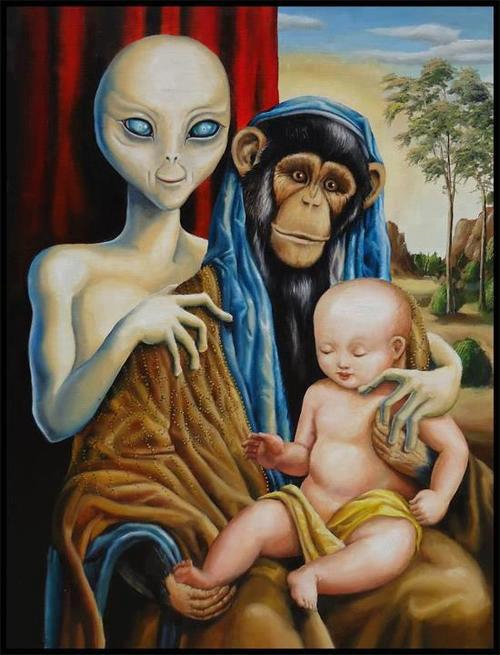
E, sad postavlja se pitanje ko stvori razne majmune?
Da ne idemo tako daleko pa da razmatramo postanak vanzemaljaca.

Ma, nemamo mi pojma ni jedni ni drugi.
Ostaje nam da i dalje lutamo.
E, sad postavlja se pitanje ko stvori razne majmune?
Da ne idemo tako daleko pa da razmatramo postanak vanzemaljaca.
Ma, nemamo mi pojma ni jedni ni drugi.
Ostaje nam da i dalje lutamo.
-
fortaleza
- Posts: 6220
- Joined: 05/03/2012 23:16
- Location: https://www.youtube.com/watch?v=Vh4QWmx50qA
#5225 Re: Evolucija
Nekako mi se čini da ako su vanzemaljska bića već toliko uznapredovala i putuju brzinama svjetlosti da se nisu pobrinuli za reprodukciju na neki drugačiji način ili se već osigurali. Logičnije je da su "donijeli život" s namjerom, a ne iz puke primitivne potrebe. Naravno, govorimo o Sci fi scenarijima.