Ad blocker detected: Our website is made possible by displaying online advertisements to our visitors. Please consider supporting us by disabling your ad blocker on our website.
World is a luxury lifestyle magazine loaded with a vibrant mix of words and pictures from top local and international writers and photographers on four main areas of interest; luxury living, travel, wine and food, and fine cars.
FOREIGN POLICY is the premier, award-winning magazine of global politics, economics, and ideas. Our mission is to explain how the world works -- in particular, how the process of global integration is reshaping nations, institutions, cultures, and, more fundamentally, our daily lives.
nadia wrote:Ja sam dosadna sa programiranjem...ali cekam danekom dosadim pa da zakaci link
Microsoft® Visual C#® .NET Step by Step: Version 2003
Programming with Microsoft Visual C++ .NET
by George Shepherd, David Kruglinski
Microsoft® Visual C++® .NET: Step by Step
by Julian Templeman, Andy Olsen
==============================
M'zoft Visual C++ .NET 2003 Kick Start (Paperback)
Kate Gregory
M'zoft Visual C++ .NET 2003 Kick Start is targeted toward developers interested in making the jump to .NET, working programmers already familiar with another programming language or the previous version of VS. Visual C++ .NET 2003 Kick Start speeds through basic concepts and focuses on practical examples and benefits of moving to VC++ .NET. This book explains how VC++ code interacts with the .NET Framework, the extra capabilities of VC++ compared to VB.NET and C# in .NET code interoperability, how to use Windows Forms (a new feature for VC++ .NET in the 2003 edition), and how to migrate from Visual Studio 6 and COM. The author covers the use of managed and unmanaged Visual C++ code, using both types for most examples. Full of code examples, tips, and professional insights, this book provides maximum learning with minimum investment of time and effort.
Book Description
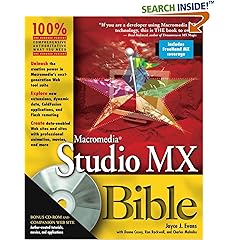
* Provides everything Web designers need to build cutting-edge applications with Macromedia's new tool suite, which includes Dreamweaver MX, Flash MX, ColdFusion MX, Fireworks MX, and Freehand
* Covers building data-enabled sites with Dreamweaver MX, creating Flash MX animations, working with ActionScript, creating Web graphics and animations with Fireworks MX, building interactive ColdFusion MX applications, integrating Flash and ColdFusion, and drawing vector art with Freehand
* Major changes in the Macromedia MX tool suite mean even veteran developers and programmers are looking for the updates this book provides
* CD-ROM includes trial versions of the software, extensions, sample databases, images and applications
Book Info
Comprehensive reference for using Macromedia Web development applications together. Helps beginner or new user get started and move quickly to intermediate & advanced topics. Provides in-depth course in each application: Freehand MX, Flash MX, Dreamweaver MX, Fireworks MX, and ColdFusion MX. Includes CD-ROM with author-created tutorials, extensions, and sample databases. Softcover.
Excellent book covers all aspects of Flash problems & solutions
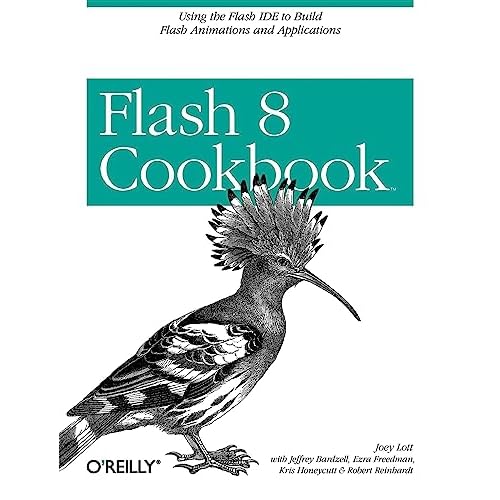
This book focuses primarily on how to use the Flash IDE to build Flash animations and applications, but additional Flash Platform technologies are discussed when deemed appropriate and within the scope of the book. This book is intended for anyone who wants to learn solutions to specific tasks using Flash regardless of experience. Like all books in O'Reilly's cookbook series, this book is not a typical reference book or training guide, thus it is assumed that you are already familiar with the basics of Flash. It is also assumed that if you are reading this book, you are most interested in Flash-based, authoring time, non-ActionScript solutions. For example, it is technically possible to animate programmatically with ActionScript; however, the non-ActionScript solution is emphasized in this book. It's possible that an ActionScript solution is either necessary or better in some circumstances, and, in those cases, the ActionScript solution is provided either by itself or in addition to a non-ActionScript solution. If you are looking for a book that focuses on ActionScript solutions, you probably want to look elsewhere. Thus, the vast majority of solutions provided for each "Recipe" are in the form of numbered steps that tell you which options within the Flash IDE to select. However, there are also detailed discussions in addition to the "How-To" steps for each recipe. The book starts out answering the most basic questions about drawing simple geometric shapes and proceeds on to topics such as interactivity, structuring and laying out movies, using 3D in flash, and animation. My favorite chapter is "Deploying Flash on Mobile Devices", since all published material on that subject is now very outdated. Amazon does not show the table of contents, so I do that here:
Chapter 1. Drawing in Flash
Chapter 2. Importing and Exporting Artwork
Chapter 3. Structuring Movies and Laying Out Content
Chapter 4. Creating Animation
Chapter 5. Simulating 3D in Flash
Chapter 6. Composing Images with Bitmaps and Masks
Chapter 7. Working with Text Basics
Chapter 8. Working with Dynamic Text
Chapter 9. Adding Interactivity
Chapter 10. Managing Playback
Chapter 11. Managing Movie Clips
Chapter 12. Creating Presentations and Slideshows
Chapter 13. Building Flash Forms
Chapter 14. Building Advanced Flash Forms
Chapter 15. Customizing UI Components
Chapter 16. Loading Images and Flash Content
Chapter 17. Working with Sound
Chapter 18. Working with Video
Chapter 19. Using Data
Chapter 20. Building Preloaders
Chapter 21. Publishing Flash
Chapter 22. Deploying Flash on Mobile Devices
Chapter 23. Making Movies Accessible
Macromedia Flash 8 A Tutorial Guide
This guide allows you to learn specific Flash skills step-by-step at your own pace. Choose from among several tutorials to develop the skills that are most appropriate to the Flash projects you are working on at any given time. Each lesson leads you through the workflow for implementing a specific real-world feature or effect in your Flash applications.
In Macromedia Flash 8: A Tutorial Guide, learn how to:
• Navigate the Flash workspace and use common document types
• Use the Flash drawing tools and create engaging graphic effects
• Use ActionScript to add interactivity and custom functionality to your documents
• Connect your Flash projects to external data sources to create data-driven applications
Powerful development and design tools require thorough and authoritative technical advice and documentation. When it comes to Macromedia Flash, no one is more authoritative than Macromedia’s own development and writing teams. Now their official documentation is available to you in printed book form. As you work, keep this guide by your side for ready access to valuable information on using Flash. We’ve designed it so that it’s easy to annotate as you progress.
Flash Professional 8 Essential Training
Flash Professional 8 Essential Training with Shane Rebenschied teaches new users how to use the drawing tools, swatches, and color panels in Flash 8. The course walks learners through animation processes, and how to integrate type, graphics, audio, and video. Shane teaches you how to use ActionScript for common projects such as creating slide shows, pop-up menus, and scrolling text. The training ends with instruction on how to publish to the Web or CD-ROM.
Rating: 5
I am already a Flash user but I picked up this title anyway because I always learn so much from Shane and knew he would help me learn all I need to know about this new version of Flash.
Once again he made it simple and fun to learn. I came away knowing so much about this new version and had absolutely NO issues moving my projects and working in Flash 8.
His instruction was clear and to the point with detailed yet easy examples and fun exercises. You will not find yourself doing a lot of backtracking or spending a lot of time going over the same movie tutorial trying to "get it". You will move through lessons smoothly and come away feeling comfortable diving into Flash 8.
anais_nin wrote:meni jos niko da nadje udzbenik ili kurs turskog jezika
bilo je to ljetos. Cak ima i tema o ucenju stranih jezika, pogledaj ovdje (strana 2 ovog podforuma inace, tema online ucenje stranih jezika, tako nekako):
anais_nin wrote:meni jos niko da nadje udzbenik ili kurs turskog jezika
bilo je to ljetos. Cak ima i tema o ucenju stranih jezika, pogledaj ovdje (strana 2 ovog podforuma inace, tema online ucenje stranih jezika, tako nekako):
Biochemistry
Jeremy M. Berg, John L. Tymoczko, Lubert Stryer
Publisher: W. H. Freeman; 6th edition
ISBN: 0716787245
Hm, evo u prvom prolazu sta zamijetih:
Lippincott's Illustrated Reviews: Biochemistry
ISBN: 0781722659
Title: Lippincott's Illustrated Reviews: Biochemistry (Lippincott's Illustrated Reviews)
Author: Pamela C. Champe Richard A., Ph.D. Harvey Denise R., Ph.D. Ferrier
Publisher: Lippincott Williams & Wilkins
Publication Date: 2004-07-26
Number Of Pages: 534
Book Info
(Benjamin Cummings) Oregon State Univ., Corvallis. Introductory textbook for students taking a one-year biochemistry course. Includes new chapters. Previous edition: c1996. The CD-ROM contains an outline, concepts, terminology, and quizzing sections. System requirements: Windows 95/98/NT or MacOS 7.6.1+.
About the Author
Christopher K. Mathews is Distinguished Professor and Chairman of the Department of Biochemistry and Biophysics at Oregon State University. Dr. Mathews was an Eleanor Roosevelt International Cancer Fellow at the Karolinska Institute in Stockholm in 1984-85 and Tage Erlander Guest Professor at Stockholm University in 1994-95. He has published several books and more than 125 scientific papers dealing with molecular virology, metabolic regulation, nucleotide enzymology, and biochemical genetics.
K.E. van Holde is Distinguished Professor Emeritus of Biophysics and Biochemistry at Oregon State University. Dr. van Holde's major research interest is the structure of chromatin; his work resulted in theaward of an American Cancer Society Research Professorship in 1977 and hiselection to the National Academy of Sciences in 1989. He has received Guggenheim, NSF, and EMBO Fellowships and is the author of two books and more than 175 scientific papers.
Kevin Ahern is a Senior Instructor in the Department of Biochemistry and Biophysics at Oregon State University, where he pioneered the development of Web-based courses for teaching biochemistry. He is a contributing editor to Science magazine and a columnist for Genetic Engineering News. He has edited two books, Biotechnology Software Reports - Computer Applications for Molecular Biologists and The Biotechnology Software Directory, A Buyer's Guide, and is the founder of DaVinci Press Ink, a scientific software consulting firm. Dr. Ahern's teaching experience includes undergraduate and graduate biochemistry courses.
This Thieme Flexibook presents the fundamentals of human and mammalian biochemistry in 192 stunning color plates. Key features include the unique combination of highly effective color graphics and comprehensive figure legends. Unified color-coding of atoms, coenzymes, chemical classes, and cell organelles allows quick recognition of all involved systems, and computer graphics provide simulated 3D representation of many important molecules. This Flexibook is ideal for students of all levels with its complete coverage of the structure and composition of biologically relevant molecules and their metabolism.--This text refers to an out of print or unavailable edition of this title.
Basic Concepts in Biochemistry: A Student's Survival Guide
Basic Concepts In Biochemistry: A Student's Survival Guide
Hiram F. Gilbert (McGrawHill 2nd Edition)
It is a book that offers help in two different ways—help in understanding
the concepts of biochemistry and help in organizing your attack on the
subject and minimizing the subject’s attack on you.
This book presents what are often viewed as the more difficult concepts
in an introductory biochemistry course and describes them in
enough detail and in simple enough language to make them understandable.
We surveyed first- and second-year medical students at a national
student meeting asking them to list, in order, the parts of biochemistry
they found most difficult to understand. The winner (or loser), by far, was
integration of metabolism. Metabolic control, pH, and enzyme kinetics
ran closely behind, with notable mention given to molecular biology and
proteins.
Biochemistry texts and biochemistry professors are burdened with
the task of presenting facts, and the enormity of this task can get in the
way of explaining concepts. Since I don’t feel burdened by that necessity,
I’ve only outlined most of the facts and concentrated on concepts. My
rationale is that concepts are considerably easier to remember than facts
and that concepts, if appropriately mastered, can minimize the amount of
material that has to be memorized—you can just figure everything out
when required. In Basic Concepts in Biochemistry, central concepts are
developed in a stepwise fashion. The simplest cncepts provide a review
of what might have been forgotten, and the more complex concepts present
what might not have been realized.





 znam za taj link ali sam bila okasnila na njega...jer pise "link forbidden to be shared"


 ja jos turski cekam