boric wrote:Tripwire wrote:kekec wrote:
Ding-dong ti objasni, a evo malo i da ti se nacrta

(reda radi):
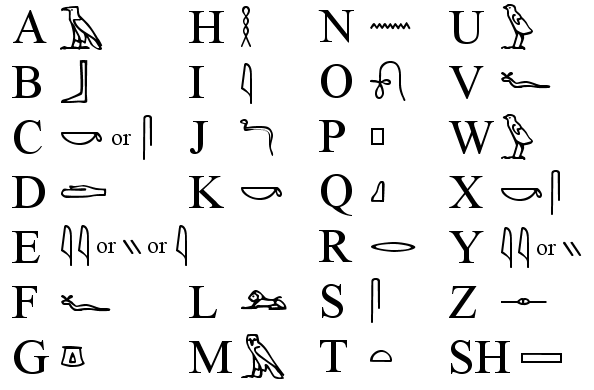
Kako sad razlikovat slova C od K i od X, E od I i od Y, F od V, U od W bas su mi nekako isti ovi znakovi

Mozes samo mislit kako su preveli silne natpise po egiptu .
ja tvrdim odgovorno da oni nisu nista preveli..ali jesu,jer bi bila sramota za nauku i tolike strucnjake da ostane neka tnajna nerijesena.da im se ugled ne sroza.ovo mu dodje sa ovim prijevodom kao kod policije,ako je nesposobna rijesiti neko misteriozno ubistvo,ona uhapsi nevina,sud ga proglasi krivim i tako spase obraz.
tvoji komentari na ovom forumu ne kvalifikuju te kao pretjerano inteligentnu niti obrazovanu osobu. prije bi bilo suprotno, tvoje pisanje o tebi govori vise kao o osobi skromne inteligencije i vise nego skromnog obrazovanja. stoga to sto ti tvrdis ili ne uopce nije relevantno. a i kad se pogleda dosta je smijesno. onakav kakav si i sam. ludnice su pune Napoleona, vanzemaljaca i neotkrivenih genija. takvih kakav si i ti sam.
nego, posto nauka dvije stotine godina obmanjuje naivne laike time da je desifrovala hijeroglife evo ti u prilog nekoliko slika ploce iz Rozete i malo sire obrazlozenje kako je doslo desifrovanja. kad i ako uopce zavrsis citanje brzo izadji pred supermarket i pokupi ona silna kolica koja su ostala iza musterija.
http://en.wikipedia.org/wiki/Rosetta_Stone

"The Rosetta Stone is dark grey-pinkish granite stone (originally thought to be basalt in composition) with writing on it in two languages, Egyptian and Greek, using three scripts, Hieroglyphic, Demotic Egyptian and Greek. Because Greek was well known, the stone was the key to deciphering the hieroglyphs.
Ptolemy V assumed the crown at the age of five after a rather turbulent time in Egyptian history. The young ruler was faced with the daunting task of reclaiming lands lost to various invaders and reunifying his country's populace. As an attempt to reestablish legitimacy for the ruler and create a royal cult, Ptolemy's priests issued a series of decrees. The decrees were inscribed on stones and erected throughout Egypt. The Rosetta stone is a copy of the decree issued in the city of Memphis.
The same Ptolemaic decree of 196 BC is written on the stone in the three scripts. The Greek part of the Rosetta Stone begins: Basileuontos tou neou kai paralabontos tēn basileian para tou patros... (Greek: Βασιλεύοντος του νέου και παραλαβόντος την βασιλείαν παρά του πατρός...) (The new king, having received the kingship from his father...) It is a decree from Ptolemy V, describing various taxes he repealed (one measured in ardebs (Greek artabai) per aroura), and instructing that statues be erected in temples and that the decree be published in the writing of the words of gods (hieroglyphs), the writing of the people (demotic), and the Wynen (Greek; the word is cognate with Ionian) language.
The Greeks had the habit of making bilinguals in territories they occupied, and in this case we have Egyptian, and Greek. Thus the Egyptian hieroglyphs, and the Egyptian Demotic (citizen text, as in democratic), was written against the Greek language, as the new occupiers of pharaonic rule, following Alexander the Great's conquest.
The Rosetta Stone is stone three in a series of three, a stone each for Ptolemy III, Ptolemy IV, and the Rosetta Stone, for Ptolemy V. Leap Year is implemented in Stone 1, the Stone of Canopus, for Ptolemy III.
There are approximately two copies of the Stone of Canopus; two of stone 2 (one imperfect), The Memphis Stele; and two and a half copies of the Rosetta Stone, including the Nubayrah Stele and a pyramid Wall inscription with edits because of being overwritten with scene replacements by subsequent scribes.
Condensed listing, the three decrees, the three-stone series
Multiple copies of the stones were erected in multiple temple courtyards, as specified in the text of the decrees.
239 BC Decree of Canopus (Ptolemy III), (247-221 BC)
stone 1: Stele of Canopus, (no. 1), found 1866, 37 lines hieroglyphs, 74 lines Demotic(right side), 76 lines Greek 'capitals', fine limestone.
stone 2: Stele of Canopus, no. 2, found 1881, 26 lines hieroglyphs, 20 lines Demotic, 64 lines Greek 'capitals', white limestone.
3rd partial of hieroglyphic lines (location: Louvre).
216 BC Decree of Memphis (Ptolemy IV), (221-203 BC)
stone 1: Stele No. 1, found 1902, hieroglyphs, demotic, and Greek, dark granite.
stone 2: Pithom Stele, No. II, found 1923, hieroglyphs (front), 42 lines Demotic (back), virtually complete providing almost total translation, and Greek (side), sandstone.
196 BC Decree of Memphis (Ptolemy V), (203-198 BC)
stone 1: Rosetta Stone, "Stele of Rosetta", found 1799, (remaining) hieroglyphs, 14 lines, 32 lines Demotic, 54 lines Greek 'capitals', dark granite.
stone 2: Stele of Nubayrah, found early 1880's, hieroglyphs, lines 1-27 used to complete missing Rosetta Stone lines, demotic, Greek capitals, limestone.
site 3: the Temple of Philae, inscribed hieroglyphs, for Decree of Memphis (Ptolemy V), on walls, also overwritten, by scenes, and figures of humans/gods.
Totals: 6 stones, or stelae, 1 partial, and one temple wall inscription writing.
History of the stone
The Rosetta Stone solved a particularly difficult linguistic problemFrench Captain Pierre-François Bouchard (sometimes spelled Boussard)(1772-1832) discovered the stone in the Egyptian port city of Rosetta (present-day Rashid) on July 15, 1799.
Some scientists [1] accompanied Napoleon's French campaign in Egypt (1798-1801). After Napoleon Bonaparte founded the Institut de l'Égypte in Cairo in 1798 some 50 became members of it. Bouchard found a black stone when guiding construction works in the Fort Julien near the city of Rosetta. He immediately understood the importance of the stone and showed it to General Abdallah Jacques de Menou who decided that it should be brought to the institute, where it arrived in August, 1799.
In 1801 the French had to surrender. A dispute arose about the results of the scientists—the French wishing to keep them, while the British considered them forfeit in the name of King George III.
The French scientist Étienne Geoffroy Saint-Hilaire, writing to the English diplomat William Richard Hamilton, threatened to burn all their discoveries, ominously referring to the burned Library of Alexandria. The British gave in and insisted only on the delivery of the monuments. The French tried to hide the Rosetta Stone in a boat despite the clauses of the capitulation, but failed. The French were allowed to take the imprints they had made previously, when embarking in Alexandria.
Experts inspecting the Rosetta Stone during the International Congress of Orientalists of 1874.When it was brought back to Britain, it was presented to the British Museum, where it has been kept since 1802.
In 1814, Thomas Young finished translating the enchorial (demotic) text, and went on to work on the hieroglyphic alphabet. Jean-François Champollion greatly expanded on his work during the years 1822–1824 and is known as the translator of the Rosetta Stone.
White painted inscriptions, contemporary with its acquisition, record on the left side 'Captured in Egypt by the British Army in 1801' and on the right 'Presented by King George III'. The stone was cleaned by the British Museum in 1998, and this evidence of its history was not removed. A small area of the surface at the bottom left-hand corner was also left uncleaned for comparative purposes.
In July 2003, the Egyptians demanded the return of the Rosetta Stone. Dr. Zahi Hawass, secretary general of the Supreme Council of Antiquities in Cairo, told the press: "If the British want to be remembered, if they want to restore their reputation, they should volunteer to return the stone because it is the icon of our Egyptian identity."
http://en.wikipedia.org/wiki/Rosetta_Stone
link iz British Museum o ploci iz Rozete
http://www.thebritishmuseum.ac.uk/compa ... on=summary
kratko objanjsenje o hijeroglifima:
"hieroglyph
The most well-known script used for writing the Egyptian language was in the form of a series of hieroglyphs (small signs). Each of these began as a picture of a real-world object, animal or person, or as the representation of a spoken sound. Early Egyptian hieroglyphs were religious texts carved into stone; the Greek word 'hieroglyph' means 'sacred' (hieros) and 'to carve in stone' (gluptein). Hieroglyphic writing died out in Egypt in the fourth century AD because it was considered unsuitable for Christian texts. "
Ploca iz Rozete, cijeli tekst:"The Rosetta Stone: translation of the demotic text
The Memphite Decree
[Year 9, Xandikos day 4], which is equivalent to the Egyptian month, second month of Peret, day 18, of the King 'The Youth who has appeared as King in the place of his Father', the Lord of the Uraei 'Whose might is great, who has established Egypt, causing it to prosper, whose heart is beneficial before the gods', (the One) Who is over his Enemy 'Who has caused the life of the people to prosper, the Lord of the Years of Jubilee like Ptah-Tenen, King like Pre', [the King of the Upper Districts and] the Lower Districts 'The Son of the Father-loving Gods, whom Ptah has chosen, to whom Pre has given victory, the Living Image of Amun', the Son of Pre 'Ptolemy, living forever, beloved of Ptah, the Manifest God whose excellence is fine', son of Ptolemy and Arsinoe, the Father-loving Gods, (and) the Priest of Alexander and the Saviour Gods and [the Brother-and-Sister Gods and the] Beneficent [Gods] and the Father-loving Gods and King Ptolemy, the Manifest God whose excellence is fine, Aetos son of Aetos; while Pyrrha daughter of Philinos was Prize-bearer before Berenice the Beneficent, while Areia daughter of Diogenes was [Basket]-bearer [before Arsi]noe the Brother-loving, and while Eirene daughter of Ptolemy was Priestess of Arsinoe the Father-loving: on this day, a decree of the mr-sn priests and the hm-ntr priests, and the priests who enter the sanctuary to perform clothing rituals for the gods, and the scribes of the divine book and the scribes of the House of Life, and the other priests who have come from the temples of Egypt [to Memphis on] the festival of the Reception of the Rulership by King Ptolemy, living forever, beloved of Ptah, the Manifest God whose excellence is fine, from his father, who have assembled in the temple of Memphis, and who have said:
Whereas King Ptolemy, living forever, the Manifest God whose excellence is fine, son of King Ptolemy [and Queen] Arsinoe, the Father-loving Gods, is wont to do many favours for the temples of Egypt and for all those who are subject to his kingship, he being a god, the son of a god and a goddess, and being like Horus son of Isis and Osiris, who protects his father Osiris, and his heart being beneficent concerning the gods, since he has given much money and much grain to the temples of Egypt, [he having undertaken great expenses] in order to create peace in Egypt and to establish the temples, and having rewarded all the forces that are subject to his rulership; and of the revenues and taxes that were in force in Egypt he had reduced some or(?) had renounced them completely, in order to cause the army and all the other people to be prosperous in his time as [king; the arrear]s which were due to the King from the people who are in Egypt and all those who are subject to his kingship, and (which) amounted to a large total, he renounced; the people who were in prison and those against whom there had been charges for a long time, he released; he ordered concerning the endowments of the gods, and the money and the grain that are given as allowances to their [temples] each year, and the shares that belong to the gods from the vineyards, the orchards, and all the rest of the property which they possessed under his father, that they should remain in their possession; moreover, he ordered concerning the priests that they should not pay their tax on becoming priests above what they used to pay up to Year 1 under his father; he released the people [who hold] the offices of the temples from the voyage they used to make to the Residence of Alexander each year; he ordered that no rower should be impressed into service; he renounced the two-thirds share of the fine linen that used to be made in the temples for the Treasury, he bringing into its [correct] state everything that had abandoned its (proper) condition for a long time, and taking all care to have done in a correct manner what is customarily done for the gods, likewise causing justice to be done for the people in accordance with what Thoth the Twice-great did; moreover, he ordered concerning those who will return from the fighting men and the rest of the people who had gone astray (lit. been on other ways) in the disturbance that had occurred in Egypt that [they] should [be returned] to their homes, and their possessions should be restored to them; and he took all care to send (foot)soldiers, horsemen, and ships against those who came by the shore and by the sea to make an attack on Egypt; he spent a great amount in money and grain against these (enemies), in order to ensure that the temples and the people who were in Egypt should be secure; he went to the fortress of Sk3n [which had] been fortified by the rebels with all kinds of work, there being much gear and all kinds of equipment within it; he enclosed that fortress with a wall and a dyke(?) around (lit. outside) it, because of the rebels who were inside it, who had already done much harm to Egypt, and abandoned the way of the commands of the King and the commands [of the god]s; he caused the canals which supplied water to that fortress to be dammed off, although the previous kings could not have done likewise, and much money was expended on them; he assigned a force of footsoldiers and horsemen to the mouths of those canals, in order to watch over them and to protect them, because of the [rising] of the water, which was great in Year 8, while those canals supply water to much land and are very deep; the King took that fortress by storm in a short time; he overcame the rebels who were within it, and slaughtered them in accordance with what Pre and Horus son of Isis did to those who had rebelled against them in those places in the Beginning; (as for) the rebels who had gathered armies and led them to disturb the nomes, harming the temples and abandoning the way of the King and his father, the gods let him overcome thein at Memphis during the festival of the Reception of the Rulership which he did from his father, and he had them slain on the wood; he remitted the arrears that were due to the King from the temples up to Year 9, and amounted to a large total of money and grain; likewise the value of the fine linen that was due from the temples from what is made for the Treasury, and the verification fees(?) of what had been made up to that time; moreover, he ordered concerning the artaba of wheat per aroura of land, which used to be collected from the fields of the endowment, and likewise for the wine per aroura of land from the vineyards of the gods' endowments: he renounced them; he did many favours for Apis and Mnevis, and the other sacred animals that are honoured in Egypt, more than what those who were before him used to do, he being devoted to their affairs at all times, and giving what is required for their burials, although it is great and splendid, and providing what is dedicated(?) in their temples when festivals are celebrated and burnt offerings made before them, and the rest of the things which it is fitting to do; the honours which are due to the temples and the other honours of Egypt he caused to be established in their (proper) condition in accordance with the law; he gave much gold, silver, grain, and other items for the Place of Apis; he had it adorned with new work as very fine work; he had new temples, sanctuaries, and altars set up for the gods, and caused others to assume their (proper) condition, he having the heart of a beneficent god concerning the gods and enquiring after the honours of the temples, in order to renew them in his time as king in the manner that is fitting; and the gods have given him in return for these things strength, victory, success(?), prosperity, health, and all the (sic) other favours, his kingship being established under him and his descendants forever:
With good fortune! It has seemed fitting to the priests of all the temples of Egypt, as to the honours which are due to King Ptolemy, living forever, the Manifest God whose excellence is fine, in the temples, and those which are due to the Father-loving Gods, who brought him into being, and those which are due to the Beneficent Gods, who brought into being those who brought him into being, and those which are due to the Brother-and-Sister Gods, who brought into being those who brought them into being, and those which are due to the Saviour Gods, the ancestors of his ancestors, to increase them; and that a statue should be set up for King Ptolemy, living forever, the Manifest God whose excellence is fine - which should be called 'Ptolemy who has protected the Bright Land', the meaning of which is 'Ptolemy who has preserved Egypt' - together with a statue for the local god, giving him a scimitar of victory, in each temple, in the public part of the temple, they being made in the manner of Egyptian work; and the priests should pay service to the statues in each temple three times a day, and they should lay down sacred objects before them and do for them the rest of the things that it is normal to do, in accordance with what is done for the other gods on the festivals, the processions, and the named (holi)days; and there should be produced a cult image for King Ptolemy, the Manifest God whose excellence is fine, son of Ptolemy and Queen Arsinoe, the Father-loving Gods, together with the (sic) shrine in each temple, and it should be installed in the sanctuary with the other shrines; and when the great festivals occur, on which the gods are taken in procession, the shrine of the Manifest God whose excellence is fine should be taken in procession with them; and in order that the shrine may be recognized, now and in the rest of the times that are to come, ten royal diadems of gold should be added - there being one uraeus on them each, like what is normally done for the gold diadems - on top of the shrine, instead of the uraei that are upon the rest of the shrines; and the double crown should be in the centre of the diadems, because it is the one with which the King was crowned in the temple of Memphis, when there was being done for him what is normally done at the Reception of the Rulership; and there should be placed on the upper side of (the) square(?) which is outside the diadems, and opposite the gold diadem that is described above, a papyrus plant and a 'sedge' plant; and a uraeus should be placed on a basket with a 'sedge' under it on the right of the side on top of the shrine, and a uraeus with a basket under it should be placed on a papyrus on the left, the meaning of which is 'The King who has illumined Upper and Lower Egypt'; and whereas fourth month of Shemu, last day, on which is held the birthday of the King, has been established already as a procession festival in the temples, likewise second month of Peret, day 17, on which are performed for him the ceremonies of the Reception of the Rulership - the beginning of the good things that have happened to everyone: the birth of the King, living forever, and his reception of the rulership - let these days, the 17th and the last, become festivals each month in all the temples of Egypt; and there should be performed burnt offerings, libations, and the rest of the things that are normally done on the other festivals, on both festivals each month; and what is offered in sacrifice(?) should be distributed as a surplus(?) to the people who serve in the temple; and a procession festival should be held in the temples and the whole of Egypt for King Ptolemy, living forever, the Manifest God whose excellence is fine, each year, from first month of Akhet, day 1, for five days, with garlands being worn, burnt offerings and libations being performed, and the rest of the things that it is fitting to do; and the priests who are in each of the temples of Egypt should be called 'The Priests of the Manifest God whose excellence is fine' in addition to the other priestly titles, and they should write it on every document, and they should write the priesthood of the Manifest God whose excellence is fine on their rings and they should engrave it on them; and it should be made possible for the private persons also who will (so) wish, to produce the likeness of the shrine of the Manifest God whose excellence is fine, which is (discussed) above, and to keep it in their homes and hold the festivals and the processions which are described above, each year, so that it may become known that the inhabitants of Egypt pay honour to the Manifest God whose excellence is fine in accordance with what is normally done; and the decree should be written on a stela of hard stone, in sacred writing, document writing, and Greek writing, and it should be set up in the first-class temples, the second-class temples and the third-class temples, next to the statue of the King, living forever.
Translation by R.S. Simpson
Revised version from R.S. Simpson, Demotic Grammar in the Ptolemaic Sacerdotal Decrees (Oxford, Griffith Institute, 1996), pp. 258-71"
http://www.thebritishmuseum.ac.uk/compa ... on=summary


... pricinjava vam se ...
 ding-dong ti nije egiptolog niti zna desifrovati hijeroglife. imao je srece da vidi plocu iz Rozete i malo hoda po nekim piramidama i prica sa pravim egiptolozima.


 :P:P:P