Page 1 of 1

#1 Tamna materija(Dark matter)

Posted: 24/01/2010 14:56
by Prozor
Prema mišljenju većine naučnika i astronoma, većinu vidljivog Univerzuma sačinjava tkz. "Tamna Materija" i "Tamna energija"(Dark Energy), koji igraju ključnu ulogu u formiranju galaskija, velikih grupa galaksija, širenju svemira i većini svemirskih zbivanja. Pošto se recimo širenje svemira ne može objasniti znanom materijom niti gravitacijom, pitanje istog je bilo enigma za većinu naučnika do pronalaska tragova djelovanja nepoznate materija i energije. Njeno djelovanje se može vidjeti samo kroz gravitacijsko djelovanje i druge posljedice njenog djelovanja. No, sama materija i energija ostaje nevidljiva i do danas, nepoznata. Po procjeni naučnika veliku većinu našeg Svemira sačinjava upravo ova vrsta materija i energije. Na ovoj temi sam mislio da malo više razgovaramo o ovom fenomenu i nevidljivoj tvari koja u tolikim mjerama utiče na naš Svemir.

Evo malo informacija o dark matter sa wikipedija:
In astronomy and cosmology, dark matter is a theoretical form of matter that is undetectable by its emitted radiation, but whose presence can be inferred from gravitational effects on visible matter.[1] According to present observations of structures larger than galaxies, as well as Big Bang cosmology, dark matter and dark energy could account for the vast majority of the mass in the observable universe.

Dark matter was postulated by Fritz Zwicky in 1934, to partially account for evidence of "missing mass" in the universe, including the rotational speeds of galaxies, orbital velocities of galaxies in clusters, gravitational lensing of background objects by galaxy clusters such as the Bullet Cluster, and the temperature distribution of hot gas in galaxies and clusters of galaxies. Fritz Zwicky is the "Father of Dark Matter," coining the term itself, as well as gravitational lensing and the sky survey technique.

Dark matter is believed to play a central role in structure formation and galaxy evolution, and has measurable effects on the anisotropy of the cosmic microwave background. All these lines of evidence suggest that galaxies, clusters of galaxies, and the universe as a whole contain far more matter than that which interacts with electromagnetic radiation: the remainder is frequently called the "dark matter component," even though there is a small amount of baryonic dark matter. The largest part of dark matter, which does not interact with electromagnetic radiation, is not only "dark" but also, by definition, utterly transparent.[2]

The vast majority of the dark matter in the universe is believed to be nonbaryonic, which means that it contains no atoms and that it does not interact with ordinary matter via electromagnetic forces. The nonbaryonic dark matter includes neutrinos, and possibly hypothetical entities such as axions, or supersymmetric particles. Unlike baryonic dark matter, nonbaryonic dark matter does not contribute to the formation of the elements in the early universe ("big bang nucleosynthesis") and so its presence is revealed only via its gravitational attraction. In addition, if the particles of which it is composed are supersymmetric, they can undergo annihilation interactions with themselves resulting in observable by-products such as photons and neutrinos ("indirect detection").[3]

Nonbaryonic dark matter is classified in terms of the mass of the particle(s) that is assumed to make it up, and/or the typical velocity dispersion of those particles (since more massive particles move more slowly). There are three prominent hypotheses on nonbaryonic dark matter, called Hot Dark Matter (HDM), Warm Dark Matter (WDM), and Cold Dark Matter (CDM); some combination of these is also possible. The most widely discussed models for nonbaryonic dark matter are based on the Cold Dark Matter hypothesis, and the corresponding particle is most commonly assumed to be a neutralino. Hot dark matter might consist of (massive) neutrinos. Cold dark matter would lead to a "bottom-up" formation of structure in the universe while hot dark matter would result in a "top-down" formation scenario.[4]

As important as dark matter is believed to be in the universe, direct evidence of its existence and a concrete understanding of its nature have remained elusive. Though the theory of dark matter remains the most widely accepted theory to explain the anomalies in observed galactic rotation, some alternative theories such as modified Newtonian dynamics and tensor-vector-scalar gravity have been proposed. None of these alternatives, however, has garnered equally widespread support in the scientific community.
http://en.wikipedia.org/wiki/Dark_matter

#2 Re: Tamna materija(Dark matter)

Posted: 25/01/2010 06:31
by bogumil-8
Koje godine je otkrivena "tamna materija"? Ima li "tamna materija" uticaja na "elektro-magnetna kretanja" u Svemiru? Hoće li postojanje "tamne materije" promijeniti shvatanje ranije aktuelnog pojma "eter"?
- Nema "glupih pitanja", već samo "glupih" odgovora! Ljudska "pamet" i "glupost" je mnooogo relativna.
Može li neko napisati prevod ovih citata (engleski pojma nemam)?!

#3 Re: Tamna materija(Dark matter)

Posted: 25/01/2010 06:40
by Macan Online
bogumil-8 wrote:Koje godine je otkrivena "tamna materija"? Ima li "tamna materija" uticaja na "elektro-magnetna kretanja" u Svemiru? Hoće li postojanje "tamne materije" promijeniti shvatanje ranije aktuelnog pojma "eter"?
- Nema "glupih pitanja", već samo "glupih" odgovora! Ljudska "pamet" i "glupost" je mnooogo relativna.
Može li neko napisati prevod ovih citata (engleski pojma nemam)?!
Ima nešto na Wiki o tome:
http://hr.wikipedia.org/wiki/Tamna_tvar

#4 Re: Tamna materija(Dark matter)

Posted: 25/01/2010 23:21
by Arminovski
Otkrio je Fritz Zvicky 30. godina dvadesetog stoljeca. Bila u zaboravu, niko se nije obazirao jer je Fritz bio prgav covjek pa ga niko nije slusao. :)

Eter nije aktuelan.

#5 Re: Tamna materija(Dark matter)

Posted: 25/01/2010 23:47
by Neelix
:) Zanimljivo je da bi koristenje tamne materije moglo omoguciti warp putovanja, nesto kao star trek :) citat sa wikipedije:

An FTL propulsion system — based on Alcubierre’s warp drive — that utilizes dark energy to propel a spacecraft faster than light has been proposed, and could revolutionize space travel according to an article on the website of Cosmos Magazine [4]. The concept is supported by the calculations of several physicists at Baylor University in Waco, Texas. Comparable to the warp drive concept of Star Trek, their theory states that a spacecraft could travel at warp velocity in a bubble of space-time, by manipulating dark energy — the mysterious invisible force allegedly responsible for the observed acceleration in the expansion of the universe. Essentially, the spacecraft would remain in the same place, while space-time ahead of the craft would shrink, expanding again behind it.

#6 Re: Tamna materija(Dark matter)

Posted: 26/01/2010 00:14
by statix
Pa ako pretpostavljaju da toliki procenat ima u masi kosmosa, sta su ranije mislili da je u tom prostoru, jel' vakum?

#7 Re: Tamna materija(Dark matter)

Posted: 26/01/2010 00:27
by Margita81
Bilo nekidan na discovery o tome...uglavnom su skontali da dark matter "jede" svemir i da svemir kojeg mi znamo polako ali sigurno umire. Dark matter ce na kraju da proguta sve :o

#8 Re: Tamna materija(Dark matter)

Posted: 26/01/2010 00:36
by Static-X
Mogu reci ima pametni i kreativni naucnika, koji dolaze do teorija koje su nekad i previse za ovaj moj mozak :D.
Vezano za svemir, sigurno ste culi za crne rupe (black holes) kako je njihovo gravitaciono polje toliko jako i privlacno tako da cak ni svijetlos nemoze pobjeci iz tih rupa. Meni je ovo bilo, ono wwoowww :shock:

#9 Re: Tamna materija(Dark matter)

Posted: 26/01/2010 00:38
by Bušman
U svemiru postoje dvije stvari koje ne mozemo da vidimo sa Zemlje, jer nemaju nikakvu interakciju sa svjetloscu. Jedna je tamna tvar, tvar koja daje dodatnu masu galaksijama, nesto kao oreol, samo nevidljiv. Napravljen je postulat o postojanju tamne tvari nakon sto je primjeceno da se neke galaksije mnogo brze krecu nego sto bi trebale (ima veze sa onim famoznim F=ma samo mnogo slozenije :) ).

S druge strane, tamna energija je nesto sto se nalazi u medjugalaktickom prostoru. Ono sto tamna energija radi je da "prosiruje prostor" i time se bilo koje tacke svemira udaljavaju stalno jedna od druge (i sve se brze udaljavaju, ispade nesto suprotno od gravitacije). Eh sad, ima tu svakakvih teorija kako ce to zavrsiti - veliki raspad (big rip), veliko zamrzavanje (big freeze) i implozija (implosion theory) su najpoznatije jer su opisane Einsteinovim jednacinama (promjenom jednog koeficijenta se dolazi do mogucih scenarija, naravno uz jos dodatnog rezonovanja :) ).

#10 Re: Tamna materija(Dark matter)

Posted: 26/01/2010 00:48
by statix
Margita81 wrote:Bilo nekidan na discovery o tome...uglavnom su skontali da dark matter "jede" svemir i da svemir kojeg mi znamo polako ali sigurno umire. Dark matter ce na kraju da proguta sve :o
Ma progutat ce nas mnogo ranije nesto, najkasnije u narednih 5000 godina, ili bar dovesti na rub izumiranja. Kada posmatras vijek zemlje na skali miliona godina ili oko 4,5 milijarde, nase vrijeme je nezanemarivo i predstavlja jednu svijetlu tacku u stalnom "haosu", mislim na nepogode i udare. Zato je tesko ocekivati napredne civilizacije koje ce nas posjetiti, jer nema se dovoljno vremena za takav tehnoloski razvoj. :zzzz:

#11 Re: Tamna materija(Dark matter)

Posted: 26/01/2010 00:54
by Bušman
statix wrote: Ma progutat ce nas mnogo ranije nesto, najkasnije u narednih 5000 godina
A sta ce nas to progutat u narednih 5000 godina?

#12 Re: Tamna materija(Dark matter)

Posted: 26/01/2010 00:56
by macan prvi
Neelix wrote::) Zanimljivo je da bi koristenje tamne materije moglo omoguciti warp putovanja, nesto kao star trek :) citat sa wikipedije:

An FTL propulsion system — based on Alcubierre’s warp drive — that utilizes dark energy to propel a spacecraft faster than light has been proposed, and could revolutionize space travel according to an article on the website of Cosmos Magazine [4]. The concept is supported by the calculations of several physicists at Baylor University in Waco, Texas. Comparable to the warp drive concept of Star Trek, their theory states that a spacecraft could travel at warp velocity in a bubble of space-time, by manipulating dark energy — the mysterious invisible force allegedly responsible for the observed acceleration in the expansion of the universe. Essentially, the spacecraft would remain in the same place, while space-time ahead of the craft would shrink, expanding again behind it.
Ja stalno tvrdim da je fizika Zvjezdanih staza fizika buducnosti. :D

#13 Re: Tamna materija(Dark matter)

Posted: 26/01/2010 01:06
by statix
Bušman wrote:
statix wrote: Ma progutat ce nas mnogo ranije nesto, najkasnije u narednih 5000 godina
A sta ce nas to progutat u narednih 5000 godina?
Sta bi ti, da zadrzis status quo?
http://en.wikipedia.org/wiki/Risks_to_c ... anet_Earth

#14 Re: Tamna materija(Dark matter)

Posted: 26/01/2010 01:09
by Bušman
Aha, ja kontao neka naucna hipoteza. Ovo su ipak samo nagadjanja. Mada vrlo realna :D

#15 Re: Tamna materija(Dark matter)

Posted: 26/01/2010 01:14
by statix
Bušman wrote:Aha, ja kontao neka naucna hipoteza. Ovo su ipak samo nagadjanja. Mada vrlo realna :D
Ma naravno, samo spekulacije, ali neizbjezne kroz zemljinu istoriju pa takvo odvijanje stvari se ocekuje i u buducnosti, prije nego nas sunce sagori.

#16 Re: Tamna materija(Dark matter)

Posted: 26/01/2010 01:15
by Static-X
Od svega toga mislim da su najrealnije sanse da nas kakav meteor zvekne i vise nas nema :D

#17 Re: Tamna materija(Dark matter)

Posted: 26/01/2010 01:21
by statix
Static-X wrote:Od svega toga mislim da su najrealnije sanse da nas kakav meteor zvekne i vise nas nema :D
Meni je supererupcija Yellowstona takodjer realna, jer procjenjuju da su se u proslosti svakih 600000 god. desavale, a posljednja je bila prije nekih 630000 god.Takodjer rekose da je poslijednje godine zabiljezeno podizanje tla od 7,5 cm sto je vise nego u poslijednjim godinama, ali ne plasi se izdat ce se upozorenje. :mrgreen:

#18 Re: Tamna materija(Dark matter)

Posted: 26/01/2010 01:26
by Static-X
statix wrote:
Static-X wrote:Od svega toga mislim da su najrealnije sanse da nas kakav meteor zvekne i vise nas nema :D
Meni je supererupcija Yellowstona takodjer realna, jer procjenjuju da su se u proslosti svakih 600000 god. desavale, a posljednja je bila prije nekih 630000 god.Takodjer rekose da je poslijednje godine zabiljezeno podizanje tla od 7,5 cm sto je vise nego u poslijednjim godinama, ali ne plasi se izdat ce se upozorenje. :mrgreen:
Da, nebi me cudilo kad bi u bliskoj buducnosti eruptirao, al nemislim da bi mogao prouzrokovati toliku stetu da nas istrijebi s planete, mozda nebi sunca vidjeli par dana il mjeseci, al bi prezivjeli, nadam se :D

#19 Re: Tamna materija(Dark matter)

Posted: 26/01/2010 01:36
by statix
Evo da se vratim temi prije nego sto se skinem s nje, jer je otislo u off

Image

A ovo mi uvijek pomaze kada slusam i citam teoriju o mnogo univerzuma koji postoje neovisno ili postoje paralelno sa nasim.
Image

#20 Re: Tamna materija(Dark matter)

Posted: 26/01/2010 09:15
by Vragolan
Space, the final frontier. These are the voyages of the starship Enterprise. Her five-year mission: to explore strange new worlds, to seek out new life and new civilizations, to boldly go where no man has gone before.”


eeeeeee da je to tako jednostavno

zadnjih nekoliko dana NATGEO nas gadja emisijama o svemiru
tak tada mozemo vidjeti koliko smo mi mali, mozemo vidjeti i cuti za desavanja koja se desavaju na kozmickom nivou, koja su toliko velika da ih nas mali mozak nekada nemoze ni pojmiti

dark matter, stvar koja drzi svemir na okupu, a dark energy razvlaci svemir, koji se siri
od big bang-a svemir se siri, e sada se postavlaj pitanje da li ima jos svemira, teorija balona,
znam samo jedno razmisljajuci o svemiru mozemo samo poluditi, jer se uvijek, sa svakim novim otkricem, doalzi do novih pitanja, mnogo stvari je samo teorija,
teorija su bile i crne rupe (s. hawking-guru fizike i ostalih stvari nedokucivih za nas primitivni mozak)
znam samo jedno, ne zamarati se puno sa teorijama, dok se one ne dokazu
i na zamarati se puno dok ne dodju rezultati iz CERN-a

#21 Re: Tamna materija(Dark matter)

Posted: 27/01/2010 09:07
by Vragolan
NASA Finds Direct Proof of Dark Matter Dark matter and normal matter have been wrenched apart by the tremendous collision of two large clusters of galaxies. The discovery, using NASA's Chandra X-ray Observatory and other telescopes, gives direct evidence for the existence of dark matter.

"This is the most energetic cosmic event, besides the Big Bang, which we know about," said team member Maxim Markevitch of the Harvard-Smithsonian Center for Astrophysics in Cambridge, Mass.

These observations provide the strongest evidence yet that most of the matter in the universe is dark. Despite considerable evidence for dark matter, some scientists have proposed alternative theories for gravity where it is stronger on intergalactic scales than predicted by Newton and Einstein, removing the need for dark matter. However, such theories cannot explain the observed effects of this collision.

"A universe that's dominated by dark stuff seems preposterous, so we wanted to test whether there were any basic flaws in our thinking," said Doug Clowe of the University of Arizona at Tucson, and leader of the study. "These results are direct proof that dark matter exists."

In galaxy clusters, the normal matter, like the atoms that make up the stars, planets, and everything on Earth, is primarily in the form of hot gas and stars. The mass of the hot gas between the galaxies is far greater than the mass of the stars in all of the galaxies. This normal matter is bound in the cluster by the gravity of an even greater mass of dark matter. Without dark matter, which is invisible and can only be detected through its gravity, the fast-moving galaxies and the hot gas would quickly fly apart.

The team was granted more than 100 hours on the Chandra telescope to observe the galaxy cluster 1E0657-56. The cluster is also known as the bullet cluster, because it contains a spectacular bullet-shaped cloud of hundred-million-degree gas. The X-ray image shows the bullet shape is due to a wind produced by the high-speed collision of a smaller cluster with a larger one.

In addition to the Chandra observation, the Hubble Space Telescope, the European Southern Observatory's Very Large Telescope and the Magellan optical telescopes were used to determine the location of the mass in the clusters. This was done by measuring the effect of gravitational lensing, where gravity from the clusters distorts light from background galaxies as predicted by Einstein's theory of general relativity.

The hot gas in this collision was slowed by a drag force, similar to air resistance. In contrast, the dark matter was not slowed by the impact, because it does not interact directly with itself or the gas except through gravity. This produced the separation of the dark and normal matter seen in the data. If hot gas was the most massive component in the clusters, as proposed by alternative gravity theories, such a separation would not have been seen. Instead, dark matter is required.

"This is the type of result that future theories will have to take into account," said Sean Carroll, a cosmologist at the University of Chicago, who was not involved with the study. "As we move forward to understand the true nature of dark matter, this new result will be impossible to ignore."

This result also gives scientists more confidence that the Newtonian gravity familiar on Earth and in the solar system also works on the huge scales of galaxy clusters.

"We've closed this loophole about gravity, and we've come closer than ever to seeing this invisible matter," Clowe said.

(http://www.nasa.gov/home/hqnews/2006/au ... atter.html )

#22 Re: Tamna materija(Dark matter)

Posted: 27/01/2010 09:10
by Vragolan
pored Dark matter i ma Dark energy

Dark Energy Changes the Universe
Dark energy has the cosmoslogists scratching their heads. Observations taken by NASA's Hubble Space Telescope and future space telescopes will be needed in order to determine the properties of dark energy, which makes up about 70 percent of the universe.

Probing dark energy, the energy in empty space causing the expanding universe to accelerate, calls for accurately measuring how that expansion rate is increasing with time. Dark energy is thought to drive space apart.

The diagram at right shows the changes in the rate of expansion since the universe's birth 15 billion years ago. The more shallow the curve, the faster the rate of expansion. The curve changes noticeably about 7.5 billion years ago, when objects in the universe began flying apart at a faster rate. Astronomers theorize that the faster expansion rate is due to a mysterious, dark force that is pulling galaxies apart. Image courtesy of NASA/STScI/Ann Feild. Click on image for larger view.

Astronomers used NASA's Hubble Space Telescope to hunt for supernovae (an energetic explosive event that occurs at the end of a star's lifetime), using their brightness, astronomers could measure if the universe was expanding faster or slower in the distant past.

In its search, Hubble discovered 42 new supernovae, including six that are among the most distant ever found. The farthest supernovae show that the universe was decelerating long ago, but then "changed gears" and began to accelerate.

Albert Einstein coined the term "cosmological constant" to represent the possibility that even empty space has energy and couples to gravity. Like other astronomers of the time, he thought that the universe was static and so proposed there was a repulsive force from space that kept the universe in balance.

Einstein discarded his own findings in 1929, when Edwin Hubble found through his research that the universe was expanding and not static. Today, new data from Hubble may well prove Einstein was on the right track. The pull of gravity and the push of dark energy have been trying to outmuscle each other since the beginning of time. About seven billion years ago, dark energy got the upper hand because the universe had grown so large and matter (the source of gravity) had expanded and scattered.

At left is an illustration of the possible fates of the universe. Unstable dark energy could cause a "big rip" (the universe expands violently, then the stars, planets and atoms come unglued) or a "big crunch" (the universe implodes or compresses). Image courtesy of NASA/STScI/Ann Feild. Click on image for larger view.

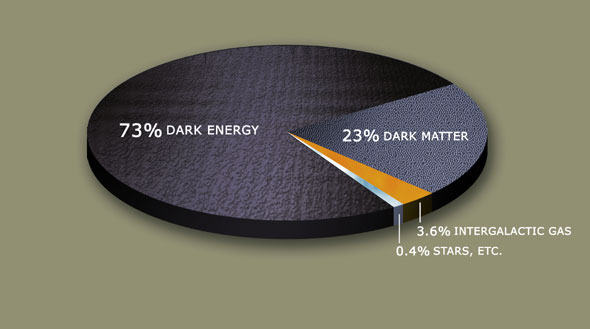
Cosmologists believe about 70 percent of the universe consists of dark energy, 25 percent is dark matter, and only four percent normal matter (the stuff that stars, planets and people are made of). Hubble observations suggest the dark energy may be Einstein's cosmological constant, an energy percolating out of the vacuum of the space between galaxies.

The energy of the universe is dominated by empty space emitting a repulsive form of gravity that is pushing the universe apart. But what does all this mean to Earth? Even if Einstein's theory was correct, we won't have to be concerned about the "dark side" for about 30 billion years, according to Hubble researchers.

( http://www.nasa.gov/missions/deepspace/ ... nergy.html )