Sava (Janjic), Fader
»BETAWEEK« (E) July 6 [2000] - skriver om Fader Sava:
BIOGRAPHY
A Career: Father Sava Janjic
DIPLOMAT IN PRIEST'S ROBES
The young and until two years ago anonymous monk of the Visoki Decani Monastery in Kosovo, Father Sava Janjic, with the culmination of the Kosovo crisis, became one of the most renowned representatives of the Serb community in that province, who with his bold and persistent advocacy for democratic solutions, moral and intellectual superiority, earned an undoubted authority among the international community and the respect of moderate Albanians in Kosovo.
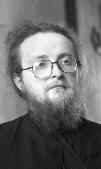
Finding himself in a situation unparalleled to any a Serb priest had found himself in during recent Serb history, Father Sava, together with his spiritual father, Bishop Artemije of Raska and Prizren, preached reconciliation, common sense and Christian charity during the bloody ethnic war in Kosovo in 1998-1999, condemning crimes and aiding the innocent population, regardless of their nationality.
Immediately after the NATO intervention against the Federal Republic of Yugoslavia and the withdrawal of the Yugoslav forces from Kosovo, he was the first to openly speak of the violence and "horrible crimes" committed against Albanian civilians, directly accusing Yugoslav President Slobodan Milosevic.
"I want to say that there were various armed formations, which unfortunately had a hand in the mass expulsion of the population, which in the majority of cases was not running from the bombs, but as a result of systematic expulsion, plunder of property and other forms of violence of which we now daily find traces for which the unfortunate Serb people in Kosovo now have to foot the bill," said Father Save in an interview to the NIN weekly in July 1999.
At that time he said that those who committed the crimes had to be first taken "before a court of their own people, and only afterward before an international court," adding that such acts must not remain unpunished, because "they represent a huge disgrace and shame perpetrated against everything that is chaste and holy among the Serb people."
At the same time, however, he warned that UNMIK and KFOR were "facing defeat because they had not succeeded in creating a multi-ethnic Kosovo," since "hundreds of Serbs had been killed and kidnapped, thousands of houses had been burned, and more than 180,000 people had been expelled."
The fact that together with Bishop Artemije his political engagement centered on the Serb National Council in Gracanica, attempting to establish cooperation with the U.N. mission and KFOR in order to find ways to protect the Serbs remaining in Kosovo and facilitate the return of those who fled, was enough for the authorities in Belgrade and the political leaders of the Serbs in northern Kosovo to label him a "traitor," one of "Kouchner's Serbs" and "the shame of Orthodoxy and the Church."
The rage of the internationally isolated government of President Milosevic is especially insisted by the numerous diplomatic missions of the leaders of the Gracanica-based Serb National Council, during which they have met with most of the senior officials of the EU and U.S. Father Sava plays a very significant role during those meetings.
The belief that cooperation with UNMIK is the only way Serbs can survive in Kosovo, however, was not an obstacle of his ability to fiercely criticize the international community for its inability to protect the Serb population from the not infrequent attacks by Albanian terrorists.
"For the Serb community in Kosovo, the war is not over. After the official end of the war, our people continue to suffer, to be systematically irradicated, kidnapped and our churches and monasteries destroyed. These are not simple criminal acts. This is organized ethnic cleansing of the Serbs and that must come under the authority of The Hague-based Tribunal," he said in June of this year after meeting with the International Criminal Tribunal's chief prosecutor Carla del Ponte.
Although as a member of the Gracanica-based Council he had met on numerous occasions with U.S. Secretary of State Madeleine Albright and other senior U.S. officials, after the wave of violence in June he blamed U.S. policies of "being behind Albanian terrorism in Kosovo" and the U.S. of being "a passive observer, who tolerates what is happening."
"The aim of U.S. policy in Kosovo is not the creation of a multiethnic and tolerant society, but the creation of a greater Albanian state, based on terrorism," he assessed at the time. Father Sava believes that the greatest responsibility for the misfortunes of Kosovo lies with Yugoslav President Slobodan Milosevic, whose "irresponsible policies and violence led to the war."
"Behind it Milosevic's regime has left ruins, mass graves, robbed homes and poor defenseless Serbs now paying for deeds of his generals," he believes.
He sees the role of the Serbian Orthodox Church in Kosovo as steering the political process "towards a direction that will allow the survival of our people and the creation of better living conditions," so that "once legal and legally elected democratic institutions are established," the Church can withdraw from politics.
"The Serb Church has said what is needed: the regime of President Milosevic must forever leave Serbia and allow the establishment of a contemporary democratic society. On the contrary, the damnation that has followed the Serb people for years with the Milosevic regime will continue to sow the seed of evil in Serbia and Montenegro," said Father Sava in an interview to the Danas daily in March of this year.
He did not shy away from asking the Serb Patriarch Pavle to "apologize to the Serb people" for attending a Republic Day reception hosted by Yugoslav President Slobodan Milosevic on November 29, 1999.
"The actions of his Holiness, and especially of his 'almighty' counsel, Episcope Irinej of Backa, who regularly takes him before Milosevic, thus scandalizing our people. In the past few years some episcopes have failed to recognize the times in which we are living and have allowed a godless regime to use the Church as its instrument to meet its political ends and maintain its authority," assessed Father Sava in January 2000.
Father Sava says that an unfortunate mixture of events forced him into "political and national" activities, which is exactly what he wanted to avoid when he joined the order of monks.
Sava Janjic was born in Dubrovnik on Dec. 7, 1965. He graduated from elementary and secondary school in Trebinje. He studied English and Literature from 1985 to 1989 at the Faculty of Philology in Belgrade. He was received by the Crna Reka Monastery near Novi Pazar as a novice in 1989, while Bishop Artemije was the prior of the monastery. He became a monk on Nov. 14, 1990. He came to the Visoki Decani Monastery in 1992, together with Bishop Artemije, and stayed there until the end of the war in Kosovo, in June 1999.
He has been Bishop Artemije's personal secretary since 1998, and with the outbreak of major conflicts in Kosovo, in that same year, he became known as a result of the internet domain
http://www.decani.yunet.com/home.html, where he published news and various views of the Kosovo crisis. Foreign journalists, among whom he is very popular, have given him the nickname "Cybermonk." Besides the web site, he also edits a news bulletin on the net, Kosovo Daily News, which has more than 1,000 visitors per day.
He was soon allowed to preform church rites as a monk and in January 1999 he was promoted to archsyncellous.
In June 1999, together with Bishop Artemije, he transferred to the Gracanica Monastery, where he is today the spokesman of the Serb National Council.
He is a member of the Interim Council of Kosovo, the Joint Committee for the return of refugees and the Board of the independent Serb radio station.
He translates church literature from the English and Greek languages. He speaks English and Greek, and passable German.


