
iskreno receno, citao i barnabino i ovu bibliju, razlika u logici je ogromna, daleko daleko logicnije je barnabino evandjelje nego ovo sad sto imamo od Biblije.SamoVasGledam wrote:Ti pričaš o logici, a i dalje koristiš jevanđelje po Varnavi kao neki validan istorijski izvor, iako je više puta ovde navedeno zašto je to nemoguće
Kao i Jovana 16.
Islam vs Krscanstvo, slicnosti, razlike, zamjerke
-
Smrcak15

- Posts: 11092
- Joined: 13/12/2015 13:23
#726 Re: Islam vs Krscanstvo, slicnosti, razlike, zamjerke
-
SamoVasGledam

- Posts: 1475
- Joined: 24/05/2016 16:41
#727 Re: Islam vs Krscanstvo, slicnosti, razlike, zamjerke
Opet kažem to je zato što si pristrasan i što posmatraš sve iz islamske perspektive. Zbog toga nisi merodovan da donosiš odluke o tome.
Ovo Varnavino jevanđelje se prvi put pojavljuje tek u srednjem veku i to na italijanskom i španskom jeziku.
Muslimani su odavno odavno batalili ovo delo kao nekakav dokaz i argument. Jedino ga ti još uzimaš kao merodavno za nešto.
Ja i zaboravim na ovu knjigu, ali kada dođem ovde ti me podsetiš na nju.
Ovo Varnavino jevanđelje se prvi put pojavljuje tek u srednjem veku i to na italijanskom i španskom jeziku.
Muslimani su odavno odavno batalili ovo delo kao nekakav dokaz i argument. Jedino ga ti još uzimaš kao merodavno za nešto.
Ja i zaboravim na ovu knjigu, ali kada dođem ovde ti me podsetiš na nju.
-
Smrcak15
- Posts: 11092
- Joined: 13/12/2015 13:23
#728 Re: Islam vs Krscanstvo, slicnosti, razlike, zamjerke
ali eto ti si merodavan koji uopste nevjerujes u Bibliju da meni dokazes nesto sa biblijom, knjigom koju ti nevjerujes.....SamoVasGledam wrote:Opet kažem to je zato što si pristrasan i što posmatraš sve iz islamske perspektive. Zbog toga nisi merodovan da donosiš odluke o tome.
Ovo Varnavino jevanđelje se prvi put pojavljuje tek u srednjem veku i to na italijanskom i španskom jeziku.
Muslimani su odavno odavno batalili ovo delo kao nekakav dokaz i argument. Jedino ga ti još uzimaš kao merodavno za nešto.
Ja i zaboravim na ovu knjigu, ali kada dođem ovde ti me podsetiš na nju.

pusti ti to sta su muslimani batalili, batalili su oni mnog stosta sto se ne treba batailiti.Muslimani su odavno odavno batalili
Gleda sta je logicnije, sta ima vecu potporu kad onako cisto logicki sagledamo dvije knjige, kada citam barnabino, jednostavno stvari se poklapaju kao puzle na tacne pozicije, dok biblija samo donosi zbrku u dosta slucajeva.
-
SamoVasGledam
- Posts: 1475
- Joined: 24/05/2016 16:41
#729 Re: Islam vs Krscanstvo, slicnosti, razlike, zamjerke
Naravno da sam merodavniji od tebe, jer ja ne pripadam ni jednoj religiji pa sam samim tim i nepristrasniji.
A Bibliji sam posvetio dosta vremena, slušao mnoga predavanja o njoj, pročitao masu knjiga pa mislim da imam i nekog znanja o njoj.
I ne samo o njoj već i o istoriji rane Crkve.
Po tvojoj logici sutra da neko napiše novo jevanđelje ti ćeš ga uvažiti i smatrati verodostojnijim od kanonskih jevanđelja ako ti to više paše.
A Bibliji sam posvetio dosta vremena, slušao mnoga predavanja o njoj, pročitao masu knjiga pa mislim da imam i nekog znanja o njoj.
I ne samo o njoj već i o istoriji rane Crkve.
Po tvojoj logici sutra da neko napiše novo jevanđelje ti ćeš ga uvažiti i smatrati verodostojnijim od kanonskih jevanđelja ako ti to više paše.
-
Smrcak15
- Posts: 11092
- Joined: 13/12/2015 13:23
#730 Re: Islam vs Krscanstvo, slicnosti, razlike, zamjerke
necu, niti je to moguce.SamoVasGledam wrote:Naravno da sam merodavniji od tebe, jer ja ne pripadam ni jednoj religiji pa sam samim tim i nepristrasniji.
A Bibliji sam posvetio dosta vremena, slušao mnoga predavanja o njoj, pročitao masu knjiga pa mislim da imam i nekog znanja o njoj.
I ne samo o njoj već i o istoriji rane Crkve.
Po tvojoj logici sutra da neko napiše novo jevanđelje ti ćeš ga uvažiti i smatrati verodostojnijim od kanonskih jevanđelja ako ti to više paše.
-
SamoVasGledam
- Posts: 1475
- Joined: 24/05/2016 16:41
#731 Re: Islam vs Krscanstvo, slicnosti, razlike, zamjerke
Ali to upravo činiš sa Varnavinim jevanđeljem. Najranije pronađene kopije Varnavinog jevanđelja su s početka 17. veka i to su napisane na nesemitskim jezicima.
Iz perspektive istoriografije ono nema ama baš nikakvu vrednost i validnost kada su u pitanju događaji oko Isusa u pitanju.
Iz perspektive istoriografije ono nema ama baš nikakvu vrednost i validnost kada su u pitanju događaji oko Isusa u pitanju.
-
Smrcak15
- Posts: 11092
- Joined: 13/12/2015 13:23
#732 Re: Islam vs Krscanstvo, slicnosti, razlike, zamjerke
SamoVasGledam wrote:Ali to upravo činiš sa Varnavinim jevanđeljem. Najranije pronađene kopije Varnavinog jevanđelja su s početka 17. veka i to su napisane na nesemitskim jezicima.
Iz perspektive istoriografije ono nema ama baš nikakvu vrednost i validnost kada su u pitanju događaji oko Isusa u pitanju.
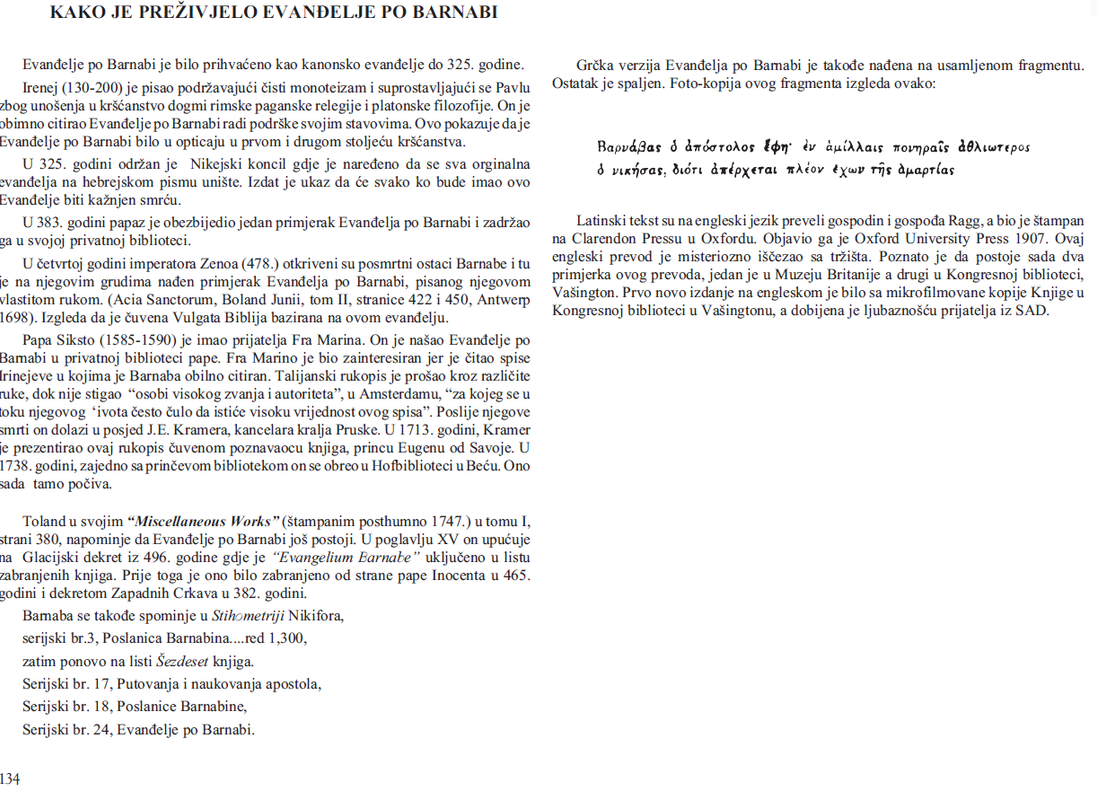
barnabino evnadjelje je pisano prije ovih kanonskih evandjelja, Luke, mateja, marka i Ivana.Iz perspektive istoriografije ono nema ama baš nikakvu vrednost i validnost kada su u pitanju događaji oko Isusa u pitanju
-
SamoVasGledam
- Posts: 1475
- Joined: 24/05/2016 16:41
#733 Re: Islam vs Krscanstvo, slicnosti, razlike, zamjerke
Ovo je čista propaganda. Često se meša Varnavina poslanica, koja je zaista napisana u prvom veku, sa ovom knjigom koju neki zovu Varnavinim jevanđeljem.
https://en.wikipedia.org/wiki/Epistle_of_Barnabas
Ne postoji nikakav dokaz da je Varnava napisao tu knjigu, niti da je ona iz perioda dok je on bio živ.
To da je sahranjen sa svojim jevanđeljem je samo mit, a još čuveniji mit je da je sahranjen sa Matejovim jevanđeljem.
Inače Varnava je bio veoma blizak Pavlov prijatelj i često su zajedno išli na misionarstvo. To je još jedna stvar koja ne ide u prilog ovoj tezi.
https://en.wikipedia.org/wiki/Epistle_of_Barnabas
Ne postoji nikakav dokaz da je Varnava napisao tu knjigu, niti da je ona iz perioda dok je on bio živ.
To da je sahranjen sa svojim jevanđeljem je samo mit, a još čuveniji mit je da je sahranjen sa Matejovim jevanđeljem.
Inače Varnava je bio veoma blizak Pavlov prijatelj i često su zajedno išli na misionarstvo. To je još jedna stvar koja ne ide u prilog ovoj tezi.
-
zagortenej

- Posts: 3903
- Joined: 22/04/2013 13:27
- Location: Arš
#734 Re: Islam vs Krscanstvo, slicnosti, razlike, zamjerke
I još je Barnaba nagovijestio u svom Jevanđelju da će se Muhamed pojaviti
-
SamoVasGledam
- Posts: 1475
- Joined: 24/05/2016 16:41
#735 Re: Islam vs Krscanstvo, slicnosti, razlike, zamjerke
Evo Smrle šta kažu najpoznatiji islamski učenjaci današnjice o Varnavinom jevanđelju. Takođe je navedeno i nekoliko dokaza zašto je jevanđelje neautentično. Recimo spominju se predmeti koji su nastali u srednjem veku, citira se Danteov ''Pakao'' i slično.
Ovo bi trebalo da bude doovljno da ovo jevanđelje padne u vodu, ali pretpostavljam da tebi neće biti.
Ovo bi trebalo da bude doovljno da ovo jevanđelje padne u vodu, ali pretpostavljam da tebi neće biti.
-
SamoVasGledam
- Posts: 1475
- Joined: 24/05/2016 16:41
#736 Re: Islam vs Krscanstvo, slicnosti, razlike, zamjerke
Najjače je što je tekst pod naslovom ''The facts !!'', a već u prvoj rečenici piše ''The Gospel was found on the dead body of Barbabas in the year 478 AD.''zagortenej wrote:Brojčana čuda u Barnabijevom Jevanđelju:
http://numerical19.tripod.com/muhammad_in_barnabas.htm
Must read!
A evo šta je pravi fakt:
''According to the History of the Cyprus Church, in 478 Barnabas appeared in a dream to the Archbishop of Constantia (Salamis, Cyprus) Anthemios and revealed to him the place of his sepulchre beneath a carob-tree. The following day Anthemios found the tomb and inside it the remains of Barnabas with a manuscript of Matthew's Gospel on his breast.''
Sa zvaničnog sajta kiparske Crkve. Drugi pasus, treći red. Ko zna ćirilicu može pronaći taj deo bez većih problema.
https://en.wikipedia.org/wiki/Church_of_Cyprus
Inače sam varnava je bio Kipranin, rođen je na Kipru i umro je tamo. Kiprani ga smatraju osnivačem svoje Crkve, pa možda oni nešto više znaju od Smrleta.
Ali opet MOŽDA.
-
arzuhal

- Posts: 20825
- Joined: 03/06/2008 11:26
- Location: u čajdžinici "Kod nefsu-l-levvame"
-
Smrcak15
- Posts: 11092
- Joined: 13/12/2015 13:23
#738 Re: Islam vs Krscanstvo, slicnosti, razlike, zamjerke
The Gospel of BarnabasSamoVasGledam wrote:Ovo je čista propaganda. Često se meša Varnavina poslanica, koja je zaista napisana u prvom veku, sa ovom knjigom koju neki zovu Varnavinim jevanđeljem.
https://en.wikipedia.org/wiki/Epistle_of_Barnabas
Ne postoji nikakav dokaz da je Varnava napisao tu knjigu, niti da je ona iz perioda dok je on bio živ.
To da je sahranjen sa svojim jevanđeljem je samo mit, a još čuveniji mit je da je sahranjen sa Matejovim jevanđeljem.
Inače Varnava je bio veoma blizak Pavlov prijatelj i često su zajedno išli na misionarstvo. To je još jedna stvar koja ne ide u prilog ovoj tezi.
http://www.al-mawrid.org/index.php/arti ... f-barnabas
Scriptures
I had written two installments of my article 'Barnabas, His Gospel and Its Credibility'[1], but could not complete it due to some other assignments. Although the article is still incomplete, it would be advisable for the readers to go through both of its installments once again. (Author)
'Epistle to Hebrews' had sometimes been attributed to Barnabas by some scholars, but, according to modern research, it was not written by Barnabas. Of course Barnabas was a scholarly person and he composed a 'Gospel', but the attribution of the 'Epistle to Hebrews' to him is not authentic. Actually there exists another 'Epistle of Barnabas'. It has been included in 'The Ante-Nicene Fathers, Translations Of The Writings of the Fathers down to A.D. 325', Ed. The Rev. Alexander Roberts & James Donaldson, WM. B. Eerdmans Pblg. Co., Grand Rapids, Michigan, Vol. I, pp. 133-149. Initially, there is a three page 'Introductory Note' to it. Necessary footnotes have also been afforded to it. Its attribution to Barnabas is also doubtful. However, it is a worth-reading treatise. As regards his Gospel, the Oxford Dictionary of the Christian Church asserts:
Gospel of Barnabaswas declared a rejected book in the Decretum Gelasianum by Pope Gelasius [Pope of Rome 492-96]. According to E. Von Dobschutz, it is a private compilation which was composed in Italy (but not at Rome) in the early sixth century.[2]
It is strange that a book which is claimed to be 'composed in Italy in the early sixth century' had been declared a 'rejected book' in the fifth century. So the observation of E. Von Dobschutz, if it has been truly attributed to him, is absurd and baseless and may be rejected outright. It is thus clear that the 'Gospel of Barnabas' had already been existing when Pope Gelasius declared it 'a rejected book' in the fifth century more than a hundred years earlier to the advent of Islam. As to its date of actually being written, there are reasons to believe that it had been written even before the 'Gospel according to Matthew' was written. I shall try to elaborate it just a few lines later.
As to the Gospel according to Matthew's date of being written, the research of the 'New Testament Introduction' claims it to be ca. A.D. 85-90. It asserts:
(1) Matthew(ca. A.D. 85-90). This gospel makes use of Mk as well as other traditions about Jesus and collections of Jesus' sayings. It was composed in Greek as the reference to Daniel as 'the prophet' in 24:15 implies. (…). Many scholars think that the community that formed the basis of the Matthean church had come from Palestine and settled in Syria. Mt 4:24 has the only reference in the gospels of Jesus' fame spreading 'throughout all Syria'. The community may have been predominantly Christians of Jewish background, since non-Jews (Gentiles) are referred to as outsiders (5:47; 6:7,32; 10:5-6, 17-18; 18:17).[3]
The results of the research of the 'Oxford Companion to the Bible' are also of similar nature. It has afforded the rationale of its conclusion as well. It observes:
It is commonly held that Matthew was written about 85 or 90 CE by an unknown Christian who was at home in a church located in Antioch of Syria. A date toward the end of the first century seems probable because the destruction of Jerusalem, which occurred in 70 CE, appears to be an event that was rapidly receding into the past (22.7). Although the apostle Matthew may have been active in founding the church in which the gospel story attributed to him arose (9.9; 10.3), it is unlikely that he was the story's author. On the contrary, the author exhibits a theological outlook, command of Greek, and rabbinic training that suggest that he was a Jewish Christian of the second rather than the first generation (cf. 13.52). Also, Antioch of Syria commends itself as the place where he may have been at home. Because the social conditions reflected in his story correspond with those that seem to have prevailed there: the city was Greek-speaking, urban, and prosperous, and it had a large population of both Jews and Gentiles.[4]
The Cambridge Companion to the Bible writes:
In the late first century, after the destruction of the temple, Matthew, Luke-Acts, and John were written. The mother church of Christianity, the Jerusalem community, was destroyed in the sack of Jerusalem, so power shifted definitively to the Gentile communities around the Mediterranean. Followers of Jesus continued to interpret the Bible to match their evolving understanding of Jesus and new communal circumstances.[5]
Even the identity of the author of the Gospel of Matthew is unknown and it is anonymous like the other gospels. The Cambridge Companion to the Bible notes:
This Gospel is anonymous, like the others. When the church in the second century sought to lend authority to its Gospels, it assigned each of them to an apostle or an associate of an apostle. About 130, Papias attributed this Gospel to Matthew[stress added] (who seems also to have been known as Levi; cf. Matt. 9:9 and Mark 2:13) and claimed that he wrote it in Hebrew. But its author used the Greek Gospel of Mark as a source. [It means that 'Matthew' was written after 'Mark'.], and the many scriptural quotations are from Greek translation rather than directly from the Hebrew Bible. Although we cannot determine who the author was, careful analysis shows us what his concerns were and on what basis he modified and expanded the Gospel tradition. The issues that are central for him reflect the developments described above that were taking place in Judaism around the years 95-100.[6]
The Cambridge Companion to the Bible also notes at another place:
The most plausible explanation for the relationship among the synoptic gospels is that Mark is the original, with Matthew and Luke drawing on Mark and a second common source (Q) but developing the details of structure and content independently.[7]
As to the date of the gospel of Mark, the same authority observes:
(…), and the oldest of the gospels, Mark, dates from no earlier than the late sixties and was written probably about the time of the Jewish revolt of 66-70.[8]
The time when the Gospel of Mark was written is also uncertain. Its concern with the threatened coming of armies to seize Jerusalem and destroy its temple suggests that it dates from the years after the Jewish nationalists began their revolt against the Romans but before the temple was destroyed: that is, between 66 and 70 CE.[9]
The 'New Testament Introduction' places it between AD 68 and 70:
Mark (ca. A.D. 68-70). Our earliest gospel, Mk has been used by both Mt and Lk. Mk emphasizes the need for Christians to expect sufferings.[10]
Although some of the scholars purposefully claim that the Gospel according to Matthew had been written earlier, but it is by no means safe to assign it a date prior to A.D. 70, as can easily be appreciated from the evidence recorded above, which assigns it some date around AD 85-90.
Barnabas died in A.D. 61. He had separated from Paul in A.D. 49 after a 'sharp contention' with him on the question of the inclusion of his cousin, John Mark, in the Second Missionary Journey (AD 49-52)[11]. He left for Cyprus for good. He might have immediately started composing his gospel and would have completed it within a year or two, i.e. AD 50 or 51 after which he started preaching it.
We see, when I Corinthians was written in c. AD 55[12] or AD 56[13], Barnabas was still alive, as stated in the New BD:
When I Corinthians was written Barnabas was still alive, and, like Paul and unlike most of their colleagues, supporting himself without drawing on the churches (I Cor 9:6 [which reads: 'Or is it only I and Barnabas who must work for a living.']).[14]
As regards his year of death, it is most probably AD 61. G. Milligan has concluded in his article 'Barnabas' in Hastings DB:
(…), while Col 4.10 has been taken as proving that by this time (about A.D. 63) Barnabas must have been dead, else Mark would not have rejoined Paul (cf. 2 Ti: 4.!!, 1P:5.13).[15]
It means that Barnabas must have died shortly before the Epistle to Colossians was written. So Barnabas' year of death can easily be ascertained, if the date of writing of this Epistle is confirmed. Here are some references to establish the date of this Epistle:
McKenzie's DB suggests AD 61-63 to be the date of writing of this 'Epistle to Colossians'.[16] William Smith's DB asserts under the heading of 'First imprisonment of St. Paul at Rome. A.D. 61-63':
To that imprisonment (…) belongs the noble group of letters to Philemon, to the Colossians, to the Ephesians and to the Philippians.[17]
The New Bible Dictionary has also assigned the same date to this 'Epistle to Colossians', as can be concluded from the following:
Paul had a stormy sea-voyage and, after being wrecked, spent the winter on Malta (c. AD 61). He reached Rome in the spring and spent the next 2 years under house-arrest (…). Most probably Paul was released in AD 63 (…).[18]
The Pictorial Bible Encyclopedia reports:
Philippians, Colossians, Philemon, written during Paul's imprisonment in Rome (ca. 60-64 CE, though scholars are divided as to the exact dates).[19]
The above evidence makes it clear that 'Epistle to Colossians' was written during the 'First imprisonment of St. Paul at Rome: A.D. 61-63'. Thus we can almost exactly ascertain his year of death. It can be located somewhere between AD 55 and 63. Most probably Barnabas died in AD 61.[20] The New Age Encyclopaedia reports:
Barnabas is supposed to have been martyred at Salamis in Cyprus in 61 AD,[21]
Merit Students Encyclopedia asserts:
Barnabas, Saint, an Apostle of Christ. Born Joseph, 1st century A.D. died about 60 A.D. (…). St. Barnabas is ranked as an Apostle even though he was not one of the 12 Apostles.[22]
Everyman's Encyclopaedia states:
Barnabas is supposed to have been martyred at Salamis in Cyprus in 61 AD, but many traditions take him to Milan, Rome, and Alexandria.[23]
The New Catholic Encyclopedia has also expressed similar views:
Death apparently came to him after Paul wrote of him, as though still alive, in I Corinthian 9.6 [in AD 55 or 56], and before Paul wrote to the Colossians [between AD 60 and 63] that Mark was now his colaborer (Col 4.10).[24]
It has thus been made clear that Barnabas died in ca. AD 61 whereas the 'Gospel according to Matthew' was written decades of years after it: ca AD 85-90; but not before AD 70. Even the 'Gospel according to Mark', which is considered to be the source of Matthew's Gospel, was written years after the death of Barnabas.
The New Encyclopaedia Britannica writes:
Barnabas' reputed tomb, was discovered in 488, is near the Monastery of St Barnabas, in the Cypriot city of Salamis, whose Christian community was founded by Paul and Barnabas.[25]
The 1907 edition of Britannica has recorded the name of the Byzantine Emperor, during whose reign the dead body of Barnabas was discovered, as Zeno (Emperor of the Eastern Roman Empire from AD 474 to 491).[26] New Catholic Encyclopedia says:
(…); his body was later found with his own hand-written copy of Matthew's Gospel over his heart.[27]
We have another report by 'Acta Sanctorum' that the manuscript discovered from his tomb was the gospel of Barnabas written with his own hand.[28]
It has been reported in the "Life of St. Barnabas" that the body of Barnabas was placed in a cave 1½ mile from Salamis. The manuscript of the 'Gospel according to Matthew', written with the author's own hand, was found on his bosom. The dead body was recovered intact during the reign of Emperor Zeno with the Gospel on its chest. The manuscript of the 'Gospel according to Matthew', written by the author in his own handwriting, was sent to Constantinople to be placed in the Emperor's Library. It was destroyed among other valuables during the conquest of Constantinople by the Turks.[29]
A Turkish journal, 'Ilime ve Sanat Dergisi', had published a write-up regarding the discovery of a ca. 19 centuries old Aramaic manuscript of this Gospel. It was written by Dr. Hamzah Piktash and was published in its issue of March-April, 1986. According to it a voluminous book was found by some people in a cave near the Turkish town of Hakari in 1984. They tore a leaf from it to get some information about it. They contacted Dr. Piktash to identify the manuscript. It had been written in the Aramaic language in Syriac script. It was written on Papyrus. Its klix revealed that it was written ca. 19 centuries back. On perusal, it came to be the Gospel of Barnabas written in Aramaic, the language of Jesus Christ. The discoverers left the photocopy of its only one leaf with Dr. Piktash. They disappeared; and were later arrested by the police while trying to smuggle it out. The manuscript was given in the custody of the government. Dr. Piktash states that the text with him was concordant with the English and Arabic translation of the Gospel of Barnabas to a great extent.[30]
We have seen above that the 'Gospel according to Matthew' was written many years after the death of Barnabas. How can it be possible that he wrote a book (Gospel according to Matthew) with his own hands which had actually been written many a year after his death and how could it get buried with him in his grave? Actually the Gospel found from his grave lying over his heart was, and could only be, his own gospel, the Gospel of Barnabas, written with his own hand.
There is evidence which shows that the Gospel of Barnabas, which would have been written by AD 51, had become commonly known in Christian community of NW. According to McKenzie St. Paul wrote the Letter to the Galatians in AD 54.[31] W. Smith says:
When he left Antioch, he "went over all the country of Galatia and Phrygia in order, strengthening all the disciples," (…). It is probable that the Epistle to the Galatians was written soon after this visit―A.D. 56-57.[32]
The 7th Day Adventist BD, under the entry 'Galatians, Epistle to the' says, '(…), the date of writing would be the winter of A.D. 57-58, and the place of writing doubtless Corinth.'[33]
According to the New American Bible:
If it is addressed to the Galatians in the north, the letter was probably written around A.D. 54 or 55, most likely from Ephesus after Paul's arrival there for a stay of several years on his third missionary journey.[34]
A New Catholic Commentary writes:
Nevertheless, because of certain similarities of mood and tone and parallels in phraseology with I Cor and Rm, many commentators with Benoit, ascribe Gal to a date about the same as Rm, i.e. c. A.D. 56.[35]
It is thus clear that St. Paul wrote the Epistle to the Galatians sometime between AD 54 and 58, whereas the Gospel of Barnabas had been written in c.51. Paul writes in Galatians:
I am amazed that you are changing so soon from the one who called you by means of (Christ's) grace, to a different gospel which is not another one, only there are some unsettling you and willing to pervert the gospel of Christ. But even if we or an angel from heaven were to proclaim the gospel [to you] differently than how we proclaimed the gospel to you, let that one be anathema [accursed]. As we have just said, and as I now say once again: If anyone should proclaim the gospel to you contrary to what you have received, let him be anathema![36]
A footnote has been inserted to these verses saying:
Paul is declaring in the strongest manner that the gospel he preaches is the one and only way to salvation, and that to preach another gospel is to nullify the death of Christ. Paul's curse reminds the readers of the absolute truth of his gospel.[37]
Obviously Paul is pointing to some other 'gospel' in these verses of the Epistle to the Galatians. This Epistle to the Galatians was not written before ca. AD 54 to 58. There did not exist any of the 4 gospels by that time. Therefore the word 'gospel' here means the doctrines which Paul had designed and was preaching. On the other hand the Gospel of Barnabas had already been compiled in ca. AD 51. It was only Barnabas who was preaching some 'gospel' contrary to that of Paul's. It can thus be appreciated that Paul indicated to the 'Gospel of Barnabas' in his Epistle to the Galatians. It makes quite clear that there existed the 'Gospel of Barnabas' prior to AD 54-58, before any of the 4 gospels had been compiled.
All the above discourse makes it abundantly clear that:
i) Barnabas had died in ca. AD 61.
ii) The 'Gospel according to Matthew', The 'Gospel according to Mark', and all the other Gospels, were written after his death. None of the Gospels had been written during the lifetime of Barnabas.
iii) The dead body of Branabas was discovered in AD 488 from the Cypriot city of Salamis.
iv) A manuscript of a Gospel was found in his tomb lying on his heart. Scholars identify it in three different ways: (a) it was the Gospel of Barnabas written with his own hand [as stated in the 'Acta Sanctorum'], (b) it was the 'Gospel according to Matthew' written by Matthew himself with his own hand [as stated in the 'Life of St. Barnabas'] and (c) it was the 'Gospel according to Matthew' written by Barnabas [as stated in the 'New Catholic Encyclopedia'].
v) As regards the options (b) and (c) above, they are absolutely impossible as the 'Gospel according to Matthew' was written many years after the death of Barnabas.
vi) It could naturally have been the Gospel of Barnabas and none other than it. It may have been in the Aramaic language, the language used by Jesus Christ.
vii) This manuscript was sent to Constantinople (Istanbul of today) to be preserved in the Emperor's Library.
viii) An Aramaic Manuscript of the Gospel of Barnabas klix to the first century AD was discovered in a Turkish town, Hakari in AD 1984.
ix) Most probably it may have been the same MS. found from the tomb of Barnabas in AD 488 near the Cypriot city of Salamis or some manuscript copied from it.
x) Paul has referred to some 'gospel' in his Epistle to the Galatians and this Epistle was written ca. AD 54-58. None of the 4 gospels had been written by that time. Paul could have naturally pointed only to the 'Gospel of Barnabas', which according to him, preached some 'gospel' contrary to his own teachings.
It is now unto the reader himself to draw a reasonable conclusion from the above data.
There is a 'Catalogue of the 60 Canonical Books' (instead of the present canon of 66 books). It has given a list of 25 apocryphal books as well. 'The Gospel according to Barnabas' has been recorded in it at Serial No. 24.[38] It shows that this Gospel of Barnabas existed in the early years of Christianity and it was purposely banned by the Christian authorities.
How could some Muslim scholar have written it? It was discovered by the Christians, it was introduced to the world by the Christians, and it was published by the Christians. The Muslims knew nothing about this 'Gospel of Barnabas' until George Sale (AD 1697-1736) mentioned it[39] in the prologue (To The Reader) of his English translation of the Qur'an (AD 1734), named 'Alkoran of Mohammed'.[40] Then they got their foremost opportunity of going through it after its English translation was first published by the Clarendon Press, Oxford in 1907. Before its introduction by the Christian scholars in 1907, the Muslim scholars had no approach to it. All the Muslim literature, throughout the centuries, is void of any quotation from this Gospel. Had they known it, they must have profusely quoted from it, because it prophesied about the Holy Prophet by mentioning his name.
Why do the modern Christians not own and accept it? Simply because there is a lot in it which does not agree with their ideals[41] and because there are in it a number of prophecies regarding the Prophet of Islam by his very name in unequivocal terms. There might be some later alterations, adulterations, and interpolations in it like almost all the other books of the Bible. There might have crept into it some misunderstandings or confusions of the writer himself. But its existence as a book written by Barnabas cannot be denied. Its subject matter, its language, its confident style, its exhaustive material on important themes which is elsewhere unavailable, and its presentation of the logical and reasonable themes are superior to the four Gospels of the NT of the Bible. It is unfortunate for the Christians that they have deprived themselves of this valuable treasure of religious knowledge. Here are some excerpts regarding only the Prophet of Islam, Muhammad (sws), from Lonsdale & Laura Ragg's 'The Gospel of Barnabas':
But after me shall come the Splendour[42] of all the prophets and holy ones, and shall shed light upon the darkness of all that the prophets have said, because he is the messenger of God.[43]
Verily I say unto you, that every prophet when he is come hath borne to one nation only the mark of the mercy of God. And so their words were not extended save to that people to which they were sent. But the messenger of God, when he shall come[44] [stress added] God shall give him as it were the seal of His hand, insomuch that he shall carry salvation and mercy to all the nations of the world that shall receive his doctrine.[45] He shall come with power upon the ungodly, and shall destroy idolatry,[46] insomuch that he shall make Satan confused; for so promised God to Abraham, saying: "Behold, in thy seed I will bless all the tribes of the earth; and as thou hast broken in pieces the idols, O Abraham, even so shall thy seed do." James answered: 'O master, tell us in whom this promise was made; for the Jews say "in Isaac," and the Ishmaelites say "in Ishmael." ' (…). Believe me, for verily I say to you, that the promise was made in Ishmael, not in Isaac [For it is a fact that no prophet from the progeny of Isaac can be claimed ever to have broken in pieces the idols as Abraham had broken them in pieces].[47]
I therefore say unto you that the messenger of God is a splendour that shall give gladness to nearly all that God hath made, for he is adorned with the spirit of understanding and of counsel, the spirit of wisdom and might, the spirit of fear and love, the spirit of prudence and temperance; the spirit of justice and piety, the spirit of gentleness and patience,[48] (…). O blessed time, when he shall come to the world![49] (…). And when I saw him my soul was filled with consolation, saying: "O Mohammed, God be with thee.[50]
Jesus answered: '(…). As for me, I am now come to the world to prepare the way for the messenger of God, who shall bring salvation to the world. (…).' Then said Andrew: 'Master, tell us some sign, that we may know him.' Jesus answered: 'He will not come in your time, but will come some years after you, when my gospel shall be annulled insomuch that there shall be scarcely thirty faithful.[51] At that time God will have mercy on the world, and so he will send his messenger, (…). He shall come with great power against the ungodly, and shall destroy idolatry upon the earth[52]. And it rejoiceth me because that through him our God shall be known and glorified, and I shall be known to be true; and he will execute vengeance against those who shall say that I am more than man. Verily I say to you that the moon shall minister sleep to him in his boyhood,[53] and when he shall be grown up he shall take her [the moon] in his hands.[54] (…). He shall come with truth[55] more clear than that of all the prophets, (…); and so when idolatry shall be seen to fall to the ground and confess me a man like other men, verily I say unto you the messenger of God shall be come.[56]
Jesus answered: 'The name of the Messiah is admirable[57], for God himself gave him the name when he had created his soul, and placed it in a celestial splendour. God said: "Wait Mohammed; (…). When I shall send thee into the world I shall send thee as my messenger of salvation, and thy word shall be true[58], insomuch that heaven and earth shall fail but thy faith shall never fail." Mohammed is his blessed name.'[59]
Whereupon I am sure that he who shall sell me[60] shall be slain in my name, for that God shall take me up from the earth, and shall change the appearance of the traitor[61] so that everyone shall believe him to be me; nevertheless, when he dieth an evil death, I shall abide in that dishonour[62] for a long time in the world. But when Mohammed shall come, the sacred messenger of God, that infamy shall be taken away. And this shall God do because I have confessed the truth of the Messiah; who shall give me this reward, that I shall be known to be alive and to be a stranger to that death of infamy.'[63]
-
Smrcak15
- Posts: 11092
- Joined: 13/12/2015 13:23
#739 Re: Islam vs Krscanstvo, slicnosti, razlike, zamjerke
pa i ova sadasnja biblija najavljuje imenom Muhammeda pa sta je cudno ako bi Barnabino evandjelje najavilo ga???zagortenej wrote:I još je Barnaba nagovijestio u svom Jevanđelju da će se Muhamed pojaviti
-
Smrcak15
- Posts: 11092
- Joined: 13/12/2015 13:23
#740 Re: Islam vs Krscanstvo, slicnosti, razlike, zamjerke
SamoVasGledam wrote:Evo Smrle šta kažu najpoznatiji islamski učenjaci današnjice o Varnavinom jevanđelju. Takođe je navedeno i nekoliko dokaza zašto je jevanđelje neautentično. Recimo spominju se predmeti koji su nastali u srednjem veku, citira se Danteov ''Pakao'' i slično.
Ovo bi trebalo da bude doovljno da ovo jevanđelje padne u vodu, ali pretpostavljam da tebi neće biti.
volim da cujem i jednu i drugu stranu sta imaju da kazu, pa onda vagam cije misljenje je bolje , logicnije, validnije.Evo Smrle šta kažu najpoznatiji islamski učenjaci današnjice o Varnavinom jevanđelju.
pregledao sam video....jednostavno uzimaju oni Barnabino evandjelje sa rezervom jer nema lansa prenosilaca da bi se mogla utvrditi njezina autenticnost, ja to razumijem.
apsolutno video ne osporava barnabino evandjejle nego jednostavno se kaze da se ne moze koristiti sa krscanima u diskusijama jer ga ne priznaju.
pa je bolje koristiti standardnu bibliju ako vec se diskutuje o necemu.
Licno meni koji sam procitao barnabino evandjelje 3 puta, valjda sam kompetentan da nesto kaze o njemu.
kada uzmemo bibliju u jednu ruku i barnabino u drugu, i sporedimo samo onako cisto logicki razlika je ogromna, toliko logicno sve djeluje u barnabinom evandjelju a neke greskice koje se nalaze u tom evandjelju daju mu ektra notu vjerodostojnosti da je stavrno doslo od barnabe, jer svi ljudi grijese, pa kada neko pokusava da isprica sve dogadjaje vrlo lahko se moze potkrasti greskica....ali greske u bibliji su neoprostive, jer tu su greske koje se nemogu tek tako lahko objasniti, a to su kontradiktorni tekstovi , dok barnabino evandjelje nema kontradikcije.
-
Smrcak15
- Posts: 11092
- Joined: 13/12/2015 13:23
#741 Re: Islam vs Krscanstvo, slicnosti, razlike, zamjerke
SamoVasGledam wrote:Najjače je što je tekst pod naslovom ''The facts !!'', a već u prvoj rečenici piše ''The Gospel was found on the dead body of Barbabas in the year 478 AD.''zagortenej wrote:Brojčana čuda u Barnabijevom Jevanđelju:
http://numerical19.tripod.com/muhammad_in_barnabas.htm
Must read!
A evo šta je pravi fakt:
''According to the History of the Cyprus Church, in 478 Barnabas appeared in a dream to the Archbishop of Constantia (Salamis, Cyprus) Anthemios and revealed to him the place of his sepulchre beneath a carob-tree. The following day Anthemios found the tomb and inside it the remains of Barnabas with a manuscript of Matthew's Gospel on his breast.''
Sa zvaničnog sajta kiparske Crkve. Drugi pasus, treći red. Ko zna ćirilicu može pronaći taj deo bez većih problema.
https://en.wikipedia.org/wiki/Church_of_Cyprus
Inače sam varnava je bio Kipranin, rođen je na Kipru i umro je tamo. Kiprani ga smatraju osnivačem svoje Crkve, pa možda oni nešto više znaju od Smrleta.
Ali opet MOŽDA.
kako kad je Barnaba umro prije nego je napisano Metejevo evandjelje, nema logike.A evo šta je pravi fakt:
''According to the History of the Cyprus Church, in 478 Barnabas appeared in a dream to the Archbishop of Constantia (Salamis, Cyprus) Anthemios and revealed to him the place of his sepulchre beneath a carob-tree. The following day Anthemios found the tomb and inside it the remains of Barnabas with a manuscript of Matthew's Gospel on his breast.''
-
Humljanin

- Posts: 2491
- Joined: 07/10/2017 00:10
#742 Re: Islam vs Krscanstvo, slicnosti, razlike, zamjerke
Joj Smrčak 
Šta kažeš, Barnabino evanđelje je po tebi logično i vjerodostojno jer ima grešaka
Šta kažeš, Barnabino evanđelje je po tebi logično i vjerodostojno jer ima grešaka
-
Smrcak15
- Posts: 11092
- Joined: 13/12/2015 13:23
#743 Re: Islam vs Krscanstvo, slicnosti, razlike, zamjerke
sudi kad procitas i bibliju i barnabino.....Humljanin wrote:Joj Smrčak
Šta kažeš, Barnabino evanđelje je po tebi logično i vjerodostojno jer ima grešaka
Kada procitas obadva onda imas pravo glasa da kaze ovo nije uredu a ovo je uredu

kada kazem gresicke, to je vise ono tipa sta je pokusao da zapamti od isusa pa onako dok je poslije pisao poslije Isusova uzdignuca potkrale se greskice koje nisu velike, onako male ali lahko objasnjive.
Dok greske iz ove biblije sada se nemogu objasniti.
i jos nesto da kazem, barnbino evnadjelje je logicnije ne radi gresaka, nego cjelokupne slike svih tekstova kada se uzme u obzir sve.
a nisam ni rekao da je logicnije jer ima gresaka, kako tako sve naopako razumijes nije mi jasno
-
SamoVasGledam
- Posts: 1475
- Joined: 24/05/2016 16:41
#744 Re: Islam vs Krscanstvo, slicnosti, razlike, zamjerke
Opet ti o poređenju i logici. Čoveče Varnavino jevanđelje citira Dantea! Ako ne znaš ko je bio Dante Aligieri i kada je živeo izguglaj. To nije greškica, to je čist dokaz da je u pitanju srednjovekovni falsifikat.
A zanimiljivo je i to da si ovde više puta kačio i predstavljao Naika i Shabira Alija kao nekakve autoritet, a sada kada se ne slažu sa tobom njihovo mišljenje ne valja i nebitno je. Ako to nije primer licemerja ja ne znam šta je.
Evo još nekih nelogičnosti u jevanđelju:
1. U poglavlju 42. Isus kaže za sebe da nije Mesija što je u kontradiktornosti sa Islamom i što Varnava nikada ne bi napsiao.
2. Po Varnavi Isus je rekao da nije Mesija, a u samom uvodu jevanđelja autor ga tri puta naziva Hristom. Autor očigledno nije znao da je Hrist na grčkom isto što i na hebrejskom Mesija. Autor je verovatno mislio da je to ''Hrist'' Isusovo prezime. Varnava kao kiparski Jevrejin, kome su i hebrejski i grčki jezik bili znani nikada takvu glupost ne bi napisao.
3. u poglavlju 97. piše da je zapravo Muhamed Mesija.
4. U poglavlju 3. piše da su Irod i Pilat zajedno vladali Judejom. Međutim Irod je umro 30 godina pre nego što je Pilat i došao u Jerusalim. Varnava kao savremenik tih ljudi bi to morao da zna.
5. U poglavlju 20. piše da je Isus Galilejskim jezerom plovio do Nazareta i da je grad tada bio prepun moreplovaca. Međutim problem je taj što je Nazaret udaljen čak 30 km od Galilejskog jezera pa samim tim teško da je Isus tamo otplovio, isto kao što je teško i da su moreplovci tamo boravili.
A nakon toga Isus se zaputio u Kapernaum koji se zaista nalazi na obali Galilejskog jezera i udaljen je 40 km od Nazareta.
Drugim rečima Isus je za ta dva dana otplovio i prepešačio skoro 100 km.
http://www.sacred-texts.com/isl/gbar/
Ovo nisu druže obične greške. Ovo su gluposti koje Jevrejin iz prvog veka nikada ne bi napisao. Nema ovde ništa logično druže. Autor ovog dela ne zna ni osnovnu istoriju, ni osnovnu geografiju tih prostora, a ni osnovnu judeohrišćansku teologiju, pa ako hoćeš čak ni islamsku.
A tebi je opet ovo logičnije nego biblijska jevanđelja. Naravno da ti je logičnije, jer kao što sam rekao strašno si pristrasan i sve posmatraš kroz prizmu Islama. Islam je za tebe jedina alatka koja odlučuje šta ima smisla, a šta ne, šta je istina, a šta je neistina.
Kur'an si proučio do detalja, a ovde nisi primetio ni to da autor ne zna da Hrist i Mesija imaju isto značenje. Ili si možda i primetio, ali si ignorisao, jer ti to ne ide u prilog.
A što se tiče Varnave i to sa kojom knjigom je sahranjen, ja sam rekao da je to samo lokalna legenda. Ali i da nije sahranjen sa Matejovim jevanđeljem zašto automatski mora biti sahranjen sa nekim svojim i to baš sa ovim o kojem raspravljamo?
A zanimiljivo je i to da si ovde više puta kačio i predstavljao Naika i Shabira Alija kao nekakve autoritet, a sada kada se ne slažu sa tobom njihovo mišljenje ne valja i nebitno je. Ako to nije primer licemerja ja ne znam šta je.
Evo još nekih nelogičnosti u jevanđelju:
1. U poglavlju 42. Isus kaže za sebe da nije Mesija što je u kontradiktornosti sa Islamom i što Varnava nikada ne bi napsiao.
2. Po Varnavi Isus je rekao da nije Mesija, a u samom uvodu jevanđelja autor ga tri puta naziva Hristom. Autor očigledno nije znao da je Hrist na grčkom isto što i na hebrejskom Mesija. Autor je verovatno mislio da je to ''Hrist'' Isusovo prezime. Varnava kao kiparski Jevrejin, kome su i hebrejski i grčki jezik bili znani nikada takvu glupost ne bi napisao.
3. u poglavlju 97. piše da je zapravo Muhamed Mesija.
4. U poglavlju 3. piše da su Irod i Pilat zajedno vladali Judejom. Međutim Irod je umro 30 godina pre nego što je Pilat i došao u Jerusalim. Varnava kao savremenik tih ljudi bi to morao da zna.
5. U poglavlju 20. piše da je Isus Galilejskim jezerom plovio do Nazareta i da je grad tada bio prepun moreplovaca. Međutim problem je taj što je Nazaret udaljen čak 30 km od Galilejskog jezera pa samim tim teško da je Isus tamo otplovio, isto kao što je teško i da su moreplovci tamo boravili.
A nakon toga Isus se zaputio u Kapernaum koji se zaista nalazi na obali Galilejskog jezera i udaljen je 40 km od Nazareta.
Drugim rečima Isus je za ta dva dana otplovio i prepešačio skoro 100 km.
http://www.sacred-texts.com/isl/gbar/
Ovo nisu druže obične greške. Ovo su gluposti koje Jevrejin iz prvog veka nikada ne bi napisao. Nema ovde ništa logično druže. Autor ovog dela ne zna ni osnovnu istoriju, ni osnovnu geografiju tih prostora, a ni osnovnu judeohrišćansku teologiju, pa ako hoćeš čak ni islamsku.
A tebi je opet ovo logičnije nego biblijska jevanđelja. Naravno da ti je logičnije, jer kao što sam rekao strašno si pristrasan i sve posmatraš kroz prizmu Islama. Islam je za tebe jedina alatka koja odlučuje šta ima smisla, a šta ne, šta je istina, a šta je neistina.
Kur'an si proučio do detalja, a ovde nisi primetio ni to da autor ne zna da Hrist i Mesija imaju isto značenje. Ili si možda i primetio, ali si ignorisao, jer ti to ne ide u prilog.
A što se tiče Varnave i to sa kojom knjigom je sahranjen, ja sam rekao da je to samo lokalna legenda. Ali i da nije sahranjen sa Matejovim jevanđeljem zašto automatski mora biti sahranjen sa nekim svojim i to baš sa ovim o kojem raspravljamo?
Last edited by SamoVasGledam on 06/03/2019 11:27, edited 2 times in total.
-
zagortenej
- Posts: 3903
- Joined: 22/04/2013 13:27
- Location: Arš
#745 Re: Islam vs Krscanstvo, slicnosti, razlike, zamjerke
izgleda da je još jedan u nizu islamskih mitova, o Barnabijevom jevanđelju, provaljen 
-
ovo_mi_je_nick
- Posts: 1804
- Joined: 04/09/2013 10:02
- Contact:
#746 Re: Islam vs Krscanstvo, slicnosti, razlike, zamjerke
Sličnost je u tome da žive od novca koji dobijaju time što uvjere vjernike da će im biti bolje "gore" ako doniraju koju markicu.
Donor zadovoljan jer misli da je vjernik a ne izvršava ni 90 % vjerskih propisa.
Razlika je u tome što ovi daju novce na serdžadu a drugi u kutiju.
I najveća sličnost je što hodže i popovi češkaju mudenzi na lake novce.
Znači oni se toliko zalažu za ljude da ne bi gorili u vatri, kao žao im što ljudi čine grijehe pa će zbog toga biti u vatri. Ma hajde molim vas, boli njih k za vas dok je vaših novaca.
Kakve su to vjere kad se mora u džamiju i crkvu sa novcima. Ne mora ili te dotični učini manje vrijednim ili lošim vjernikom ako imaš a ne daš.
Donor zadovoljan jer misli da je vjernik a ne izvršava ni 90 % vjerskih propisa.
Razlika je u tome što ovi daju novce na serdžadu a drugi u kutiju.
I najveća sličnost je što hodže i popovi češkaju mudenzi na lake novce.
Znači oni se toliko zalažu za ljude da ne bi gorili u vatri, kao žao im što ljudi čine grijehe pa će zbog toga biti u vatri. Ma hajde molim vas, boli njih k za vas dok je vaših novaca.
Kakve su to vjere kad se mora u džamiju i crkvu sa novcima. Ne mora ili te dotični učini manje vrijednim ili lošim vjernikom ako imaš a ne daš.
-
Smrcak15
- Posts: 11092
- Joined: 13/12/2015 13:23
#747 Re: Islam vs Krscanstvo, slicnosti, razlike, zamjerke
SamoVasGledam wrote:Opet ti o poređenju i logici. Čoveče Varnavino jevanđelje citira Dantea! Ako ne znaš ko je bio Dante Aligieri i kada je živeo izguglaj. To nije greškica, to je čist dokaz da je u pitanju srednjovekovni falsifikat.
A zanimiljivo je i to da si ovde više puta kačio i predstavljao Naika kao nekakav autoritet, a sada kada se ne slaže sa tobom njegovo mišljenje nevalja i nebitno je. Ako to nije primer licemerja ja ne znam šta je.
Evo još nekih nelogičnosti u jevanđelju:
1. U poglavlju 42. Isus kaže za sebe da nije Mesija što je u kontradiktornosti sa Islamom i što Varnava nikada ne bi napsiao.
2. Po Varnavi Isus je rekao da nije Mesija, a u samom uvodu jevanđelja autor ga tri puta naziva Hristom. Autor očigledno nije znao da je Hrist na grčkom isto što i na hebrejskom Mesija. Autor je verovatno mislio da je to ''Hrist'' Isusovo prezime. Varnava kao kiparski Jevrejin, kome su i hebrejski i grčki jezik bili znani nikada takvu glupost ne bi napisao.
3. u poglavlju 97. piše da je zapravo Muhamed Mesija.
4. U poglavlju 3. piše da su Irod i Pilat zajedno vladali Judejom. Međutim Irod je umro 30 godina pre nego što je Pilat i došao u Jerusalim. Varnava kao savremenik tih ljudi bi to morao da zna.
5. U poglavlju 20. piše da je Isus Galilejskim jezerom plovio do Nazareta i da je grad tada bio prepun moreplovaca. Međutim problem je taj što je Nazaret nije udaljen čak 30 km od Galilejskog jezera pa samim tim teško da je Isus tamo otplovio, isto kao što je teško i da su moreplovci tamo boavili.
A nakon toga Isus se zaputio u Kapernaum koji se zaista nalazi na obali Galilejskog jezera i udaljen je 40 km od Nazareta.
Drugim rečima Isusa je za ta dva dana otplovio i prepešačio skoro 100 km.
http://www.sacred-texts.com/isl/gbar/
Ovo nisu druže obične greške. Ovo su gluposti koje Jevrejin iz prvog veka nikada ne bi napisao. Nema ovde ništa logično druže. Autor ovog dela ne zna ni osnovnu istoriju, ni osnovnu geografiju tih prostora, a ni osnovnu judeohrišćansku teologiju, pa ako hoćeš čak ni islamsku.
A tebi je opet ovo logičnije nego biblijska jevanđelja. Naravno da ti je logičnije, jer kao što sam rekao strašno si pristrasan i sve posmatraš kroz prizmu Islama. Islam je za tebe jedina alatka koja odlučuje šta ima smisla, a šta ne, šta je istina, a šta je neistina.
Kur'an si proučio do detalja, a ovde nisi primetio ni to da autor ne zna da Hrist i Mesija imaju isto značenje. Ili si možda i primetio, ali si ignorisao, jer ti to ne ide u prilog.
A što se tiče Varnave i to sa kojom knjigom je sahranjen, ja sam rekao da je to samo lokalna legenda. Ali i da nije sahranjen sa Matejovim jevanđeljem zašto automatski mora biti sahranjen sa nekim svojim i to baš sa ovim o kojem raspravljamo?
stani malo ba, logika ti je malo zakrzlja, jesi li mozda kontao da je Dante kopitao iz vjerskih knjiga svoje izjave?Čoveče Varnavino jevanđelje citira Dantea! Ako ne znaš ko je bio Dante Aligieri i kada je živeo izguglaj. To nije greškica, to je čist dokaz da je u pitanju srednjovekovni falsifikat.
ti nisi ni poslusao sta Naik kaze na tom videu, hajde ponovo vrati se i poslusaj.A zanimiljivo je i to da si ovde više puta kačio i predstavljao Naika kao nekakav autoritet, a sada kada se ne slaže sa tobom njegovo mišljenje nevalja i nebitno je. Ako to nije primer licemerja ja ne znam šta je.
ti moras da sagledas cijelu sliku a ne samo ovaj dio ja nisam Mesija, jer Kuran sam kaze Isus je mesija, sad sta je na stvari ovdje da pogledamo1. U poglavlju 42. Isus kaže za sebe da nije Mesija što je u kontradiktornosti sa Islamom i što Varnava nikada ne bi napsiao.
42
Uèenici zaplakaše poslije ove rasprave i
Isus je plakao, kad oni ugledaše mnoge koji su
došli da ga naðu, jer su se sveæenièki pravci
dogovorili meðusobno da ga uhvate u govoru.
Oni su zato poslali Le vite i neke od
pismoznanaca da ga pitaju: “Ko si ti?”
Isus priznade i reèe istinu: “Ja nisam
Mesija”. Oni rekoše: “Jesi li ti Ilija ili Jeremija,
ili neki od drvenih proroka?”
Isus odgovori: “Ne.”
Tad oni rekoše: “Ko si ti? Reci, da bi mi
mogli svjedoèiti onima koji su nas poslali”.
Tad reèe Isus: “Ja sam glas koji vièe kroz
svu Judeju, i vièe: žPripremite put za Poslanika
Gospodnjegž, kao što je pisano u Isaiji”.
Oni rekoše: “Ako ti nisi Mesija niti Ilija ili
neki drugi prorok, zašto propovjedaš novu
dogmu i praviš se viši od Mesije?”
Isus odgovori: “Èuda koja Bog izvodi
mojim rukama pokazuju da ja govorim ono šta
želi Bog; niti ja sebe raèunam kao onog o kom
govorite. Jer ja nisam vrijedan da razvežem
uzice na cipelama Poslanika Božijeg, kojeg vi
zovete ”Mesija", koji je napravljen prije mene,
a doæi æe poslije mene, i donijet æe rijeèi istine,
tako da njegova vjera neæe imati kraja". Leviti i
pismoznanci odoše zbunjeni i ispriæaše sve
sveæenièkim prvacima, koji rekoše: “On ima
ðavla u svojim leðima koji mu sve prièa”. Tad
reèe Isus uèenicima svojim: “Uistinu, kažem
vam da poglavari našeg naroda traže priliku
protiv mene”. Potom reèe Petar: “Zato ti više ne
idi u Je ru sa lem”. Isus mu reèe: “Ti si budala i ne
znaš šta govoriš, jer, potrebno je da ja pretrpim
mnoge progone, jer su tako trpili svi proroci i
sveci Božiji. Ali ne bojte se, jer tamo æe biti onaj
ko je uz nas i tamo æe biti onaj ko je protiv nas”.
Rekavši ovo Isus ode i pope se na goru Ta bor i
tamo se s njim uspeše Petar i Jakov i Ivan,
njegov brat, s njim onaj koji ovo piše. Poslije
tamo zasjaji velika svjetlost nad njim i njegova
odjeæa postade bijela kao snijeg, a njegovo lice
je blistalo kao Sunce i gle! tu doðoše Mojsije i
Ilija govoreæi s Isusom o svemu šta mora da
doðe na našu rasu i na èitav grad.
Petar je govorio, rekavši: “Gospodaru,
dobro je biti ovdje. Zato, ako ti želiš, mi æemo
ovdje napraviti tri tabernakla, jedan za Mojsija,
jedan za tebe i jedan za Iliju”. I dok je on
govorio, oni su bili prekriveni bijelim oblakom,
i èuli glas kako kaže: “Gle Mog sluge, s kojim
sam ja vrlo zadovoljan; èujte ga”.
Uèenici su bili ispunjeni strahom i pali
svojim licima na zemlju kao mrtvi. Isus se
spusti i podiže uèenike, govoreæi: “Ne bojte se,
jer Bog vas voli i ovo je uèinio da biste vi
vjerovali u moje rijeèi”.
jasno vidimo iz istog teksta
da se Isus izvukao ovdje na legalan nacin, jer su zidovi ocekivali dvojicu Mesija , ratnog mesiju i svestnickog mesiju
Qumran's dual Messianism
https://www.livius.org/articles/religio ... -messiahs/
The distinguishing characteristic is that the Qumranites expected the coming of not one, but two Messiahs....In other texts, the Messiah is a war leader (e.g., 4QFlorilegium and 4Q458). These are clearly conflicting messianologies.... For example, the author of the Testaments of the twelve patriarchs expected a priestly and a kingly ruler.
Ovaj svestenicki Mesija se vjerovatno odnosi na Isusa, dok kraljevski ratni mesija je Muhammed, jer je bio ratni komadant i ujedno jdelovalo kao kralj, jer su se njegove naredbe izvrsavale, zakoni postovali.
Pa posto su ocekivali dvojicu mesija, Isus tu jasno kaze nisam taj Mesija ciljauci na Muhammeda, kako bi se izvkuao iz svestenickih ruka da ga ne bi na smrt osudili
kao sto kaze:“Uistinu, kažem
vam da poglavari našeg naroda traže priliku
protiv mene”
According to the G.o.B. Jesus was born when Pilate was governor, but in fact he only became governor between A.D. 26 and 27.4. U poglavlju 3. piše da su Irod i Pilat zajedno vladali Judejom. Međutim Irod je umro 30 godina pre nego što je Pilat i došao u Jerusalim. Varnava kao savremenik tih ljudi bi to morao da zna.
This is an inaccurate statement. According to the Encyclopedia “Pilate’s biographical details before and after his appointment to Judaea are unknown, but have been supplied by tradition…” The year of his governorship are also not facts. However, that is not debated here. The thing mentioned by Barnabas was that Pilate was referred to as the governor. This shall be explained with an example: A man became the President in the year 2000 and a book is written about him in 2010 when he is not the President any more. The book refers to him as “President” when it speaks of his early life and when it speaks of his life after presidency. The title “President” stays with the man no matter what he does. This does not mean that the man is still a President or was a President when the book speaks of the period before 2000.
Another example can be used to furhter make it clear: When Mr. A was born in 1980, his mother saw President Bush in a hotel. Obviously George Bush was not the President back then but the sentence makes complete sense and no one would dismiss it as being incorrect. The title remains with the person throughout his/her life.
5. U poglavlju 20. piše da je Isus Galilejskim jezerom plovio do Nazareta i da je grad tada bio prepun moreplovaca. Međutim problem je taj što je Nazaret nije udaljen čak 30 km od Galilejskog jezera pa samim tim teško da je Isus tamo otplovio, isto kao što je teško i da su moreplovci tamo boavili.
A nakon toga Isus se zaputio u Kapernaum koji se zaista nalazi na obali Galilejskog jezera i udaljen je 40 km od Nazareta.
The surprised reader of the G.o.B. finds Nazareth on the shore of Lake Galilee (Chapter 20), whereas it is a town miles away from the Lake, surrounded by mountains.
odgovori na nesulgasice oko Barnabinog evandjelja
https://invitationtotruth.wordpress.com ... -barnabas/
An interesting point made by Brother Andrew but if we read what the Gospel says, we do not see anything interesting.
Jesus went to the Sea of Galilee, and having embarked in a ship sailed to his city of Nazareth;
Jesus (peace be upon him) going to the Sea of Galilee is not a problem at all. He went to his city is also not a problem but there is a problem if it is stated that Nazareth is right next to the sea of Galilee. However, such a thing has not been mentioned. First of all, it states that Jesus sailed to his city. This does not mean that his city was next to the sea. For example, it takes Mr. A a train and then a bus to go to his home and it is stated that Mr. A took a train to go to his home. Such a statement is not incorrect. Secondly, the sentence posted is a translation which is not as good as the original. What if the most accurate translation read something like this?
Jesus went to the Sea of Galilee, and having embarked in a ship sailed towards his city of Nazareth;
This translation buries any kind of issue from this verse. Thirdly, maps were not drawn at that time and the outskirts of a city were considered a part of that city. Perhaps even land outside that city was considered a part of that city.
INteresantna pojava, da ovako ateista brani krscanstvo bibliju i bori se protiv barnabinog evandjelja
 za ne povjerovati ,veliku je istinu rekao Ahmed Deedat, kada krscanin postane ateista, i kada dodje do spora izmedju islama i krscanstva taj ateista je mentalno jos u krscanstvu i on ce stati na stranu krscanstva jer mu je pozadina krscanska ziva istina, a ti si istinski dokaz toga.
-
Smrcak15
- Posts: 11092
- Joined: 13/12/2015 13:23
#748 Re: Islam vs Krscanstvo, slicnosti, razlike, zamjerke
rece covjek koji ne zna sastavit ni jedan jedini argument u jednu recenicu....zagortenej wrote:izgleda da je još jedan u nizu islamskih mitova, o Barnabijevom jevanđelju, provaljen
pa Arzo je kliestima izvlacio argumente iz tebe poksusavao da nesto izvuce, ali si hinjski podmuklo vjesto bjezao pred njim i diskusijama sa njim
-
Smrcak15
- Posts: 11092
- Joined: 13/12/2015 13:23
#749 Re: Islam vs Krscanstvo, slicnosti, razlike, zamjerke
ovo_mi_je_nick wrote:Sličnost je u tome da žive od novca koji dobijaju time što uvjere vjernike da će im biti bolje "gore" ako doniraju koju markicu.
Donor zadovoljan jer misli da je vjernik a ne izvršava ni 90 % vjerskih propisa.
Razlika je u tome što ovi daju novce na serdžadu a drugi u kutiju.
I najveća sličnost je što hodže i popovi češkaju mudenzi na lake novce.
Znači oni se toliko zalažu za ljude da ne bi gorili u vatri, kao žao im što ljudi čine grijehe pa će zbog toga biti u vatri. Ma hajde molim vas, boli njih k za vas dok je vaših novaca.
Kakve su to vjere kad se mora u džamiju i crkvu sa novcima. Ne mora ili te dotični učini manje vrijednim ili lošim vjernikom ako imaš a ne daš.
ko je to rekao da se mora sa novcima???Kakve su to vjere kad se mora u džamiju i crkvu sa novcima.
druga stvar islam podstice da novcima dajes zekat/sadaku koji idu siromasima, je li to nesto problem da se siromasi pomognu sa novcima?
-
ovo_mi_je_nick
- Posts: 1804
- Joined: 04/09/2013 10:02
- Contact:
#750 Re: Islam vs Krscanstvo, slicnosti, razlike, zamjerke
Odavno znamo da si jedan od poltrona IZ tako da svaki tvoj komentar ima svoju svrhu uvlaćenja u dupe IZ.Smrcak15 wrote:ovo_mi_je_nick wrote:Sličnost je u tome da žive od novca koji dobijaju time što uvjere vjernike da će im biti bolje "gore" ako doniraju koju markicu.
Donor zadovoljan jer misli da je vjernik a ne izvršava ni 90 % vjerskih propisa.
Razlika je u tome što ovi daju novce na serdžadu a drugi u kutiju.
I najveća sličnost je što hodže i popovi češkaju mudenzi na lake novce.
Znači oni se toliko zalažu za ljude da ne bi gorili u vatri, kao žao im što ljudi čine grijehe pa će zbog toga biti u vatri. Ma hajde molim vas, boli njih k za vas dok je vaših novaca.
Kakve su to vjere kad se mora u džamiju i crkvu sa novcima. Ne mora ili te dotični učini manje vrijednim ili lošim vjernikom ako imaš a ne daš.ko je to rekao da se mora sa novcima???Kakve su to vjere kad se mora u džamiju i crkvu sa novcima.
druga stvar islam podstice da novcima dajes zekat/sadaku koji idu siromasima, je li to nesto problem da se siromasi pomognu sa novcima?