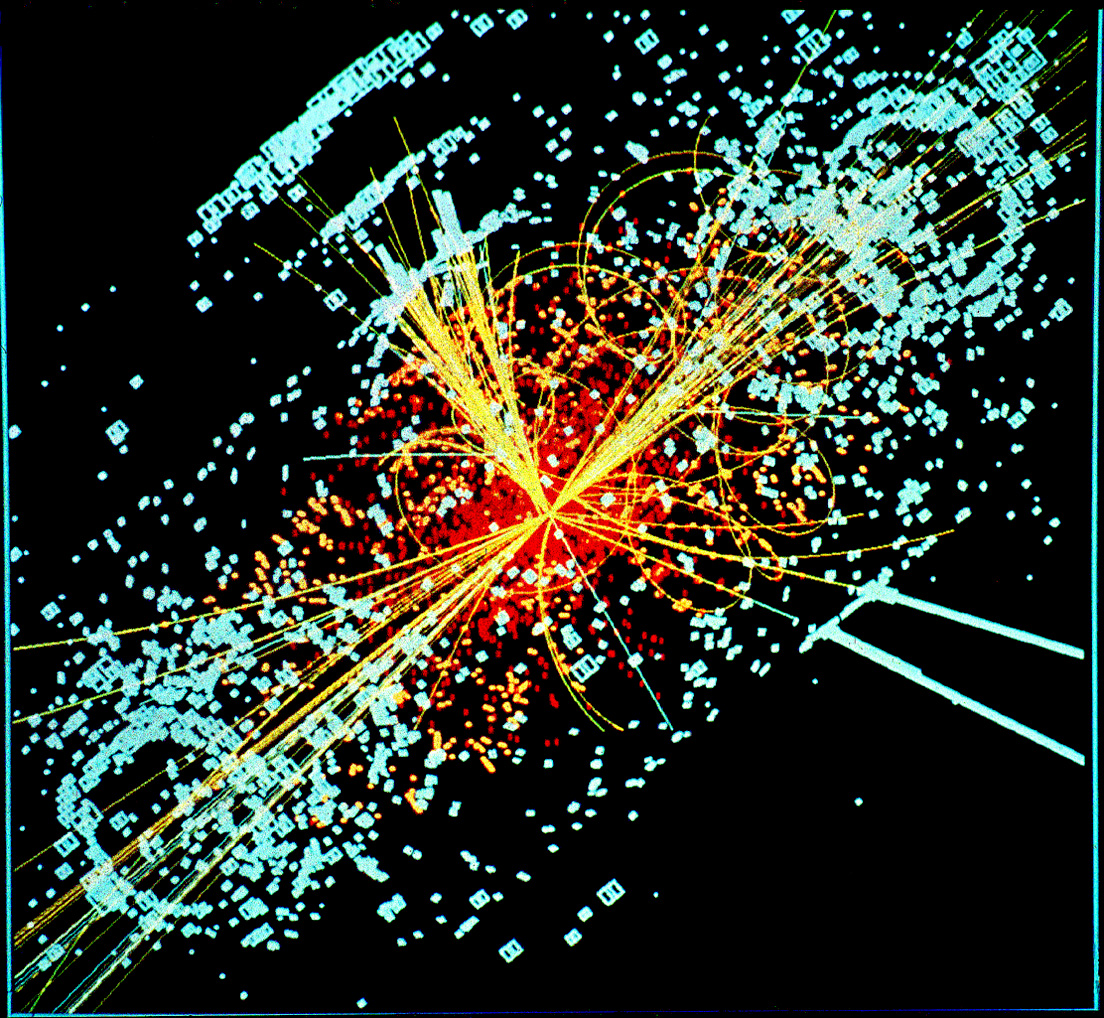
mark II wrote:madner wrote:Da sumiram par stvari. Hawking nije odustao od teorije superstruna. Bozon je jedina elementarna cestica koja jos nije pronadjena, ali moguce da ce biti (CERN).
Hawking nije odustao od mogucnosti da univerzum samo postoji i taj model nije u sudaru sa Big Beng teorijom.
Naucne teorije trenutno ne trebaju Kreatora. Jedini nacin kako je moguce doci do iste jeste umisljanje, jer ili selektivno citiranje.
To ne znaci da nauka dokazuje da ne postoji Kreator, ali postavlja jako jasne granice za njegovo djelovanje.
Hawking nikad nije imao problema sa postojanjem svemira, nego sa "nastajanjem svemira" - od "oduvijek svemira" je odustao, barem je on tako rekao. Oduvijek svemir je u koliziji sa Bing Bang svemirom, pročitaj samog Hawkinga kada razočarano veli da je odlučio pobiti svoga profesora Einsteina, jer mu je rekao da uzaludno kvantnu fiziku sa mikrokosmosa pokušava prešaltati na makro, jer "Bog se ne igra" - to ga je opeklo najviše, pa je pokušao dokazati Univerzum bez Boga.
Bozon nije jedina elemetarna čestica koja nije pronađena, nije pronađen ni kvark ni foton (samo se teorijski objašnjavaju), za foton se ne zna je li čestica ili je talasna dužina, a niko nije vidio ni leptone ni kvarkove - problem je "božanska funkcija" bozona, i kako može čestica imati božansku funkciju u smislu postojanja oduvijek i omogućavanja konekcije između ostalih čestica - inteligentna čestica možda, čestica koja planira, da nije SILA, sto mu džedaja (velim, nije šija neg' je vrat).
Ne, tu teoriju oduvijek svemira je iznjeo u skladu i sklopu teorije Big Benga. Medjutim moramo paziti da ta predpostavka nije iznesena u naucnoj teoriji, nego u zabavnoj knjizivnosti. Dakle, Hawking se igrao filozofa, ali ne spominje Boga kao faktora.
Einstein je pokusao pobiti kvantnu teoriju, jer mu se nije svidjao princip neodredjenosti. Bog se ne kocka se odnosi na njegov anatagonizam prema toj teoriji, nikako na njegova vjerska uvjerenja. I nije pokusao dokazati da Bog ne postoji, to je jednostavno zakljucak koji se moze izvesti iz njegove teorije.
"The wave function is Psi[hij,Phi]. Without bothering overly much about technical niceties, we may take Phi as representing the matter field of the initial state of the universe, roughly, how much matter this state contains and how it is distributed. hij may be regarded as representing the metrical structure of the initial state of the universe, that is, the sort of curvature possessed by the three dimensional space of this state. [Note: For a technical discussion of Hawking's quantum cosmology, see Quentin Smith, 'The Wave Function of a Godless Universe' in [20]; also see Smith and Grunbaum [21].] Psi is the amplitude, which is important since the square of the modulus of the amplitude gives a probability, namely, the probability that the universe will begin to exist with the metric hij and the matter field Phi.
The square of the modulus of the amplitude is |Psi[hij,Phi]|2. As Hartle and Hawking say, this gives us the probability 'for the Universe to appear from nothing' ([8], p. 2961), specifically, it gives us the unconditional probability that a universe begins to exist with the metric hij and matter field Phi. The reason this equation is inconsistent with classical theism is related to the respect in which quantum cosmology has superior explanatory value to classical general relativistic cosmology (the 'standard hot big bang model'). According to the standard hot big bang model, the universe began to exist about 15 billion years ago from a physical singularity, the big bang singularity. At this singularity, all physical laws break down and thus it is in principle impossible to predict what will emerge from the singularity. Furthermore, the existence of the singularity itself is an unexplained given. [Note: This assumes a realist interpretation of the big bang singularity; for further discussion see Smith [13], [14], [15], [16], [18], [19].] Hawking's quantum cosmology omits the initial singularity and implies that it is probable (to a degree less than one) that the universe begins to exist with a nonsingular state, namely hij,Phi, in accordance with the wave function law Psi[hij,Phi]. "
It is precisely this implication that precludes the existence of God. Let us suppose (for the sake of illustration) that the probability value the wave function gives us is 95%. The wave function law would then entail:
(1) The probability that a universe begin to exist with the metric hij and matter field Phi is 95%.
Now consider the hypothesis that God ordains that Hawking's wave function law obtains. Assuming this hypothesis, God could create the sort of universe that is most probable or the one that is second most probable, etc., as specified by the law he chose to make obtain. Suppose he decides to create the most probable one. It follows that the universe has a sufficient condition of its existence, not a probabilistic one. Note that
(2) God wills that a universe begin to exist with a metric hij and matter field Phi.
entails
(3) The probability that a universe begin to exist with the metric hij and matter field Phi is 100%.
God is omnipotent and thus his willing cannot fail to be effective and thus the probability value is 100%. Now (3) is inconsistent with (1). Since (1) is true if Hawking's wave function law obtains and (2) entails (3), it follows that (2) is false if Hawking's wave function law obtains.
Put another way, it is implicitly self-contradictory that
(4) God wills that Hawking's wave function law obtains and that a universe begin to exist with the metric hij and matter field Phi,
 , a mi smo samo zapisi. O fotonu se kao čestici govori od Ajnštajna, ako me pamćenje služi. Gravitacije je pojava u prostorvremenu o kojoj niko ništa ne zna, ali svi vjerujemo u nju. Teorijski se govori o gravitonu, niko ga nije vidio, niko ga nije dokazao kao česticu, niko ne poznaje šta je to, no vidimo njegovo dejstvo i pokušavamo ga objasniti. Bozon je u kontekstu u kojem sam ga ja iskoristio zbirna imenica.

 , moram, nema više smisla: