#26 Re: ja odlucio postat muzicar
Posted: 26/11/2012 18:44
Effects (FX)
- Reverb
Sound waves reflecting off of a surface or many surfaces.
- Decay is the time required for the reflections (reverberation) to die away. In most modern music production, reverb decay times of between one and three seconds are prevalent.
- Predelay is the time between the end of the initial sound and the moment when the first reflections become audible. Adjusting the predelay parameter on a reverb allows you to change the apparent size of the room without having to change the overall decay time.
- HF and LF decay. The types of surfaces in a space also affect the sound. Carpet and soft furnishings will absorb more high-frequency waves, thereby reducing the high-frequency decay time, while hard surfaces such as tile or stone reflect sound extremely well, resulting in a “brighter” ambience. Similarly, the high-frequency (HF) and low-frequency (LF) decay time allow you to adjust the “brightness” or “darkness” of the reverb, enabling you to better emulate these environmental factors.
- Delay
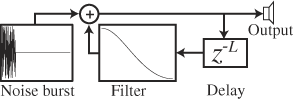
A delay essentially creates an echo.
- Delay Time. Delay time is the time between the source signal and its echo. The simplest delay effect is a single repeat. A short delay between 30 and 100 ms can be used to create slap-back echo, while longer delay times produce a more distant echo. Delay times that are too short to hear as distinct echoes can be used to create thickening effects.
- Variable Feedback. Variable feedback, or regeneration, produces multiple decaying repeats. Increasing the feedback value increases the number of echoes as well as the resonance that is created as one echo disappears into another.
- Chorus
Chorus effect creates copies of a single source signal to artificially create the impression that there is more than instrument playing, voice singing, etc. This ensemble effect is created using a series of short, continuously varying delays that produce slight pitch-shifts and add fullness to a sound.
- LFO Speed and Width: The copies are delayed using a low-frequency oscillator. Some chorus effects allow you to adjust the speed and width of the waveform being applied to modulate the source signal.
- Depth: The depth control affects how much the total delay time changes over time. As the delay time changes, you can hear slight frequency modulations.
- Phase
Phase shifting creates a copy of the source signal and shifts the copy in time relative to the original signal, creating from 0 to 360 degrees of phase difference throughout the frequency spectrum. The shifted signal is blended with the source signal so that you can hear the copy moving in and out of phase with the original. This creates a characteristic “swoosh.”
- Flange
Flanging is a type of phase shifting. It is created by splitting an audio signal into two identical signals; applying a constantly varying, short delay to one signal; and mixing it with the unaltered signal. This results in a swept, “swooshy” effect.
- Reverb
Sound waves reflecting off of a surface or many surfaces.
- Decay is the time required for the reflections (reverberation) to die away. In most modern music production, reverb decay times of between one and three seconds are prevalent.
- Predelay is the time between the end of the initial sound and the moment when the first reflections become audible. Adjusting the predelay parameter on a reverb allows you to change the apparent size of the room without having to change the overall decay time.
- HF and LF decay. The types of surfaces in a space also affect the sound. Carpet and soft furnishings will absorb more high-frequency waves, thereby reducing the high-frequency decay time, while hard surfaces such as tile or stone reflect sound extremely well, resulting in a “brighter” ambience. Similarly, the high-frequency (HF) and low-frequency (LF) decay time allow you to adjust the “brightness” or “darkness” of the reverb, enabling you to better emulate these environmental factors.
- Delay
A delay essentially creates an echo.
- Delay Time. Delay time is the time between the source signal and its echo. The simplest delay effect is a single repeat. A short delay between 30 and 100 ms can be used to create slap-back echo, while longer delay times produce a more distant echo. Delay times that are too short to hear as distinct echoes can be used to create thickening effects.
- Variable Feedback. Variable feedback, or regeneration, produces multiple decaying repeats. Increasing the feedback value increases the number of echoes as well as the resonance that is created as one echo disappears into another.
- Chorus
Chorus effect creates copies of a single source signal to artificially create the impression that there is more than instrument playing, voice singing, etc. This ensemble effect is created using a series of short, continuously varying delays that produce slight pitch-shifts and add fullness to a sound.
- LFO Speed and Width: The copies are delayed using a low-frequency oscillator. Some chorus effects allow you to adjust the speed and width of the waveform being applied to modulate the source signal.
- Depth: The depth control affects how much the total delay time changes over time. As the delay time changes, you can hear slight frequency modulations.
- Phase
Phase shifting creates a copy of the source signal and shifts the copy in time relative to the original signal, creating from 0 to 360 degrees of phase difference throughout the frequency spectrum. The shifted signal is blended with the source signal so that you can hear the copy moving in and out of phase with the original. This creates a characteristic “swoosh.”
- Flange
Flanging is a type of phase shifting. It is created by splitting an audio signal into two identical signals; applying a constantly varying, short delay to one signal; and mixing it with the unaltered signal. This results in a swept, “swooshy” effect.