
Effects (FX)
- Reverb
Sound waves reflecting off of a surface or many surfaces.
- Decay is the time required for the reflections (reverberation) to die away. In most modern music production, reverb decay times of between one and three seconds are prevalent.
- Predelay is the time between the end of the initial sound and the moment when the first reflections become audible. Adjusting the predelay parameter on a reverb allows you to change the apparent size of the room without having to change the overall decay time.
- HF and LF decay. The types of surfaces in a space also affect the sound. Carpet and soft furnishings will absorb more high-frequency waves, thereby reducing the high-frequency decay time, while hard surfaces such as tile or stone reflect sound extremely well, resulting in a “brighter” ambience. Similarly, the high-frequency (HF) and low-frequency (LF) decay time allow you to adjust the “brightness” or “darkness” of the reverb, enabling you to better emulate these environmental factors.
- Delay
A delay essentially creates an echo.
- Delay Time. Delay time is the time between the source signal and its echo. The simplest delay effect is a single repeat. A short delay between 30 and 100 ms can be used to create slap-back echo, while longer delay times produce a more distant echo. Delay times that are too short to hear as distinct echoes can be used to create thickening effects.
- Variable Feedback. Variable feedback, or regeneration, produces multiple decaying repeats. Increasing the feedback value increases the number of echoes as well as the resonance that is created as one echo disappears into another.
- Chorus
Chorus effect creates copies of a single source signal to artificially create the impression that there is more than instrument playing, voice singing, etc. This ensemble effect is created using a series of short, continuously varying delays that produce slight pitch-shifts and add fullness to a sound.
- LFO Speed and Width: The copies are delayed using a low-frequency oscillator. Some chorus effects allow you to adjust the speed and width of the waveform being applied to modulate the source signal.
- Depth: The depth control affects how much the total delay time changes over time. As the delay time changes, you can hear slight frequency modulations.
- Phase
Phase shifting creates a copy of the source signal and shifts the copy in time relative to the original signal, creating from 0 to 360 degrees of phase difference throughout the frequency spectrum. The shifted signal is blended with the source signal so that you can hear the copy moving in and out of phase with the original. This creates a characteristic “swoosh.”
- Flange
Flanging is a type of phase shifting. It is created by splitting an audio signal into two identical signals; applying a constantly varying, short delay to one signal; and mixing it with the unaltered signal. This results in a swept, “swooshy” effect.
ja odlucio postat muzicar
Moderator: _BataZiv_0809
-
chengaba

- Posts: 1870
- Joined: 08/10/2003 00:00
#27 Re: ja odlucio postat muzicar
I šta kupi na kraju druže? 
-
reis1

- Posts: 2234
- Joined: 07/11/2012 17:52
- Location: Sarajevo
#28 Re: ja odlucio postat muzicar
Nastimao sam Creativku i skrhao monitore u krevet!chengaba wrote:I šta kupi na kraju druže?
Al' kupit cu Focusrite Saffire Pro 24 DSP (kad za to dodje vrijeme) -
reis1
- Posts: 2234
- Joined: 07/11/2012 17:52
- Location: Sarajevo
#29 Re: ja odlucio postat muzicar
MUSIC THEORY
http://www.studybass.com/lessons/common-bass-patterns/
BASS BASICS
- Music is comprised of three main elements—rhythm, harmony and melody
- The bass lays the foundation for two of these three elements: rhythm and harmony
Music theory:
Rhythm — when and for how long musical events happen
Harmony — how notes are combined (keys, chords and chord progressions)
Melody — groups of notes played one after another
An arpeggio is the notes of a chord played one after another instead of at the same time.
A chord progression is a series of different chords played one after another. For example, a common chord progression is C – G – Am – F. The bass helps support the chord progression:
Scales are named with their starting note, or root note, followed by the type of scale it is. Scales complement chords. You will run across many books and lessons which say play this scale over this chord, and that one over that chord - it’s not wrong, but first you need a firm grasp of the chord to which you apply the scale.
Traditionally, bass players don’t play the main melodies of songs much. Even if a bass player is not playing the main melody, he or she is still able to play in a melodic way.
Protect your ears even when you think the sound levels are not going to be that loud.
BASS TECHNIQUE
The further away your fingers are from the strings, the longer it will take for them to come back to the strings to do anything. This will slow you down. It will impact your legato—long and connected—notes.
The basic idea to exercises is to let one finger hold and sustain a note while the other three do something else.
READING MUSIC
Even though bassists don’t typically play a lot of chords by themselves on bass, bassists are still very involved in forming the sound of the chord along with the whole band or ensemble. As a bassist, when you play with a group of musicians you are playing one of those “3 or more different notes” that forms the chord being played by the whole band. In many situations bassists are not told what specific notes to play, but only what the chords of a song are. In this common situation the bassist is expected to play notes that support and complement the sound of each chord as it passes by. So, bassists often read chord symbols in written music and make up or improvise a bassline that matches the chords of the song instead of playing a specific, written out bassline.
Slash chord is a chord which indicates emphasis of a bass note other than the root of the chord. When a chord is played it is typically assumed the bass will emphasize the root of the chord. Occasionally a different note is preferred and results in a chord with an alternate bass note. Slash chords are notated with a chord's standard chord symbol, followed by a forward slash, followed by the alternate bass note. For example, G/B or D7/F# are slash chords.
An often seen chord progression is: G - G/B - C. In this progression the G chord is being played by the entire group on the first chord G. But, on the G/B chord the band continues playing the G chord while the bass player is to stress the note B which makes a smooth, chromatic transition to the root of the C chord. So, the bass would emphasize the notes G, B, then C on each of these 3 chords.
Another example progression might be: Am - Am(maj7)/G# - Am7/G - D/F# - F. This is a very common scenario where the alternate bass notes create a smooth, descending chromatic bassline -- A, G#, G, F#, F.
Though it's not required, very often the alternate bass note of a slash chord is another note from within the chord. In the previous example of G/B the note B is the third of the G major triad (G, B, D). Or, in Am7/G the note G is the 7th of the A minor seventh chord (Am7 = A, C, E, G).
PRACTICE
Frequency of practice is more important than quantity of practice. You will retain more and learn at a faster pace if you consistently practice 30 minutes every day of the week rather than 6 hours one day a week. Long practice sessions may stimulate hand injuries, and you are at higher risk of losing your hearing.
http://www.studybass.com/lessons/common-bass-patterns/
BASS BASICS
- Music is comprised of three main elements—rhythm, harmony and melody
- The bass lays the foundation for two of these three elements: rhythm and harmony
Music theory:
Rhythm — when and for how long musical events happen
Harmony — how notes are combined (keys, chords and chord progressions)
Melody — groups of notes played one after another
An arpeggio is the notes of a chord played one after another instead of at the same time.
A chord progression is a series of different chords played one after another. For example, a common chord progression is C – G – Am – F. The bass helps support the chord progression:
Scales are named with their starting note, or root note, followed by the type of scale it is. Scales complement chords. You will run across many books and lessons which say play this scale over this chord, and that one over that chord - it’s not wrong, but first you need a firm grasp of the chord to which you apply the scale.
Traditionally, bass players don’t play the main melodies of songs much. Even if a bass player is not playing the main melody, he or she is still able to play in a melodic way.
Protect your ears even when you think the sound levels are not going to be that loud.
BASS TECHNIQUE
The further away your fingers are from the strings, the longer it will take for them to come back to the strings to do anything. This will slow you down. It will impact your legato—long and connected—notes.
The basic idea to exercises is to let one finger hold and sustain a note while the other three do something else.
READING MUSIC
Even though bassists don’t typically play a lot of chords by themselves on bass, bassists are still very involved in forming the sound of the chord along with the whole band or ensemble. As a bassist, when you play with a group of musicians you are playing one of those “3 or more different notes” that forms the chord being played by the whole band. In many situations bassists are not told what specific notes to play, but only what the chords of a song are. In this common situation the bassist is expected to play notes that support and complement the sound of each chord as it passes by. So, bassists often read chord symbols in written music and make up or improvise a bassline that matches the chords of the song instead of playing a specific, written out bassline.
Slash chord is a chord which indicates emphasis of a bass note other than the root of the chord. When a chord is played it is typically assumed the bass will emphasize the root of the chord. Occasionally a different note is preferred and results in a chord with an alternate bass note. Slash chords are notated with a chord's standard chord symbol, followed by a forward slash, followed by the alternate bass note. For example, G/B or D7/F# are slash chords.
An often seen chord progression is: G - G/B - C. In this progression the G chord is being played by the entire group on the first chord G. But, on the G/B chord the band continues playing the G chord while the bass player is to stress the note B which makes a smooth, chromatic transition to the root of the C chord. So, the bass would emphasize the notes G, B, then C on each of these 3 chords.
Another example progression might be: Am - Am(maj7)/G# - Am7/G - D/F# - F. This is a very common scenario where the alternate bass notes create a smooth, descending chromatic bassline -- A, G#, G, F#, F.
Though it's not required, very often the alternate bass note of a slash chord is another note from within the chord. In the previous example of G/B the note B is the third of the G major triad (G, B, D). Or, in Am7/G the note G is the 7th of the A minor seventh chord (Am7 = A, C, E, G).
PRACTICE
Frequency of practice is more important than quantity of practice. You will retain more and learn at a faster pace if you consistently practice 30 minutes every day of the week rather than 6 hours one day a week. Long practice sessions may stimulate hand injuries, and you are at higher risk of losing your hearing.
Last edited by reis1 on 28/11/2012 23:31, edited 1 time in total.
-
_grasshopper_
- Posts: 14
- Joined: 21/05/2012 10:46
#30 Re: ja odlucio postat muzicar
Pozdrav ljudi,
Ja bih poceo da sviram gitaru,i zelim da si kupim neku klasicnu ili akusticnu polovnu za pocetnike...evo obiljezio sam na Piku sve na ovom linku,pa bih vam bio zahvalan ako biste mi rekli kod koje je od ovih gitara najbolji odnos kvalitet/cijena??? Kod nekih se nudi i torba itd.
http://www.pik.ba/?trazilica=&id=67&bra ... gorija=419
Ja bih poceo da sviram gitaru,i zelim da si kupim neku klasicnu ili akusticnu polovnu za pocetnike...evo obiljezio sam na Piku sve na ovom linku,pa bih vam bio zahvalan ako biste mi rekli kod koje je od ovih gitara najbolji odnos kvalitet/cijena??? Kod nekih se nudi i torba itd.
http://www.pik.ba/?trazilica=&id=67&bra ... gorija=419
-
reis1
- Posts: 2234
- Joined: 07/11/2012 17:52
- Location: Sarajevo
#31 Re: ja odlucio postat muzicar
Ne radi ti link buraz..._grasshopper_ wrote:Pozdrav ljudi,
Ja bih poceo da sviram gitaru,i zelim da si kupim neku klasicnu ili akusticnu polovnu za pocetnike...evo obiljezio sam na Piku sve na ovom linku,pa bih vam bio zahvalan ako biste mi rekli kod koje je od ovih gitara najbolji odnos kvalitet/cijena??? Kod nekih se nudi i torba itd.
www.pik ba/?trazilica=&id=67&brand=&kanton=14&mjesto=&brand=&vrsta=sve&od=&do=80&stanje=&kategorija=419
Koliko ja znam (hAmaterski za zicane instrumente), ono sti ti je bitno jeste da vrat gitare (ono gdje se pritisCu zice) nije iskrivljen (lijevo-desno, gore-dole) u odnosu na rezonator gitare (ono Dze rupa). Ostalo, kvalitet zavisi od izrade rezonatora, materijala, zica, itd itd -> ovo utice na cijenu.
-
_grasshopper_
- Posts: 14
- Joined: 21/05/2012 10:46
#32 Re: ja odlucio postat muzicar
Evo linkovi
http://www.pik.ba/artikal/4572430/os...rba-za-gitaru/
http://www.pik.ba/artikal/2776496/akusticna-gitara/
http://www.pik.ba/artikal/3720579/valencia-cg1k-n/
http://www.pik.ba/artikal/4591377/klasicna-gitara/
http://www.pik.ba/artikal/4501954/klasicna-gitara/
http://www.pik.ba/artikal/2977214/gitara/
http://www.pik.ba/artikal/3498432/klasicna-gitara/
Znaci odnos cijena/kvalitet , uzmite u obzir da li dolazi torba uz gitaru...mnogo bi mi znacila vasa pomoc
http://www.pik.ba/artikal/4572430/os...rba-za-gitaru/
http://www.pik.ba/artikal/2776496/akusticna-gitara/
http://www.pik.ba/artikal/3720579/valencia-cg1k-n/
http://www.pik.ba/artikal/4591377/klasicna-gitara/
http://www.pik.ba/artikal/4501954/klasicna-gitara/
http://www.pik.ba/artikal/2977214/gitara/
http://www.pik.ba/artikal/3498432/klasicna-gitara/
Znaci odnos cijena/kvalitet , uzmite u obzir da li dolazi torba uz gitaru...mnogo bi mi znacila vasa pomoc
-
reis1
- Posts: 2234
- Joined: 07/11/2012 17:52
- Location: Sarajevo
#33 Re: ja odlucio postat muzicar
MUSIC THEORY
http://www.studybass.com/lessons
COMMON BASS PATTERNS
- Roots to Chords - A good starting point for creating basslines is to play the root of each chord at the moment the chord changes. This is often on beat 1 of the bar.
Ex4
http://www.studybass.com/lessons/common ... exercises/

- Octaves - To add some variety without adding more notes to the mix, we could add in octaves of those root notes. Some of the most obvious places you can hear octaves are in slap basslines and in disco basslines.
Ex3, Ex4
http://www.studybass.com/lessons/common ... exercises/


- Roots and Fifths - The root and fifth pattern is one of the most common note patterns used by bass players. The root and fifth of the chord are the most supportive sounding notes a bassist can play beneath a chord. The reason roots and 5ths are used so often is because they consistently sound good.
Ex3, Ex5, Ex6
http://www.studybass.com/lessons/common ... exercises/


- Root Fifth Flat Seventh - Even though the flat 7th is used a lot in basslines, it is a little less universal and a little more care needs to be taken when applying it. When you apply it always listen that it fits with the sound of the chord. Some chords have a flat 7th in them, others don't. On those chords which do, you can always apply the flat 7th. On those chords which don't, many times you can still apply the flat 7th and it will sound good. But, you have to be careful. Listening, experience, and more knowledge of chords and scales will teach you when to apply this note.
Ex2, Ex3, Ex5
http://www.studybass.com/lessons/common ... exercises/


- Root Fifth Sixth - When creating a bassline one of your major responsibilities is to support the sound of each chord. The sixth is a highly melodic note we can add to our roots, fifths and octave patterns. The sixth can be applied to virtually any major type of chord. It can also work on some minor chords. Remember, your ear is always the final judge (or the ear of whomever is paying you). Sometimes the sixth may not be the best note choice. The root-fifth-sixth pattern has a brighter, happier sound to it.
Ex1, Ex2, Ex3, Ex4
http://www.studybass.com/lessons/common ... exercises/


- Chromatic Approach Notes - Another important function of a bassline is to connect one chord to the next. Many good basslines propel a song through its chord progression. A chord progression is a sequence of chords. Progress means to move forward. So a chord progression moves forward through a series of chords. One way of creating forward motion is by using notes that lead into, or approach, the main notes which you are playing. Basically the approach note creates a little bit of tension which pulls you into some other note.
a) Chromatic approach notes lead from one note to the very next note. The chromatic approach note can come from one note above or one note below the target note. For example, if you were approaching the note C you might approach it from the note C# (one note above), or from the note B (one note below).
b) Many times when two main notes are separated by one note you can use the note inbetween to connect them. In this instance we'd call the chromatic note a passing tone. It works in the same way — chromatically leading from one place to another. For instance, if you were going from the note C to the note D you could use the note C# to smoothly connect them.
The chromatic approach note should always be handled with care. It can sound downright awful if it is applied poorly. The chromatic approach note is usually a very weak, unstable note to play. If you emphasize it in the wrong place rhythmically, you can really upset things. Most often these chromatic notes fall in weak places like inbetween the beats, or on beats 2 & 4. Rarely do they fall on beats 1 & 3 where your ear expects to hear strong supportive notes like the root and fifth instead.
Ex1, Ex2, Ex3
http://www.studybass.com/lessons/common ... ach-notes/


Most basslines don’t stick to one note pattern and use it throughout. Instead, various note patterns are mixed, matched and combined in numerous ways.
http://www.studybass.com/lessons
COMMON BASS PATTERNS
- Roots to Chords - A good starting point for creating basslines is to play the root of each chord at the moment the chord changes. This is often on beat 1 of the bar.
Ex4
http://www.studybass.com/lessons/common ... exercises/
- Octaves - To add some variety without adding more notes to the mix, we could add in octaves of those root notes. Some of the most obvious places you can hear octaves are in slap basslines and in disco basslines.
Ex3, Ex4
http://www.studybass.com/lessons/common ... exercises/
- Roots and Fifths - The root and fifth pattern is one of the most common note patterns used by bass players. The root and fifth of the chord are the most supportive sounding notes a bassist can play beneath a chord. The reason roots and 5ths are used so often is because they consistently sound good.
Ex3, Ex5, Ex6
http://www.studybass.com/lessons/common ... exercises/
- Root Fifth Flat Seventh - Even though the flat 7th is used a lot in basslines, it is a little less universal and a little more care needs to be taken when applying it. When you apply it always listen that it fits with the sound of the chord. Some chords have a flat 7th in them, others don't. On those chords which do, you can always apply the flat 7th. On those chords which don't, many times you can still apply the flat 7th and it will sound good. But, you have to be careful. Listening, experience, and more knowledge of chords and scales will teach you when to apply this note.
Ex2, Ex3, Ex5
http://www.studybass.com/lessons/common ... exercises/
- Root Fifth Sixth - When creating a bassline one of your major responsibilities is to support the sound of each chord. The sixth is a highly melodic note we can add to our roots, fifths and octave patterns. The sixth can be applied to virtually any major type of chord. It can also work on some minor chords. Remember, your ear is always the final judge (or the ear of whomever is paying you). Sometimes the sixth may not be the best note choice. The root-fifth-sixth pattern has a brighter, happier sound to it.
Ex1, Ex2, Ex3, Ex4
http://www.studybass.com/lessons/common ... exercises/
- Chromatic Approach Notes - Another important function of a bassline is to connect one chord to the next. Many good basslines propel a song through its chord progression. A chord progression is a sequence of chords. Progress means to move forward. So a chord progression moves forward through a series of chords. One way of creating forward motion is by using notes that lead into, or approach, the main notes which you are playing. Basically the approach note creates a little bit of tension which pulls you into some other note.
a) Chromatic approach notes lead from one note to the very next note. The chromatic approach note can come from one note above or one note below the target note. For example, if you were approaching the note C you might approach it from the note C# (one note above), or from the note B (one note below).
b) Many times when two main notes are separated by one note you can use the note inbetween to connect them. In this instance we'd call the chromatic note a passing tone. It works in the same way — chromatically leading from one place to another. For instance, if you were going from the note C to the note D you could use the note C# to smoothly connect them.
The chromatic approach note should always be handled with care. It can sound downright awful if it is applied poorly. The chromatic approach note is usually a very weak, unstable note to play. If you emphasize it in the wrong place rhythmically, you can really upset things. Most often these chromatic notes fall in weak places like inbetween the beats, or on beats 2 & 4. Rarely do they fall on beats 1 & 3 where your ear expects to hear strong supportive notes like the root and fifth instead.
Ex1, Ex2, Ex3
http://www.studybass.com/lessons/common ... ach-notes/
Most basslines don’t stick to one note pattern and use it throughout. Instead, various note patterns are mixed, matched and combined in numerous ways.
-
_grasshopper_
- Posts: 14
- Joined: 21/05/2012 10:46
#34 Re: ja odlucio postat muzicar
A ja se taman ponado neko mi gitaru preporucio 
-
reis1
- Posts: 2234
- Joined: 07/11/2012 17:52
- Location: Sarajevo
#35 Re: ja odlucio postat muzicar
Ne rade ti linkovi..._grasshopper_ wrote:A ja se taman ponado neko mi gitaru preporucio
Tesko ce ti iko preporuciti akusticni instrument ovako - otidji s nekim ko svira da vidi jel ispravan.
Ono sto ja znam jeste da trebas paziti vrat gitare (da nije pomjeren lijevo-desno, gore-dole). Dodatno, pod 2, moja preporuka je da su ti zice blize frethovima tj. izmedju instrumenta A gdje su zice udaljene npr. 8mm od frethova i instrumenta B gdje su ti zice udaljene npr. 5mm od frethova, uzmi B. Razlog: kad sviras, imas tako reci manje pomjeranje prstiju pa tako sa istom ulozenom vjestinom na instrumentu A mozes odsvirat npr. 8 nota/per sekundu, dok na instrumentu B mozes odsvirat npr. 10 nota/per sekund.
Kvalitet instrumenta mehanicki, tj. koliko ce ti dugo izdrzati bez deformacija, to isto moras pitat nekog ko ima iskustva sa tim, da ti preporuci "marku" (mada mislim da je ovo relativno, ako ga pazis, svaki ce ti trajati dugo). Kvalitet zvuka instrumenta - irelevantno - akusticni instrumenti svaki ima specifican zvuk, ilit "boju" kako se to kod nasKe po seljacki zove...
Otidji s nekim ko svira nek ti izabere instrument.
-
_grasshopper_
- Posts: 14
- Joined: 21/05/2012 10:46
#36 Re: ja odlucio postat muzicar
Ipak mislim da cu odabrati novu gitaru Neku Hohnerovu da vidim kako ide
Neku Hohnerovu da vidim kako ide -
reis1
- Posts: 2234
- Joined: 07/11/2012 17:52
- Location: Sarajevo
#37 Re: ja odlucio postat muzicar
MUSIC THEORY
http://www.studybass.com/lessons
RHYTHM
One theory of mine is that styles evolve partly because the audience gets bored with the current rhythms in music.
People like the rhythm. You won’t hear too many popular songs or styles with terrible rhythm. People won’t listen to it. Listeners tune into rhythm more than anything else. People like to dance! Dancing is connecting to rhythm.
Every style has its own set of unique rhythms. The rhythms are part of the language of each musical style. To master a style, you need to master its rhythms.
Melodic parts of singers and when musicians play solos are not part of the rhythm section. They instead sing or play on top of the rhythm section
http://www.studybass.com/lessons
RHYTHM
One theory of mine is that styles evolve partly because the audience gets bored with the current rhythms in music.
People like the rhythm. You won’t hear too many popular songs or styles with terrible rhythm. People won’t listen to it. Listeners tune into rhythm more than anything else. People like to dance! Dancing is connecting to rhythm.
Every style has its own set of unique rhythms. The rhythms are part of the language of each musical style. To master a style, you need to master its rhythms.
Melodic parts of singers and when musicians play solos are not part of the rhythm section. They instead sing or play on top of the rhythm section
Last edited by reis1 on 28/11/2012 23:30, edited 1 time in total.
-
reis1
- Posts: 2234
- Joined: 07/11/2012 17:52
- Location: Sarajevo
#38 Re: ja odlucio postat muzicar
MUSIC THEORY
http://www.studybass.com/lessons
INTERVALS
A melodic interval is when the two notes are played one after another (as in a melody). A harmonic interval is when the two notes are played at the same time (as in chords).
SCALES
- Pentatonic scale - Very versatile, is easy to play on the bass, and contains a very pleasing-to-hear group of notes. That’s why it is such a commonly used scale. A one-octave C major pentatonic scale is spelled C, D, E, G, A, and C an octave above. You will run into and use this scale a lot. You might use it more often than any other scale. It works very well in basslines and many melodies use the major pentatonic scale. Notice the major pentatonic's similarities to the root-fifth-sixth pattern in the common bass patterns.
- Mixolydian scale - The C major scale is C, D, E, F, G, A, B, and C. The fifth note of C major is G. Therefore the 5th mode of C major is G mixolydian: G, A, B, C, D, E, F, and G. Compared to the major scale the mixolydian mode has a flatted 7th.
- Minor Blues Scale - The intervals for the minor blues scale are: Root, m3, P4, D5, P5, m7, and P8
Many times it is the bass player who holds down the dominant sound while a soloist (guitar, piano, etc.) applies the minor pentatonic sound. But, bassists get to do it in riffs, solos and fills, too.
BASS CHORD PATTERNS
Some of scale notes — like the 2nd, 4th and 6th — aren't supportive of the chord. If your original bassline sounds weak you are probably underemphasizing the chord tones and overemphasizing scale tones.
Bass is a unique instrument playing a very critical role of supporting the chords. Other instruments won't sound as weak if they don't support the chords as well.
When creating a bassline the notes of the triad do not need to be played in any particular order. And, you don’t necessarily need to play all of the triad’s notes to imply its sound. For instance, you might only play the root and the third.
Most often basslines emphasize the root of the chord on beat 1. Everything else is open territory.
- Often times you might not play the 7th of the major 7th chord at all in your bassline. Usually the other instruments in the group will play the 7th in their parts to create the sound of the major 7th chord even if you just stick to the basic triad.
- The sound of the dominant 7th chord is often described as tense, dissonant, and maybe even harsh. The tense sound of this chord comes from the discordant relationship between the third and seventh. The dominant 7th strongly directs the music towards other chords. Other times this tension is used to produce a constant unresolved state as is common in funk.
- The diminished triad has a “diminished 5th” meaning it has a flatted, or lowered, 5th (in comparison to the typical perfect 5th found in most chords like the major and minor triads). The diminished triad is a very tense and unstable sounding chord. As a result, it doesn’t get used anywhere near as much as the major and minor triads or the major, minor and dominant 7th chords. Because of its unstable sound, the diminished triad is rarely played for a long stretch of time. Instead, it is used more often as a transition chord leading to some other chord. For example, the chord progression C – C#dim – Dm would create a chromatic root movement of C to C# to D. It’s a common mistake to play a perfect fifth rather than a diminished 5th. Hitting the wrong 5th on this chord will ruin the sound and function of this chord most times.
- The minor 7(b5) chord is built with a root, minor 3rd, diminished 5th and minor 7th. The main thing to watch out for is to remember to play a flatted 5th rather than the perfect fifth.
- The diminished 7th is a very dissonant chord. Dissonant chords are rarely played for long stretches of time by themselves. Diminished 7th chords function most as transitionary chords. Often the notes of the diminished 7th chord connect chromatically to the notes of the next chord.
HARMONY
A large aspect of playing the bass deals with defining the sound of the chord progression as it moves forward. The bassist’s job especially revolves around the root movement of the chord progression.
The root note of the key is called the tonic. When you play music, the music is constantly being pulled toward the tonic, or root of the key, wanting to come to a state of rest or completion. The tonic is the most resolved note in a key. The tonic is a key’s center.
When music has this centered sound to it, it is said to be tonal (pronounced TOE-nul), or possessing tonality. Almost all music to which we listen is tonal. When a piece of music lacks a tonal center it is said to be atonal (pronounced AY-toe-nul). Most people don't like the sound of atonal music.
# - sharp
b - flat
The order of sharps: F# C# G# D# A# E# B#
The order of flats: Bb Eb Ab Db Gb Cb Fb


You can't mix sharps and flats in a key spelling.
Diatonic means through a tonal center, or across the notes of a key. When we use the musical term diatonic, we mean the notes being used all come from the key. In that way the terms diatonic and key mean much the same thing. Diatonic chords are the chords that are derived from the notes of a key. These would be the diatonic chords in the key of C major:
............I ii iii IV V vi vii°
Key of C: C Dm Em F G Am B°
Here’s an example of a common chord progression in the key of C. The progression goes I – V – vi – IV. The chords are C – G – Am – F. It’s very common. You may recognize it from The Beatles song Let It Be, U2's With or Without You, or countless other songs.
When using the I, IV, and V chords together, your ear perceives I as home. Once home is established we can then take the listener away from home and back to home. Without a home, music will simply wander.
///////////////////////////////////////
Oki-doki, to je sto se tice bassa!!! Ostaju jos drums i onda se moze pocet komponovat...
http://www.studybass.com/lessons
INTERVALS
A melodic interval is when the two notes are played one after another (as in a melody). A harmonic interval is when the two notes are played at the same time (as in chords).
SCALES
- Pentatonic scale - Very versatile, is easy to play on the bass, and contains a very pleasing-to-hear group of notes. That’s why it is such a commonly used scale. A one-octave C major pentatonic scale is spelled C, D, E, G, A, and C an octave above. You will run into and use this scale a lot. You might use it more often than any other scale. It works very well in basslines and many melodies use the major pentatonic scale. Notice the major pentatonic's similarities to the root-fifth-sixth pattern in the common bass patterns.
- Mixolydian scale - The C major scale is C, D, E, F, G, A, B, and C. The fifth note of C major is G. Therefore the 5th mode of C major is G mixolydian: G, A, B, C, D, E, F, and G. Compared to the major scale the mixolydian mode has a flatted 7th.
- Minor Blues Scale - The intervals for the minor blues scale are: Root, m3, P4, D5, P5, m7, and P8
Many times it is the bass player who holds down the dominant sound while a soloist (guitar, piano, etc.) applies the minor pentatonic sound. But, bassists get to do it in riffs, solos and fills, too.
BASS CHORD PATTERNS
Some of scale notes — like the 2nd, 4th and 6th — aren't supportive of the chord. If your original bassline sounds weak you are probably underemphasizing the chord tones and overemphasizing scale tones.
Bass is a unique instrument playing a very critical role of supporting the chords. Other instruments won't sound as weak if they don't support the chords as well.
When creating a bassline the notes of the triad do not need to be played in any particular order. And, you don’t necessarily need to play all of the triad’s notes to imply its sound. For instance, you might only play the root and the third.
Most often basslines emphasize the root of the chord on beat 1. Everything else is open territory.
- Often times you might not play the 7th of the major 7th chord at all in your bassline. Usually the other instruments in the group will play the 7th in their parts to create the sound of the major 7th chord even if you just stick to the basic triad.
- The sound of the dominant 7th chord is often described as tense, dissonant, and maybe even harsh. The tense sound of this chord comes from the discordant relationship between the third and seventh. The dominant 7th strongly directs the music towards other chords. Other times this tension is used to produce a constant unresolved state as is common in funk.
- The diminished triad has a “diminished 5th” meaning it has a flatted, or lowered, 5th (in comparison to the typical perfect 5th found in most chords like the major and minor triads). The diminished triad is a very tense and unstable sounding chord. As a result, it doesn’t get used anywhere near as much as the major and minor triads or the major, minor and dominant 7th chords. Because of its unstable sound, the diminished triad is rarely played for a long stretch of time. Instead, it is used more often as a transition chord leading to some other chord. For example, the chord progression C – C#dim – Dm would create a chromatic root movement of C to C# to D. It’s a common mistake to play a perfect fifth rather than a diminished 5th. Hitting the wrong 5th on this chord will ruin the sound and function of this chord most times.
- The minor 7(b5) chord is built with a root, minor 3rd, diminished 5th and minor 7th. The main thing to watch out for is to remember to play a flatted 5th rather than the perfect fifth.
- The diminished 7th is a very dissonant chord. Dissonant chords are rarely played for long stretches of time by themselves. Diminished 7th chords function most as transitionary chords. Often the notes of the diminished 7th chord connect chromatically to the notes of the next chord.
HARMONY
A large aspect of playing the bass deals with defining the sound of the chord progression as it moves forward. The bassist’s job especially revolves around the root movement of the chord progression.
The root note of the key is called the tonic. When you play music, the music is constantly being pulled toward the tonic, or root of the key, wanting to come to a state of rest or completion. The tonic is the most resolved note in a key. The tonic is a key’s center.
When music has this centered sound to it, it is said to be tonal (pronounced TOE-nul), or possessing tonality. Almost all music to which we listen is tonal. When a piece of music lacks a tonal center it is said to be atonal (pronounced AY-toe-nul). Most people don't like the sound of atonal music.
# - sharp
b - flat
The order of sharps: F# C# G# D# A# E# B#
The order of flats: Bb Eb Ab Db Gb Cb Fb
You can't mix sharps and flats in a key spelling.
Diatonic means through a tonal center, or across the notes of a key. When we use the musical term diatonic, we mean the notes being used all come from the key. In that way the terms diatonic and key mean much the same thing. Diatonic chords are the chords that are derived from the notes of a key. These would be the diatonic chords in the key of C major:
............I ii iii IV V vi vii°
Key of C: C Dm Em F G Am B°
Here’s an example of a common chord progression in the key of C. The progression goes I – V – vi – IV. The chords are C – G – Am – F. It’s very common. You may recognize it from The Beatles song Let It Be, U2's With or Without You, or countless other songs.
When using the I, IV, and V chords together, your ear perceives I as home. Once home is established we can then take the listener away from home and back to home. Without a home, music will simply wander.
///////////////////////////////////////
Oki-doki, to je sto se tice bassa!!! Ostaju jos drums i onda se moze pocet komponovat...
-
reis1
- Posts: 2234
- Joined: 07/11/2012 17:52
- Location: Sarajevo
#39 Re: ja odlucio postat muzicar
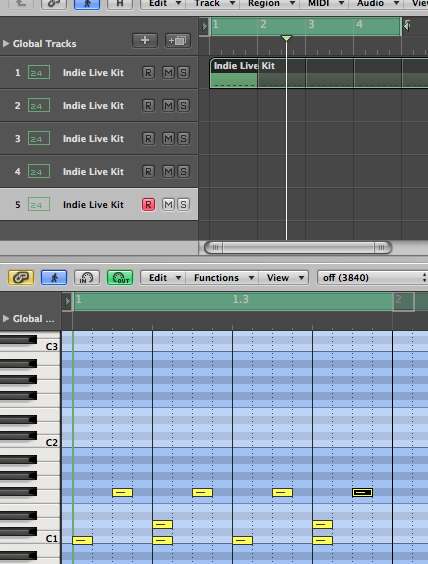
Four on the floor (or four-to-the-floor) is a rhythm pattern used in disco and electronic dance music. It is a steady, uniformly accented beat in 4/4 time in which the bass drum is hit on every beat (1, 2, 3, 4) in common time.
Rock vs disco

Standardni EDM (Electronic Dance Music)/house pattern u DAW-u:

Rock vs disco
Standardni EDM (Electronic Dance Music)/house pattern u DAW-u:
-
reis1
- Posts: 2234
- Joined: 07/11/2012 17:52
- Location: Sarajevo
#40 Re: ja odlucio postat muzicar
Moguci house drum pattern (Cubase drum editor):

Primjedba na ovaj pattern:
- previse "popunjen" elementima tako da kada je potrebno napraviti break, vjerovatno bi to bilo oduzimanjem elemenata i dodavanjem melodic instrumenata/zvuka/glasa; ili napraviti duzi break sa oduzetim elementima da bi se drum sekcija mogla pripremiti za dodavanje elemenata, sa evelocijom u novi arrangement
Primjedba na ovaj pattern:
- previse "popunjen" elementima tako da kada je potrebno napraviti break, vjerovatno bi to bilo oduzimanjem elemenata i dodavanjem melodic instrumenata/zvuka/glasa; ili napraviti duzi break sa oduzetim elementima da bi se drum sekcija mogla pripremiti za dodavanje elemenata, sa evelocijom u novi arrangement
Last edited by reis1 on 15/12/2012 23:27, edited 2 times in total.
-
reis1
- Posts: 2234
- Joined: 07/11/2012 17:52
- Location: Sarajevo
#41 Re: ja odlucio postat muzicar
MUSIC THEORY
http://classes.berklee.edu/mbierylo/mte ... equencing/
DRUM PATTERNS
The kick drum occupies low frequencies, the snare covers the mid range, while the hi-hat and cymbals in general take up the upper mid range and high frequencies. A well orchestrated drum part distributes various parts of a rhythm pattern to different frequency registers.
We can break down the roles of the different drums into two categories:
• defining the rhythm
• defining the rhythmic feel
Traditionally the kick and the snare will define the basic beat of the pattern, while the hi-hat will define the pulse, or the rhythmic feel. Drum patterns often start with the kick drum playing on the strong beats 1 and 3 while the snare plays on weaker beats 2 and 4.
The hi-hat will always define the rhythmic feel or groove of a pattern. This often is the difference between what we think of as a rock, funk, or a house pattern. The same kick snare pattern can take on very different characteristics depending on whether the hi-hat plays quarter notes, eighth notes, or sixteenth notes.


Alternating between open and closed hi-hats can provide certain accents that will contribute to a establishing a rhythmic feel.

We can always substitute other sounds to take on the roles of the kick, snare, and hi-hat. Remember the frequency ranges that each drum occupies and you'll be able to stretch the sonic boundaries in your rhythm programming.
The hi-hat can be used to help define the rhythmic feel of a pattern. In addition there are three performance characteristics that allow us to add interest and more of a human feel to our music. Performance Characteristic:
- Patterns of loud and soft attacks - Accent
- Deviation from the standard grid - Shufle
- Rhythmic ornaments - Flams
The way we divide a beat will tell us a great deal about musical style. Duple time divides a beat into groupings of two, with eighth-notes dividing a beat by two and sixteenth-notes dividing a beat by four. This is part of basic musicianship, and it's also basic to sequencing.


Although duple rhythms are very common in many types of rock and pop music, we can also divide a beat into groups of three, to get triple meter. A twelve-step grid can represent both sixteenth-notes and eighth-notes triplets.


http://classes.berklee.edu/mbierylo/mte ... equencing/
DRUM PATTERNS
The kick drum occupies low frequencies, the snare covers the mid range, while the hi-hat and cymbals in general take up the upper mid range and high frequencies. A well orchestrated drum part distributes various parts of a rhythm pattern to different frequency registers.
We can break down the roles of the different drums into two categories:
• defining the rhythm
• defining the rhythmic feel
Traditionally the kick and the snare will define the basic beat of the pattern, while the hi-hat will define the pulse, or the rhythmic feel. Drum patterns often start with the kick drum playing on the strong beats 1 and 3 while the snare plays on weaker beats 2 and 4.
The hi-hat will always define the rhythmic feel or groove of a pattern. This often is the difference between what we think of as a rock, funk, or a house pattern. The same kick snare pattern can take on very different characteristics depending on whether the hi-hat plays quarter notes, eighth notes, or sixteenth notes.
Alternating between open and closed hi-hats can provide certain accents that will contribute to a establishing a rhythmic feel.
We can always substitute other sounds to take on the roles of the kick, snare, and hi-hat. Remember the frequency ranges that each drum occupies and you'll be able to stretch the sonic boundaries in your rhythm programming.
The hi-hat can be used to help define the rhythmic feel of a pattern. In addition there are three performance characteristics that allow us to add interest and more of a human feel to our music. Performance Characteristic:
- Patterns of loud and soft attacks - Accent
- Deviation from the standard grid - Shufle
- Rhythmic ornaments - Flams
The way we divide a beat will tell us a great deal about musical style. Duple time divides a beat into groupings of two, with eighth-notes dividing a beat by two and sixteenth-notes dividing a beat by four. This is part of basic musicianship, and it's also basic to sequencing.
Although duple rhythms are very common in many types of rock and pop music, we can also divide a beat into groups of three, to get triple meter. A twelve-step grid can represent both sixteenth-notes and eighth-notes triplets.
-
reis1
- Posts: 2234
- Joined: 07/11/2012 17:52
- Location: Sarajevo
#42 Re: ja odlucio postat muzicar
MUSIC THEORY
http://classes.berklee.edu/mbierylo/mte ... equencing/
ACCENTS AND SHUFFLE
One common complaint about drum machines is that they sound lifeless and mechanical. Accenting certain beats as well as adding a shuffle feel are a couple of important ways to add life to the patterns we program.
- Accents - We generally accent a note by playing it louder. We can add accents to a rhythm pattern to establish subgroupings. A good place to add accents is in a steady hi-hat part. Although the hi-hat is used to set up a basic eighth or sixteenth-note feel, we can add interest by accenting different attacks. Although we're playing straight sixteenth-notes, the pattern implies the rhythm set up by the accents.
Accented hi-hats in Pattern A1 and the rhythm implied:


We can make these accents more obvious by lowering the dynamic level of the step just before each of the accents.
- Shuffle - Sometimes referred to as a swing feel, a shuffle delays every other attack in an eighth or sixteenth-note pattern. Even when we play straight eighth or sixteenth-notes, we'll always rush or delay certain parts of a rhythmic pattern. Musically, shuffle helps give a more natural feel to a stiff, mechanical part. Using even a small amount of shuffle on a straight sixteenth note-feel will make a pattern sound more human. Currently, sixteenth note shuffle feels are found in many types of hip-hop and r & b productions.
Sixteenth-note triplet feel with Shuffle Amount set to 127:


VARIATIONS
Although most pop, r & b, and hip-hop arrangements are based around one or two basic rhythm patterns, a good musician will always do something to make a repeating pattern interesting, whether it's something subtle like changing the accents or more obvious like adding a fill. It's these variations that make music come alive.
MIDI makes it very easy to create boring, repetitive music, but with a few simple techniques for adding variations to a basic rhythm pattern, we can make our music far more appealing.
- Changing Accents - A subtle but effective way to create a variation from a basic rhythm pattern is to change the accents in a pattern.
Original hi-hat part

Simple hi-hat variation

- Removing Attacks - Often, when we we create rhythm patterns, our initial inspiration can lead us to create some dense, fully formed drum parts. Simplifying a pattern can be an effective way to create a variation. Notice that in creating this simple type of variation, we haven't changed the basic feel of the rhythm. Although the kick and snare are used to define the rhythm in a pattern, feel free to simplify your patterns, especially the kick.
Original kick drum part

Simple kick drum variation

- Adding Approaches - Once we've established a basic rhythm pattern we can add additional attacks that lead into or set up key points in our rhythm. Often these will approach accented parts of our rhythm. We can add an approach using the same instrument.
A soft kick leading into an accented beat 1

We can also use one instrument to approach another. Remember that the kick and snare work together to outline a rhythm. For many patterns, the snare will hold steady on beats 2 and 4 to provide what's called a 'backbeat.' We can use the kick drum to set up beat 2 as seen in the following example.
Kick pattern for C1

Kick pattern for C2 - see how the kick on step 4 sets up the snare on beat 2

Kick pattern for A6 - a kick drum approach to the snare on beat 4

- Adding or Removing Instruments - Often adding or removing an instrument to a pattern is a good way to create variations on an existing pattern.
a) Try removing the snare drum, leaving only the kick and hi-hat. This is a good way to create more space in an arrangement.
b) Try removing every other hi-hat attack, or at least thinning them out so you're left with more of an eighth-note feel.
c) Try replacing the removed snare parts with handclaps
- Adding fills - One technique drummers use to set up a change in musical form is to add a fill. Typically, a fill consists of a few tom hits at the end of a pattern. This helps define a song form by breaking up the basic pattern and signaling to the listener that a change is coming. When creating fills with electronic instruments, there are two basic approaches:
• Imitative, where we try to produce what a drummer would actually play. Keep in mind that a drummer only has two hands, and order to play a fill, they have to stop playing something else. To simulate this, add your fill then take out the snare and hi-hat parts while it's playing.
• Overdub, where we add fills to a steady pattern, leaving the snare and hi-hat parts intact. This is a technique commonly used by dance music producers who want keep a steady groove, adding a fill without breaking up the pattern.
Tom fills usually start with higher pitched drums and move to lower ones. Remember to use dynamics, moving from soft to hard.

- Using Cymbals - Most drum kits will typically use two kinds of cymbals: a crash and a ride.
a) Crash Cymbals - used to signal the beginning of a musical section or to highlight an important musical event. Fills are often used to set up a crash. When making patterns that will be part of a song form, we'll usually have at least one version of the basic pattern that starts with a crash. When used sparingly, this can be a very effective musical device.
b) Ride Cymbals - Another way to mark time with a drum kit is to use a ride cymbal. Although we're used to hearing a standard kit made up of kick, snare, and hi-hat in pop, rock, and hip-hop music, jazz music uses the ride cymbal more than the hi-hat to define the rhythmic feel of a piece.
Once again there are two approaches to using cymbals in electronic drumming. If we're trying to imitate what a drummer does, we'll remove the hi-hat parts when using the ride to mark time. We can also just add a steady ride to an existing pattern. Try both and see which works better for you. Remember, you can add life to any pattern by using accents.
http://classes.berklee.edu/mbierylo/mte ... equencing/
ACCENTS AND SHUFFLE
One common complaint about drum machines is that they sound lifeless and mechanical. Accenting certain beats as well as adding a shuffle feel are a couple of important ways to add life to the patterns we program.
- Accents - We generally accent a note by playing it louder. We can add accents to a rhythm pattern to establish subgroupings. A good place to add accents is in a steady hi-hat part. Although the hi-hat is used to set up a basic eighth or sixteenth-note feel, we can add interest by accenting different attacks. Although we're playing straight sixteenth-notes, the pattern implies the rhythm set up by the accents.
Accented hi-hats in Pattern A1 and the rhythm implied:
We can make these accents more obvious by lowering the dynamic level of the step just before each of the accents.
- Shuffle - Sometimes referred to as a swing feel, a shuffle delays every other attack in an eighth or sixteenth-note pattern. Even when we play straight eighth or sixteenth-notes, we'll always rush or delay certain parts of a rhythmic pattern. Musically, shuffle helps give a more natural feel to a stiff, mechanical part. Using even a small amount of shuffle on a straight sixteenth note-feel will make a pattern sound more human. Currently, sixteenth note shuffle feels are found in many types of hip-hop and r & b productions.
Sixteenth-note triplet feel with Shuffle Amount set to 127:
VARIATIONS
Although most pop, r & b, and hip-hop arrangements are based around one or two basic rhythm patterns, a good musician will always do something to make a repeating pattern interesting, whether it's something subtle like changing the accents or more obvious like adding a fill. It's these variations that make music come alive.
MIDI makes it very easy to create boring, repetitive music, but with a few simple techniques for adding variations to a basic rhythm pattern, we can make our music far more appealing.
- Changing Accents - A subtle but effective way to create a variation from a basic rhythm pattern is to change the accents in a pattern.
Original hi-hat part
Simple hi-hat variation
- Removing Attacks - Often, when we we create rhythm patterns, our initial inspiration can lead us to create some dense, fully formed drum parts. Simplifying a pattern can be an effective way to create a variation. Notice that in creating this simple type of variation, we haven't changed the basic feel of the rhythm. Although the kick and snare are used to define the rhythm in a pattern, feel free to simplify your patterns, especially the kick.
Original kick drum part
Simple kick drum variation
- Adding Approaches - Once we've established a basic rhythm pattern we can add additional attacks that lead into or set up key points in our rhythm. Often these will approach accented parts of our rhythm. We can add an approach using the same instrument.
A soft kick leading into an accented beat 1
We can also use one instrument to approach another. Remember that the kick and snare work together to outline a rhythm. For many patterns, the snare will hold steady on beats 2 and 4 to provide what's called a 'backbeat.' We can use the kick drum to set up beat 2 as seen in the following example.
Kick pattern for C1
Kick pattern for C2 - see how the kick on step 4 sets up the snare on beat 2
Kick pattern for A6 - a kick drum approach to the snare on beat 4
- Adding or Removing Instruments - Often adding or removing an instrument to a pattern is a good way to create variations on an existing pattern.
a) Try removing the snare drum, leaving only the kick and hi-hat. This is a good way to create more space in an arrangement.
b) Try removing every other hi-hat attack, or at least thinning them out so you're left with more of an eighth-note feel.
c) Try replacing the removed snare parts with handclaps
- Adding fills - One technique drummers use to set up a change in musical form is to add a fill. Typically, a fill consists of a few tom hits at the end of a pattern. This helps define a song form by breaking up the basic pattern and signaling to the listener that a change is coming. When creating fills with electronic instruments, there are two basic approaches:
• Imitative, where we try to produce what a drummer would actually play. Keep in mind that a drummer only has two hands, and order to play a fill, they have to stop playing something else. To simulate this, add your fill then take out the snare and hi-hat parts while it's playing.
• Overdub, where we add fills to a steady pattern, leaving the snare and hi-hat parts intact. This is a technique commonly used by dance music producers who want keep a steady groove, adding a fill without breaking up the pattern.
Tom fills usually start with higher pitched drums and move to lower ones. Remember to use dynamics, moving from soft to hard.
- Using Cymbals - Most drum kits will typically use two kinds of cymbals: a crash and a ride.
a) Crash Cymbals - used to signal the beginning of a musical section or to highlight an important musical event. Fills are often used to set up a crash. When making patterns that will be part of a song form, we'll usually have at least one version of the basic pattern that starts with a crash. When used sparingly, this can be a very effective musical device.
b) Ride Cymbals - Another way to mark time with a drum kit is to use a ride cymbal. Although we're used to hearing a standard kit made up of kick, snare, and hi-hat in pop, rock, and hip-hop music, jazz music uses the ride cymbal more than the hi-hat to define the rhythmic feel of a piece.
Once again there are two approaches to using cymbals in electronic drumming. If we're trying to imitate what a drummer does, we'll remove the hi-hat parts when using the ride to mark time. We can also just add a steady ride to an existing pattern. Try both and see which works better for you. Remember, you can add life to any pattern by using accents.
-
reis1
- Posts: 2234
- Joined: 07/11/2012 17:52
- Location: Sarajevo
#43 Re: ja odlucio postat muzicar
MUSIC THEORY
http://classes.berklee.edu/mbierylo/mte ... equencing/
BUILDING AN ARRANGEMENT FROM PATTERNS
Once we have a couple of basic patterns and some variations, our work is just beginning. How we turn those patterns into a song form is an important part of the way we work with technology tools. Patterns are really just the building blocks of a larger musical form.
Most conventional pop arrangements build sections from multiples of two. Verses and choruses are often made up of 8-, 12-, or 16-measure sections.
For example, an AABA song form might look like this:
-------------------------------------
First A Section
A1, A3, A1, A3, A1, A3, A7, A7
Second A Section
A5, A2, A4, A2, A5, A2, A7, A7
B Section
B5, B2, B1, B3, B5, B6, B6, B4
Third A Section
A5, A2, A4, A2, A5, A2, A7, A7
-------------------------------------
http://classes.berklee.edu/mbierylo/mte ... equencing/
BUILDING AN ARRANGEMENT FROM PATTERNS
Once we have a couple of basic patterns and some variations, our work is just beginning. How we turn those patterns into a song form is an important part of the way we work with technology tools. Patterns are really just the building blocks of a larger musical form.
Most conventional pop arrangements build sections from multiples of two. Verses and choruses are often made up of 8-, 12-, or 16-measure sections.
For example, an AABA song form might look like this:
-------------------------------------
First A Section
A1, A3, A1, A3, A1, A3, A7, A7
Second A Section
A5, A2, A4, A2, A5, A2, A7, A7
B Section
B5, B2, B1, B3, B5, B6, B6, B4
Third A Section
A5, A2, A4, A2, A5, A2, A7, A7
-------------------------------------
-
reis1
- Posts: 2234
- Joined: 07/11/2012 17:52
- Location: Sarajevo
#44 Re: ja odlucio postat muzicar
MUSIC THEORY
http://en.wikipedia.org/wiki/Synthesizer
TYPES OF SYNTHESIS
- Additive synthesis builds sounds by adding together waveforms (which are usually harmonically related).

- Subtractive synthesis is based on filtering harmonically rich waveforms.

- FM synthesis (frequency modulation synthesis) is a process that usually involves the use of at least two signal generators (sine-wave oscillators, commonly referred to as "operators" in FM-only synthesizers) to create and modify a voice. Often, this is done through the analog or digital generation of a signal that modulates the tonal and amplitude characteristics of a base carrier signal.

Unlike the exponential relationship between voltage-in-to-frequency-out and multiple waveforms in classical 1-volt-per-octave synthesizer oscillators, Chowning-style FM synthesis uses a linear voltage-in-to-frequency-out relationship and sine-wave oscillators. The resulting complex waveform may have many component frequencies, and there is no requirement that they all bear a harmonic relationship.
Some synths with FM can also often use filters and variable amplifier types to alter the signal's characteristics into a sonic voice that either roughly imitates acoustic instruments or creates sounds that are unique.
- Phase distortion synthesis is quite similar to FM synthesis but avoids infringing on the Chowning FM patent. Also it should be categorized to modulation synthesis along with FM synthesis, and also to distortion synthesis along with waveshaping synthesis, and discrete summation formulas.
- Granular synthesis is a type of synthesis based on manipulating very small sample slices.
- Physical modelling synthesis is the synthesis of sound by using a set of equations and algorithms to simulate a real instrument, or some other physical source of sound.
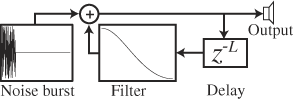
- Sample-based synthesis One of the easiest synthesis systems is to record a real instrument as a digitized waveform, and then play back its recordings at different speeds to produce different tones. Most samplers designate a part of the sample for each component of the ADSR envelope, and then repeat that section while changing the volume for that segment of the envelope.
- Analysis/resynthesis is a form of synthesis that uses a series of bandpass filters or Fourier transforms to analyze the harmonic content of a sound. The resulting analysis data is then used in a second stage to resynthesize the sound using a band of oscillators.

HARMONICS
When natural sounds are analyzed in the frequency domain (as on a spectrum analyzer), the spectra of their sounds exhibits amplitude spikes at each of the fundamental tone's harmonics corresponding to resonant properties of the instruments (spectral peaks that are also referred to as formants). A sound does not necessarily have the same harmonic content throughout the duration of the sound. Typically, high-frequency harmonics die out more quickly than the lower harmonics.
COMPONENTS
- Voltage-controlled oscillators (VCOs) and digital oscillators - create raw sounds with a timbre that depends upon the waveform generated. Harmonic Additive synthesis models sounds directly from pure sine waves, somewhat in the manner of an organ, while Frequency modulation and Phase distortion synthesis use one oscillator to modulate another. Subtractive synthesis depends upon filtering a harmonically rich oscillator waveform. Sample-based and Granular synthesis use one or more digitally recorded sounds in place of an oscillator.
- Voltage-controlled filter (VCF) – "shape" the sound generated by the oscillators in the frequency domain, often under the control of an envelope or LFO. These are essential to subtractive synthesis.
- Voltage-controlled amplifier (VCA) – After the signal generated by one (or a mix of more Voltage-controlled oscillators), modified by filters and LFOs, and the signal's waveform is shaped (contoured) by an ADSR Envelope Generator, it then passes on to one or more voltage-controlled amplifiers (VCA). The VCA is a preamp that boosts (amplifies) the electronic signal before passing on to an external or built-in power amplifier, as well as a means to control its volume using an attenuator that affects a control voltage (coming from the keyboard or other trigger source), which affects the gain of the VCA.
-ADSR envelopes - provide envelope modulation to "shape" the volume or harmonic content of the produced note in the time domain with the principle parameters being attack, decay, sustain and release. These are used in most forms of synthesis. ADSR control is provided by Envelope Generators.
- Low frequency oscillator (LFO) – an oscillator of adjustable frequency that can be used to modulate the sound rhythmically, for example to create tremolo or vibrato or to control a filter's operating frequency. LFOs are used in most forms of synthesis.
A low-frequency oscillator (LFO) generates an electronic signal, usually below 20 Hz. LFO signals create a rhythmic pulse or sweep, often used to in vibrato, tremolo and other effects.
Analog Subtractive Synthesizer

FILTER
Electronic filters are particularly important in subtractive synthesis, being designed to pass some frequency regions through unattenuated while significantly attenuating ("subtracting") others. The low-pass filter is most frequently used, but band-pass filters, band-reject filters and high-pass filters are also sometimes available.
The filter may be controlled with a second ADSR envelope. An "envelope modulation" ("env mod") parameter on many synthesizers with filter envelopes determines how much the envelope affects the filter.
LEAD vs. PAD
- Synth lead is generally used for playing the main melody of a song, but it is also often used for creating rhythmic or bass effects.
(dakle, uglavnom funkcija koju imaju organs)
- Synth pad is a sustained chord or tone generated by a synthesizer, often employed for background harmony and atmosphere in much the same fashion that a string section is often used in acoustic music. The main feature of a synth pad is very long attack and decay time with extended sustains.
(dakle, uglavnom funkcija koju imaju strings)
http://en.wikipedia.org/wiki/Synthesizer
TYPES OF SYNTHESIS
- Additive synthesis builds sounds by adding together waveforms (which are usually harmonically related).
- Subtractive synthesis is based on filtering harmonically rich waveforms.
- FM synthesis (frequency modulation synthesis) is a process that usually involves the use of at least two signal generators (sine-wave oscillators, commonly referred to as "operators" in FM-only synthesizers) to create and modify a voice. Often, this is done through the analog or digital generation of a signal that modulates the tonal and amplitude characteristics of a base carrier signal.
Unlike the exponential relationship between voltage-in-to-frequency-out and multiple waveforms in classical 1-volt-per-octave synthesizer oscillators, Chowning-style FM synthesis uses a linear voltage-in-to-frequency-out relationship and sine-wave oscillators. The resulting complex waveform may have many component frequencies, and there is no requirement that they all bear a harmonic relationship.
Some synths with FM can also often use filters and variable amplifier types to alter the signal's characteristics into a sonic voice that either roughly imitates acoustic instruments or creates sounds that are unique.
- Phase distortion synthesis is quite similar to FM synthesis but avoids infringing on the Chowning FM patent. Also it should be categorized to modulation synthesis along with FM synthesis, and also to distortion synthesis along with waveshaping synthesis, and discrete summation formulas.
- Granular synthesis is a type of synthesis based on manipulating very small sample slices.
- Physical modelling synthesis is the synthesis of sound by using a set of equations and algorithms to simulate a real instrument, or some other physical source of sound.
- Sample-based synthesis One of the easiest synthesis systems is to record a real instrument as a digitized waveform, and then play back its recordings at different speeds to produce different tones. Most samplers designate a part of the sample for each component of the ADSR envelope, and then repeat that section while changing the volume for that segment of the envelope.
- Analysis/resynthesis is a form of synthesis that uses a series of bandpass filters or Fourier transforms to analyze the harmonic content of a sound. The resulting analysis data is then used in a second stage to resynthesize the sound using a band of oscillators.
HARMONICS
When natural sounds are analyzed in the frequency domain (as on a spectrum analyzer), the spectra of their sounds exhibits amplitude spikes at each of the fundamental tone's harmonics corresponding to resonant properties of the instruments (spectral peaks that are also referred to as formants). A sound does not necessarily have the same harmonic content throughout the duration of the sound. Typically, high-frequency harmonics die out more quickly than the lower harmonics.
COMPONENTS
- Voltage-controlled oscillators (VCOs) and digital oscillators - create raw sounds with a timbre that depends upon the waveform generated. Harmonic Additive synthesis models sounds directly from pure sine waves, somewhat in the manner of an organ, while Frequency modulation and Phase distortion synthesis use one oscillator to modulate another. Subtractive synthesis depends upon filtering a harmonically rich oscillator waveform. Sample-based and Granular synthesis use one or more digitally recorded sounds in place of an oscillator.
- Voltage-controlled filter (VCF) – "shape" the sound generated by the oscillators in the frequency domain, often under the control of an envelope or LFO. These are essential to subtractive synthesis.
- Voltage-controlled amplifier (VCA) – After the signal generated by one (or a mix of more Voltage-controlled oscillators), modified by filters and LFOs, and the signal's waveform is shaped (contoured) by an ADSR Envelope Generator, it then passes on to one or more voltage-controlled amplifiers (VCA). The VCA is a preamp that boosts (amplifies) the electronic signal before passing on to an external or built-in power amplifier, as well as a means to control its volume using an attenuator that affects a control voltage (coming from the keyboard or other trigger source), which affects the gain of the VCA.
-ADSR envelopes - provide envelope modulation to "shape" the volume or harmonic content of the produced note in the time domain with the principle parameters being attack, decay, sustain and release. These are used in most forms of synthesis. ADSR control is provided by Envelope Generators.
- Low frequency oscillator (LFO) – an oscillator of adjustable frequency that can be used to modulate the sound rhythmically, for example to create tremolo or vibrato or to control a filter's operating frequency. LFOs are used in most forms of synthesis.
A low-frequency oscillator (LFO) generates an electronic signal, usually below 20 Hz. LFO signals create a rhythmic pulse or sweep, often used to in vibrato, tremolo and other effects.
Analog Subtractive Synthesizer
FILTER
Electronic filters are particularly important in subtractive synthesis, being designed to pass some frequency regions through unattenuated while significantly attenuating ("subtracting") others. The low-pass filter is most frequently used, but band-pass filters, band-reject filters and high-pass filters are also sometimes available.
The filter may be controlled with a second ADSR envelope. An "envelope modulation" ("env mod") parameter on many synthesizers with filter envelopes determines how much the envelope affects the filter.
LEAD vs. PAD
- Synth lead is generally used for playing the main melody of a song, but it is also often used for creating rhythmic or bass effects.
(dakle, uglavnom funkcija koju imaju organs)
- Synth pad is a sustained chord or tone generated by a synthesizer, often employed for background harmony and atmosphere in much the same fashion that a string section is often used in acoustic music. The main feature of a synth pad is very long attack and decay time with extended sustains.
(dakle, uglavnom funkcija koju imaju strings)
Last edited by reis1 on 15/12/2012 23:03, edited 1 time in total.
-
reis1
- Posts: 2234
- Joined: 07/11/2012 17:52
- Location: Sarajevo
#45 Re: ja odlucio postat muzicar
MUSIC THEORY
http://en.wikipedia.org/wiki/Synthesizer
ADSR ENVELOPE
When an acoustic musical instrument produces sound, the loudness and spectral content of the sound change over time in ways that vary from instrument to instrument. The "attack" and "decay" of a sound have a great effect on the instrument's sonic character.[42] Sound synthesis techniques often employ an envelope generator that controls a sound's parameters at any point in its duration. Most often this is an "ADSR" (Attack Decay Sustain Release) envelope, which may be applied to overall amplitude control, filter frequency, etc.
- Attack time is the time taken for initial run-up of level from nil to peak, beginning when the key is first pressed.
- Decay time is the time taken for the subsequent run down from the attack level to the designated sustain level.
- Sustain level is the level during the main sequence of the sound's duration, until the key is released.
- Release time is the time taken for the level to decay from the sustain level to zero after the key is released.

Some electronic musical instruments allow the ADSR envelope to be inverted, which results in opposite behavior compared to the normal ADSR envelope. During the attack phase, the modulated sound parameter fades from the maximum amplitude to zero then, during the decay phase, rises to the value specified by the sustain parameter. After the key has been released the sound parameter rises from sustain amplitude back to maximum amplitude.

Dakle,

podesavanjem ADSR vrijednosti, mijenja se oblik waveform-a, a to znaci i da se sinusoide od kojih je "slozen" waveform mijenjaju - tj. mijenjaju se harmonici instrumenta - sto utice na "boju" zvuka.
http://en.wikipedia.org/wiki/Synthesizer
ADSR ENVELOPE
When an acoustic musical instrument produces sound, the loudness and spectral content of the sound change over time in ways that vary from instrument to instrument. The "attack" and "decay" of a sound have a great effect on the instrument's sonic character.[42] Sound synthesis techniques often employ an envelope generator that controls a sound's parameters at any point in its duration. Most often this is an "ADSR" (Attack Decay Sustain Release) envelope, which may be applied to overall amplitude control, filter frequency, etc.
- Attack time is the time taken for initial run-up of level from nil to peak, beginning when the key is first pressed.
- Decay time is the time taken for the subsequent run down from the attack level to the designated sustain level.
- Sustain level is the level during the main sequence of the sound's duration, until the key is released.
- Release time is the time taken for the level to decay from the sustain level to zero after the key is released.
Some electronic musical instruments allow the ADSR envelope to be inverted, which results in opposite behavior compared to the normal ADSR envelope. During the attack phase, the modulated sound parameter fades from the maximum amplitude to zero then, during the decay phase, rises to the value specified by the sustain parameter. After the key has been released the sound parameter rises from sustain amplitude back to maximum amplitude.
Dakle,
podesavanjem ADSR vrijednosti, mijenja se oblik waveform-a, a to znaci i da se sinusoide od kojih je "slozen" waveform mijenjaju - tj. mijenjaju se harmonici instrumenta - sto utice na "boju" zvuka.
-
reis1
- Posts: 2234
- Joined: 07/11/2012 17:52
- Location: Sarajevo
#46 Re: ja odlucio postat muzicar
Effects (FX)
INSERTS vs SENDS
There are some effects that are modifiers of the original sound, and others that are additives to the original sound.
An INSERT effect is inserted into a track, in series with the track's signal, to process that signal. With an insert effect, the effect (like EQ or compression) actually changes the sound of the track's signal passing through it. You are replacing the original sound with a modified sound.
- An insert effect has a series signal path.
- Examples of insert effects are EQ, compression, gating, and de-essing.
A SEND effect is inserted into an effects bus, which is a separate channel (or an aux track) in the recording project. With a send effect, the processed signal (like reverb) is mixed or blended with the original dry signal. You apply the effect and add it to the original sound, keeping both.
- A send effect has a parallel signal path
- Examples are reverb and delay, where you retain the original un-effected sound and add reverb to taste.

The dry/wet Mix control in the send effect should be set to 100% wet. You control the amount of effects with the Send Level control in your track. For example, if you want a reverb, put it on an aux channel and send your original track to it. The reverb plugin is set to 100% wet so the aux channel is ONLY reverb, no dry signal. then you can just turn up the aux send on the snare a little bit, the vocal a little bit, etc, to give those tracks the amount of reverb you want.
Chorus and flanging can be either insert effects or send effects. If you insert them into a track, you set the amount of chorus/flanging with the dry/wet Mix control in the effect's GUI. But if you put them into an effects bus, you set the dry/wet Mix control to 100%, and set the amount of chorus/flanging with the Send Level control in your track.
An example where you would use a send with an 'insert type' plugin like a compressor - parallel compression. You want to hear the uncompressed signal alongside the compressed and the compressor plugin doesn't have a mix % knob. You place a compressor plug-in with extreme settings into an effects bus. Then you can control the amount of compressed sound -- from clean to squashed -- with the Send Level going to the effects bus.
Or...you want a pulsating (but not to zero) volume type effect but you don't have a tremolo plugin or a gate plugin with a depth setting. You send to a gate that's on/off but even when it's cutting out you still have your original playing, giving you an on-off volume effect.
INSERTS vs SENDS
There are some effects that are modifiers of the original sound, and others that are additives to the original sound.
An INSERT effect is inserted into a track, in series with the track's signal, to process that signal. With an insert effect, the effect (like EQ or compression) actually changes the sound of the track's signal passing through it. You are replacing the original sound with a modified sound.
- An insert effect has a series signal path.
- Examples of insert effects are EQ, compression, gating, and de-essing.
A SEND effect is inserted into an effects bus, which is a separate channel (or an aux track) in the recording project. With a send effect, the processed signal (like reverb) is mixed or blended with the original dry signal. You apply the effect and add it to the original sound, keeping both.
- A send effect has a parallel signal path
- Examples are reverb and delay, where you retain the original un-effected sound and add reverb to taste.
The dry/wet Mix control in the send effect should be set to 100% wet. You control the amount of effects with the Send Level control in your track. For example, if you want a reverb, put it on an aux channel and send your original track to it. The reverb plugin is set to 100% wet so the aux channel is ONLY reverb, no dry signal. then you can just turn up the aux send on the snare a little bit, the vocal a little bit, etc, to give those tracks the amount of reverb you want.
Chorus and flanging can be either insert effects or send effects. If you insert them into a track, you set the amount of chorus/flanging with the dry/wet Mix control in the effect's GUI. But if you put them into an effects bus, you set the dry/wet Mix control to 100%, and set the amount of chorus/flanging with the Send Level control in your track.
An example where you would use a send with an 'insert type' plugin like a compressor - parallel compression. You want to hear the uncompressed signal alongside the compressed and the compressor plugin doesn't have a mix % knob. You place a compressor plug-in with extreme settings into an effects bus. Then you can control the amount of compressed sound -- from clean to squashed -- with the Send Level going to the effects bus.
Or...you want a pulsating (but not to zero) volume type effect but you don't have a tremolo plugin or a gate plugin with a depth setting. You send to a gate that's on/off but even when it's cutting out you still have your original playing, giving you an on-off volume effect.