#144451 Re: Ukrajina
Posted: 02/02/2023 13:53
Neko je spomenuo samohodne minobacače,doduše na CV90 platformi,Ukrajinci će izgleda dobiti,od Šapanaca,određen broj samohodnih minobacaca,ali na platformi M113 OT.
U proljeće 2022, prije dolaska tadašnjeg premijera Bugarske Kirila Petkova u Kijev, ukrajinske su vlasti izrazile želje, pa čak i zahtjev bugarskoj strani. Činjenica je da je Bugarska proizvođač značajnog broja oružja sovjetskog tipa i da je vlasnik velike količine istog. Stoga su u Ukrajini smatrali da će Bugarska moći pomoći oružanim snagama u onim najtežim mjesecima kada zapadno oružje još nije počelo stizati, a Ukrajina je već imala akutni nedostatak, prije svega streljiva za topništvo.
Petkov je shvatio da bi takva pomoć mogla izazvati određeni otpor među njegovim partnerima u tadašnjoj koaliciji – prije svega, Bugarskoj socijalističkoj stranci, koja ima stabilne veze s Rusijom. Međutim, čak i shvativši to, bugarski premijer obećao je najprije Dmitriju Kulebi, a zatim Volodimiru Zelenskom da će učiniti sve što je moguće.
Bugarska je, formalno, prodala granate Poljskoj, a one su iz Poljske stizale u Ukrajinu. Naravno, bugarska je vlada savršeno dobro znala kome zapravo ide njihovo streljivo. Štoviše, to je dobro znala i socijalistica Cornelia Ninova, koja se toliko bunila zbog pomoći Ukrajini.
Kako bi preživjela ovaj rat iscrpljivanja koji Rusija pokušava voditi, Ukrajina treba svaku pomoć. Sukladno tome, opskrba bugarskim topničkim streljivom i dalje je vrlo važna. A sredinom prošle godine ta je pomoć bila stvarno vitalna. Možda nije dosegla razinu od 50% cjelokupnog streljiva koje je stiglo u Ukrajinu, međutim, u nekim trenucima, topničko streljivo iz Bugarske činilo je od 30% do 40% ukupnog streljiva koje je stiglo u Ukrajinu. I to je bio definitivno najveći udio u odnosu na pomoć svih ostalih zemalja.
Eh pa tradicija je to, mora se biti spremno da se jede korjenje da bi se uspjelo...sumirprimus wrote: ↑02/02/2023 10:26 eno intervjua ruskog prebjega porucnika, kaze gladovali mjesec i po i isli po kucama, trazili hranu, krali, i lovili zeceve sarane fazane
znaci bukvalno boli komandu njeznik hoce li ovi imat sta jest pit, pucat. bitno je da ih posalju
Tako je. Nakon Bakhmuta, uvijek će biti novi Bakhmut.
During the same month and the first half of January, the 58th CAA was busy rebuilding battered units and receiving reinforcements, before launching a new attempt. For its new offensive, the army concentrated the 40th and the 155th Naval Infantry Brigades (the original kontraktniki-complement of the latter was destroyed in Pavlivka, back in October), 136th Motor Rifle Brigade, 123rd Rifle Regiment (DNR), the Vostok and Kaskad Battalions (both of which were reinforced to a regimental-level), at least a regiment of Spetsnaz, and several minor units of the GRU.
Mind the following: since the mobilisation of late September, the VSRF has given up operating in its famed BTGs. Thus, the 58th CAA really deployed an equivalent of about four full manoeuvring brigades for this offensive, plus two artillery brigades. Say, a total of about 20,000 troops, 90 MBTs, perhaps two times as many IFVs, and about 100 artillery pieces.
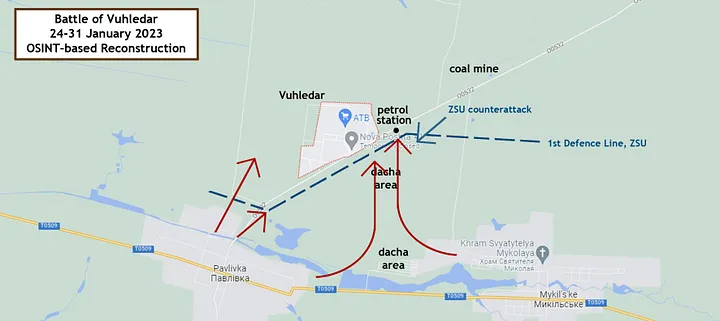
On 24 January 2022, the Russians opened their offensive by attempting to pulverise forward Ukrainian positions, apparently in between of Pavlivka and Mykilske, and on the eastern side of Vuhledar by TOS-1 MRLS’. While looking like ‘hell’ on a video (and certainly being ‘comparable to hell’ for whoever was within the targeted area), I’m not sure if this was effective at all: there are simply no reports indicating a large number of casualties of the Ukrainian 72nd Mechanised Brigades, which is providing the core of Vuhledar’s defences.
Now, some say that TOS-1-strikes were followed by the — ‘compulsory’ — massive artillery barrages on Vuhledar, aiming to soften up the defences. Others say there were no artillrey barrages, because the Russians attempted to take Ukrainians by surprise.
The Russians then assaulted through Pavlivka and from its northern edge straight for southern Vuhledar. Some say, they actually tried to move around the western side of the town, with the aim of encircling it. Is possible, but I guess they might not have liked the idea to marching over 1,000 metres of open space with full Ukrainian garrison in their deep flank, all the time. On the other side…well, gauging by the intellectual qualities of VSRF officers: one can never know.
What is sure is that simultaneously with this attack in south-west, the Russian Naval Infantry advanced from Mykilske around the southern side of the datcha area before turning north — because, the first two days of this offensive the Russian social media was brimming with reports about firefights with ‘Ukrainians trapped behind Russian lines’.
Through 25 January, reports surfaced indicating vivid activity of the VKS in this area: Su-25s and attack helicopters must’ve flown a few dozens of sorties, continuously spraying Ukrainian positions with unguided rockets. It was under the cover of air strikes and the Russian artillery fire that the Naval Infantry pushed through the ‘dacha area’ towards north, apparently aiming to by-pass Vuhledar and encircle it from the east (for this reason, it would’ve made sense for them to advance from Pavlivka towards north and thus try encircling Vuhledar from the west; but, and again: sorry, no clear confirmation in this regards).
Sometimes during 26 January, perhaps after another TOS-1 volley during the night to 27 January, the Russians reportedly reached the petrol station at the northern edge of the dacha area, about 400 metres outside of Vuhledar. No idea if this was along the plan, or somebody made a mistake, but at that point in time they turned north-west and attacked the south-eastern side of Vuhledar.
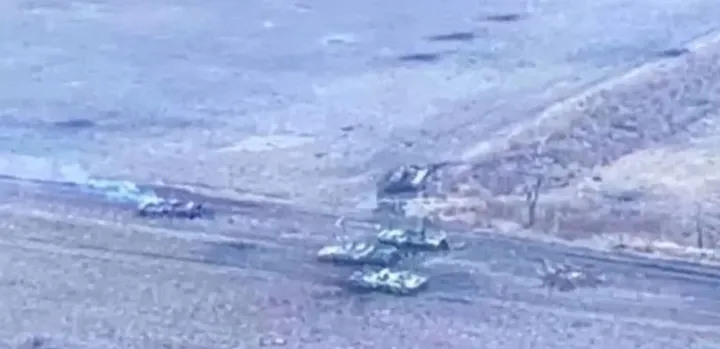
This was a very bad idea. They were advancing along a relatively narrow route, all the time in sight of Ukrainian observers posted atop of high buildings in Vuhledar, and now facing about 500 metres of empty terrain on the eastern side of the town. Worst of all: by 27 January Ukrainians were ready and thus the advancing Russians came under very precise and systematically-deployed Ukrainian artillery fire, which stopped their Naval Infantry. When the infantry was stopped, accompanying T-80 MBTs and BMP-2 IFVs stopped, too — and then they began dying in big numbers. Atop of this, Ukrainian artillery not only caused heavy losses to the advancing units, but hit their rear too — cutting off both their supply links and their possible withdrawal routes. Finally, on 28 January, the 1st Tank and the 72nd Mech counterattacked the dacha area from north-east and destroyed or captured whatever shaken Russians were still around.
Certainly enough, the Russians brought in reinforcements and regrouped their battered and dermoralised units, and were back to attacking from the southern part of the dacha area in northern direction, on 30 January. Moreover, they began attacking garrisons of the 68th Jäger in villages of Zolotay Nyva and Prechystivka, west of Vuhledar. However, nothing of this left lasting impressions upon the ZSU, which also claimed the downing of some 5–6 Ka-52 helicopters in this battle, all between 24 and 28 January.
On 31 January, the Russians attacked Vuhledar directly again, this time operating in smaller groups. That was too little and ended with the loss of another bunch of T-80s and BMP-2s. What is left of the Naval Infantry of the 40th and 155th Brigades is back to the Mykilske area.
Overall: this was no ‘small-’, no ‘probing-’, and no ‘diversionary-’, but a major attack of almost all the forces the 58th CAA was able to scratch together. Denis Pushilin might be a corrupt and incompetent politician, but he clearly said, ‘’liberation of this city solves many problems’.
It appears the Russians counted on overrunning the two battalions of the 72nd deployed in Vuhledar at the start of their attack (the town and the neighbourhood are much too small for squeezing any more troops into it) and then aimed to drive further north, perhaps all the way into the southern flank of the ZSU forces deployed along the old line of control in the Donbass. The plan didn’t work thanks to a rapid reaction of the rest of the 72nd, but especially well planned fire of the 55th Artillery, and good support of the crack 1st Tank Brigade. That converted this Russian operation into a debacle: RUMINT has it the 155th Naval Infantry Brigade lost 200–230 KIA in the first three days of this operation, just for example, and another rumor circulated in the social media is that all the involved Russian units suffered up to 20,000 casualties (KIA, WIA, MIA) over the last week, prompting troops of two involved units to flatly refuse to attack, after witnessing what’s happening ahead of them. AFAIK, nothing of this has been confirmed, but the fact remains that Vuhledar is firmly in Ukrainian hands.
Me thinks, until the 58th CAA finds the way to secure the (heavily fortified) Pivdennodonbaska Mine, it’s not going to manage any kind of advances in the Vuhledar area. Certainly enough, the British MOD announced that the Russians are preparing another, ‘concentrated assault’ in the Vuhledar area.
U velikom intervjuu za TV kanal "Rusija 24" i RIA Novosti, ministar vanjskih poslova Sergej Lavrov govorio je o kontradiktornim akcijama ukrajinskih vlasti i njihovih zapadnih pokrovitelja, ciljevima ruske specijalne operacije i odnosima Moskve sa saveznicima.
Isporuke novog oružja Kijevu naići će na odgovor Moskve, naglasio je ministar.
"Ako sada pokušavamo premjestiti topništvo ukrajinskih oružanih snaga na takvu udaljenost koja neće predstavljati prijetnju našim teritorijima, onda što više oružja dugog dometa bude isporučeno režimu u Kijevu, to će dalje biti potrebno maknuti ga s teritorija koji su dio naše zemlje", rekao je.
Odgovarajući na pitanje za koji se razvoj događaja vrijedi pripremiti, Lavrov je rekao da Moskva polazi od objektivnih podataka. "Prije svega, iz realnosti koje su sadržane u našem zakonodavstvu, našem Ustavu. Četiri nova teritorija - dvije narodne republike, dvije regije - pridružile su se Rusiji nakon referenduma. Ovdje, po mom mišljenju, nema pitanja", rekao je.
Moskva teži okončanju sukoba, "ali ovdje nije bitan faktor vremena, ovdje je bitan faktor suštine, faktor kvalitete rezultata koje dajemo za naše ljude, za one ljude koji žele ostati dio ruske kulture i kojemu je kijevska hunta dugi niz godina uz poticaj Zapada oduzela sve rusko."
Laž su informacije koje se šire na Zapadu o nespremnosti Moskve na pregovore, dodao je diplomat.
Bilateralni odnosi između Rusije i Kine, ističe Lavrov, "kvalitetniji su od vojnih saveza u klasičnom smislu, najbolji u svim godinama postojanja SSSR-a, Kine i Rusije".
"Kina će neizbježno početi smanjivati ovisnost, ali će trebati više vremena za stvaranje paralelnih alata za zaštitu od samovolje Sjedinjenih Država", dodao je ministar vanjskih poslova.

Ja mislim da je Putinov cilj jednostavno da ne izgubi. Sve drugo je OKkaranana wrote: ↑02/02/2023 16:13 kao sto sam vec i napominjao, vrijeme radi za njih jer smo uvidjeli da uopste nema senzibiliteta kad su u pitanju gubici. sta njima znaci sto ce recimo izgubiti milion ljudi za recimo 5 godina, ako ce u isto vrijeme ubiti 300-400 hiljada ukrajinaca? i ko ce prelomiti u toj igri brojeva i logistike? ja kazem da ce ovi divljaci izdrzati duze u toj igri.
mada meni i dalje nije jasno sta je njihov opceniti cilj svega ovoga.
Ja mislim da ce u buducnosti vise sankcije ozbiljnog tipa davati rezultate kod stanovnistva koje je naviklo na neki standard, nego 1/2 mil. nepoznatih mobilizanata... Zalihe i skladista se prazne brze nego sto se mogu nadoknaditi iz "prijateljskih" zemalja. To ce nositi rezultat samo treba to docekati.GAU8 wrote: ↑02/02/2023 16:38Ja mislim da je Putinov cilj jednostavno da ne izgubi. Sve drugo je OKkaranana wrote: ↑02/02/2023 16:13 kao sto sam vec i napominjao, vrijeme radi za njih jer smo uvidjeli da uopste nema senzibiliteta kad su u pitanju gubici. sta njima znaci sto ce recimo izgubiti milion ljudi za recimo 5 godina, ako ce u isto vrijeme ubiti 300-400 hiljada ukrajinaca? i ko ce prelomiti u toj igri brojeva i logistike? ja kazem da ce ovi divljaci izdrzati duze u toj igri.
mada meni i dalje nije jasno sta je njihov opceniti cilj svega ovoga.
Ima 2 izlaza:
1) Zamor zapada i politicke promjene na zapadu (podjele u drustvu, kriza demokratije)
2) Trajni rat
Bilo sta drugo za njega je smrtna presuda. A ofrlje procjene su, da Rusko stanovnistvo nece mrdnuti prstom cak ni kod 500 000 poginulih Rusa.
Sve u svemu ja mislim Putin za sada lakse dise, nakon sto je narod izgleda dobro podnio ove prve talase mobilizacije.
Ima se jos mesa, moze se jos...
Sta govori protiv Putina:
1) Nema vise vojnih kapaciteta da moze pokrenuti bilo kakvu vecu ofanzivu. Ima ljdstva, ali to je ljudstvo uzasne kvalitete i nikakve opreme.
2) Jacanje frakcija u Rosiji koji zahtijevaju pobjedu Rusije, i koji smatraju da Putin nije onaj kojim su ga zamisljali.
3) Veliki Putinovi saveznici mu polako okrecu ledja
Čitali smo to na Index-hrmishic wrote: ↑02/02/2023 17:21 Wagnerov način ratovanja je poslati prvi val napadača koji se uglavnom sastoji od sirovih novaka dovedenih izravno iz ruskih zatvora. Oni malo znaju o vojnoj taktici i slabo su opremljeni. Većina se samo nada da će moći otići kući, a ne natrag u ćeliju, ako prežive svoj šestomjesečni ugovor.
O broju Wagnerovaca i koji dolaze i koji ginu malo se zna, Sjećanja na pokretne krematorije kojih kao da je nestalo bude sumnju na to da samo mali broj ljudi zna cijelu istinu. I oko grobalja Wanerovaca koja su locirana u zabitima daleko od komunikacija dosta se špekulira. Zbog toga su i sve ove brojke dosta upitne.
 , mogao si malo izmijeniti .