Potarite glave svoje i noge do članaka. Dakle potarite noge do članaka, ne da ih operemo.
Kad bi to sve bilo tako jednostavno. Samo kazes ovako treba i gotovo.

An ancient debate which has been cemented into practice is the verse with regards ablution in Chapter 5, verse 6. Whereas in the main, Sunni Muslims wash their feet in the ablution process, Shia Muslims only wipe them. The classical debates between different authorities occupy tomes of literature and remain just as prevalent amongst modern scholars.
This article does not intend to provide a comprehensive remit of the debate. Rather, it introduces general arguments to those not familiar with them with a view to inform the reader of its general scope and if required, to assist them to make an informed decision given some of the arguments presented.
Many readers will note that in some English translations of the Quran (5:6), the word feet is usually prefixed by 'wash' in brackets, though this does not exist directly in the Arabic text as indicated by the brackets. Other translations omit the 'wash' completely as a prefix to the feet, implying a wipe action.
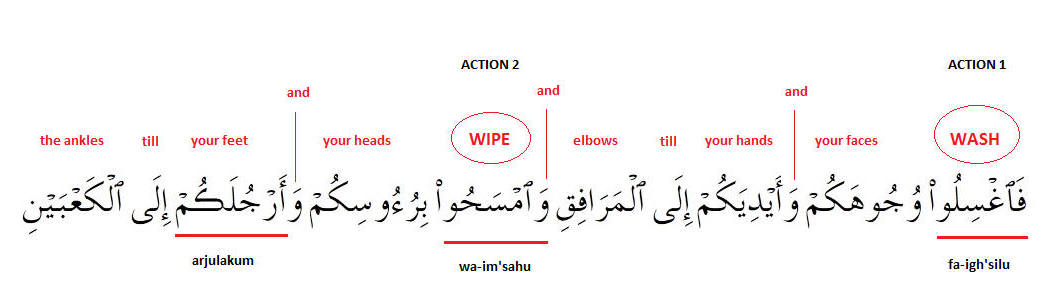
The literal Arabic text reads as follows. (Arabic text read from right to left):
ARGUMENT FOR WASHING
The main argument for washing the feet is supported by the sunna practice of the largely majority Sunni Muslims and other consensus based arguments (ijma)
However, the action to wash the feet is also argued for grammatically. The common reading in the Quran of the Arabic word for 'your feet' is 'arjulAkum' with a 'fatah' over the Arabic letter 'Laam' as highlighted by the red circle below.
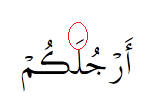
It is argued by those that vouch for the 'wash' interpretation (predominantly Sunni Muslims), that this is linked to the action 'wash' grammatically and not 'wipe'. The argument continues, that if the word 'arjukIkum' was present (with a kasra under the Arabic letter 'Laam'), then this would be linked to ACTION 2 which is to 'wipe'. This is shown by the second illustration below with the red circle over the 'kasra'. As 'arjukIkum' does not conform to the main reading of the Quran, then the interpretation to wipe, as is argued, cannot be operative, but must infer an interpretation of 'wash'.

As the earliest manuscripts of the Quran are devoid of any diacritical marks showing vocalisation, the main thrust of the argument is based on recitation (which argues arjulAkum) and not evidence based on a particular Quranic codex.
Another common argument to support the 'wash' interpretation is the notion of 'extent'. It is argued that ‘wipe’ is usually a symbolic expression. When an extent is given, such as ‘up to the ankles’ (ilal-ka’bayni), then there is a strong suggestion that the implication is to wash. (as in - wash your hands up till the elbows). Similarly, in the case of ‘tayammum’ (dry ablution) which is a symbolic expression, we note that the action to ‘wipe’ has not been qualified by an 'extent' and the hands do not include the wiping up till the elbows, as is the case in normal ablution.
ARGUMENTS FOR WIPING
Those that vouch for the 'wipe' interpretation often vehemently contest the above interpretation which they allege is based on a faulty practice and a biased grammatical interpretation.
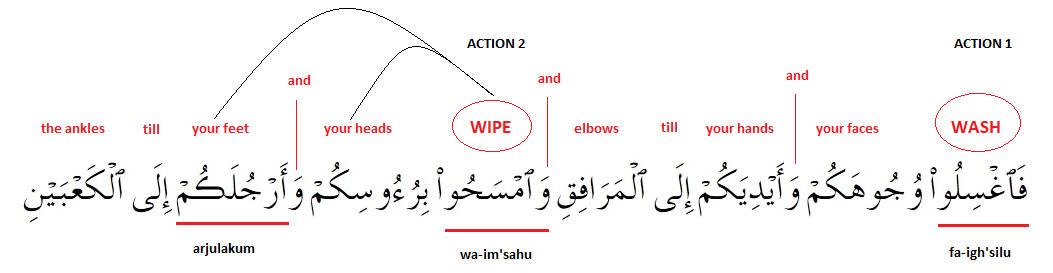
The counter argument contends for another grammatical device which points to the presence of the conjunction 'and' (Arabic: 'wa') before the Arabic word 'Arjulakum' (your feet) which renders the connection with the action 'wash' mute. It is therefore argued that the 'feet' are connected with the nearest 'action', the imperative verb 'imsah' (wipe) and not 'wash'. With this interpretation, it is argued that Arjulakum must be read with the nearest action (wipe) along with the head (ru'as) and should not be subject to another grammatical device which forces the 'wash' interpretation. This is irrespective of whether the Arabic word is read 'arjulAkum' or 'arjukIkum'
"Some, however, even of those who upheld the view that the feet are to be wiped in the 'wudu', read arjulakum in the accusative and rationalised its inflection from its conjunction with the notional inflection of ru'as. This ta'wil renders the accusative reading similar in effect to the genetive reading. The indication is, this, that the obligation is to wipe, not wash the feet" [1]
Furthermore, it can be argued that other concerns develop with a ‘wash’ interpretation. To allow for the 'wash' interpretation, one would have to conclude that God intends to prescribe a particular ritual method of order (a) Perform X first, then (b) perform Y next (c) then perform Z. (i.e. breaking the order will invalidate the ablution). Otherwise, an apt question arises as to why the ‘feet’ were simply not included with the imperative action to ‘wash’ along with the face and hands up till the elbows?
This would imply that a particular routine in a particular order is more / at least as important, as the general reason for the ablution which the Quran posits as to simply purify one (liyutahhirakum).
However, even if one were to accept that the intent of the Quran was to prescribe a systematic ritual order, the contention of not interpreting the feet with the nearest action 'wipe' remains unanswered along with the secondary question - why was a separate command for 'ighsil' (wash) not made in accordance with 31:27 to remove all doubt?
Another contention somewhat lies in the symbolic expression of 'tayammum' (dry ablution). It is noted that what was washed normally in 'ablution' (bar the elbows), now only attracts a 'wipe' command (hands and face) in tayammum. What was wiped in ablution is completely eliminated in tayammum altogether, indicating a systematic relaxation of commands. Here one notes that both the feet and head are eliminated from tayammum (dry ablution). An apt question arises, why are the feet not wiped in tayammum if they were part of the ‘wash’ action in normal ablution along with the face and hands? Why do the feet escape the symbolic ‘wipe’?
It is also argued that in line with the ancient manuscripts which do not vocalise the scripts, the most natural reading would be in the 'genitive' construct, ArjukIkum which could only be interpreted with the 'wipe' action.
Other theological considerations would also arise taking cue from the desert environment where water would usually be expected to remain relatively scarce arguing against the overt consumption of water.
With such a manner of argumentation, the case for 'wiping' the feet is usually strengthened.
Ne prejudiciram ovim ni da treba ovako ili onako da se radi, ali je glupo reci ovako treba i gotovo. Kad postoji velika debata oko ovog pitanja. Prosto nije fer to precutati.


